Prototyping · Study deck
MCU vs MPU: Measurements and Boundaries
Both controller classes could run the prototype.
Voltage Vera is your guide for this deck.
After studying this chapter
Learning objectives
You will be able to:
- Explain: A 12-bit ADC on 3.3 V divides the input into 4,096 steps of 0.806 mV and gives an ideal 74.0 dB signal-to-quantisation-noise ratio.
- Explain: Naming their actual numbers turns "microcontroller" and "microprocessor" from category labels into a measurable gap a team can plan a battery, a bill of materials, or a review record around.
- Explain: Arduino and Raspberry Pi are the two boards most prototype teams already recognize, which makes them a useful anchor for the MCU Fit and MPU Fit checklists above.
Major section
Start With the Situation
Both controller classes could run the prototype.
- A microcontroller board runs a bounded device-control program; a microprocessor board can run an operating system and more services.
- Boot is the startup process, and boot time measures how long it takes.
- The team must compare measured boot time, power, timing, interfaces, and support.

Major section
Arduino and Raspberry Pi in Numbers
That extended version is the more honest fit for a Raspberry Pi-class board.
- Arduino and Raspberry Pi are the two boards most prototype teams already recognize, which makes them a useful anchor for the MCU Fit and MPU Fit checklists above.
- Naming their actual numbers turns "microcontroller" and "microprocessor" from category labels into a measurable gap a team can plan a battery, a bill of materials, or a review record around.
- Neither board is the better one in general; the second prototype is simply answering a question the first prototype never had to ask.
Major section
Evidence Before the Choice
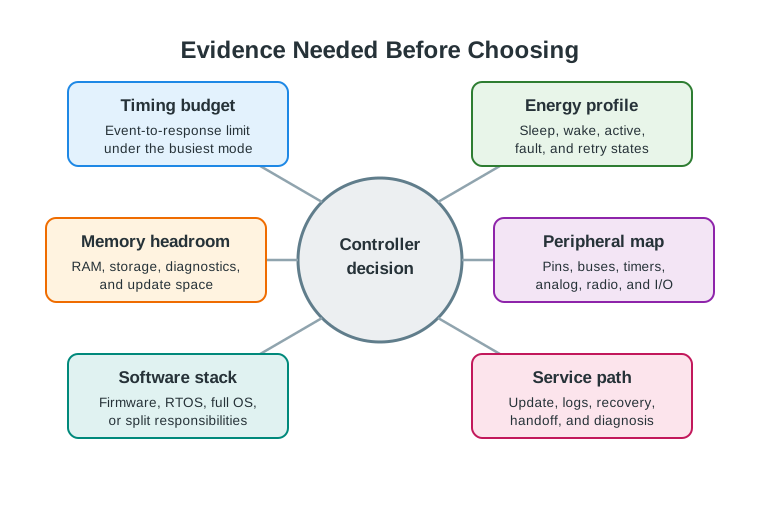
The controller choice should be backed by evidence, not preference.
- A threshold crossing must reach the buzzer within the stated 500 ms budget, even when the radio is busy.
- Energy evidence must include sleep, wake, transmit, and fault states rather than a single idle reading.
- Application evidence asks whether the gateway can store readings and upload them later.
Major section
Incremental Examples
The prototype is testing application behavior near equipment, so operating-system evidence matters.
- A door sensor reports open/closed state from a reed switch and sends a status message every few minutes.
- The main evidence is wake time, GPIO interrupt behavior, sleep current, radio transmit current, and reset recovery.
- A team is building a machine room monitoring prototype.
Major section
Incremental Examples (continued)
The firmware can be a small state machine: wake, read pin, debounce, send compact message, confirm local safe state, sleep.
- The acceptance test should measure current in sleep, wake, transmit, and fault states, then compare the result with the battery-life target.
- A Linux-capable MPU would add boot time, filesystem, package, and service-supervision risks that do not answer the main question.
- The software stack can use Linux, systemd services, a web UI, local storage, and log collection.
Major section
Incremental Examples (continued)
This case is harder because the controller is not only reading pins.
- A maintenance bench needs a local display, USB barcode scanner, SQLite cache, browser-based setup screen, and Ethernet upload when the site network returns.
- A Raspberry Pi Compute Module, BeagleBone, or similar MPU-class board is the more useful starting point.
- The main evidence is boot time, display startup, USB scanner support, filesystem behavior after power loss, local database writes, and service restart behavior.
Major section
Phoebe's Field Notes: The Vibration Endpoint's ADC Rate Is An Energy Decision
The mathematical gist: A 200 Hz vibration signal needs at least 400 samples each second.
- A 12-bit ADC on 3.3 V divides the input into 4,096 steps of 0.806 mV and gives an ideal 74.0 dB signal-to-quantisation-noise ratio.
- The endpoint should use an MCU because the important questions are local and time bounded.
- The gateway should use an MPU because the important questions are application-level.
Major section
Hybrid Boundaries
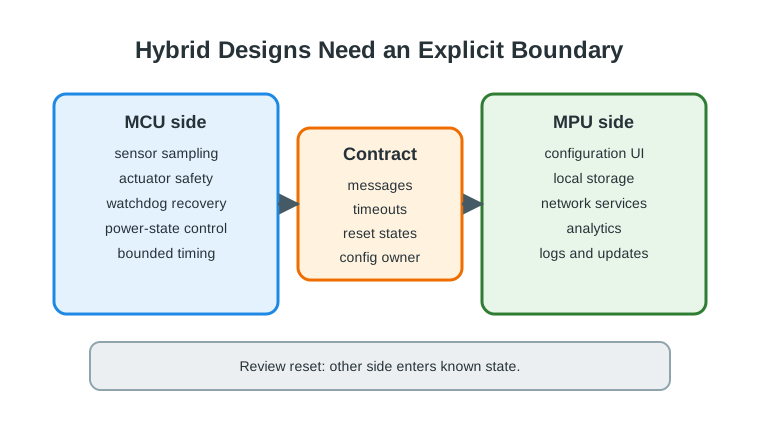
Hybrid designs combine an MCU and MPU when neither side should own every task.
- The important design work is the boundary: what stays deterministic, what becomes an application service, and what happens when either side fails.
- Configuration, storage, and network services sit on the MPU side, where a richer software stack can manage them.
- Sensor sampling, watchdogs, local alarms, and actuator safety stay on the MCU side because they must continue when the application side pauses or restarts.
Major section
Review Record
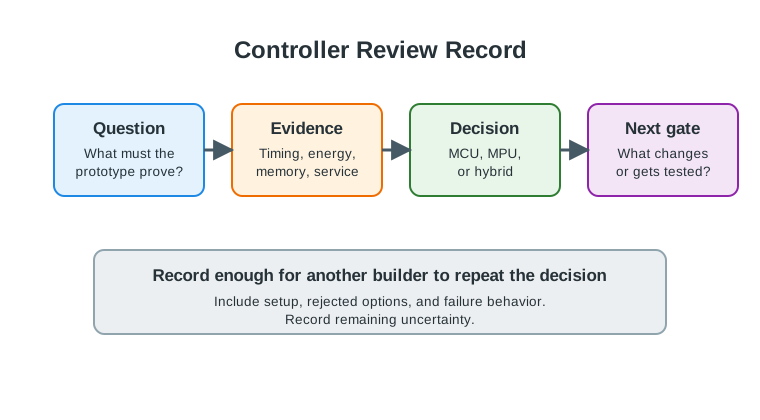
A controller review should record why the chosen class answers the current stage-gate question.
- The record should be clear enough that a later builder can repeat the decision.
- Timing evidence covers endpoint response under radio retry and local alarm; energy logs separate sleep, wake, transmit, and fault states.
- The next gate still asks for enclosure, cable, and recovery tests.
Major section
Freeze Decisions With Evidence
The team picks a controller from habit and never measures timing, energy states, memory headroom, or recovery behavior.
- The issue appears later when the prototype is harder to change.
- The: FLASH RELEASE BUDGET shows 4 KiB free, but the: SRAM PEAK BUDGET can still overflow independently; -Os and compressed instructions recover measured headroom, not interchangeable memory.
- The budget view in @fig-mcu-memory-budget separates persistence from peak runtime use before optimisation is credited as recovered capacity.
Deck summary
Key takeaways
Both controller classes could run the prototype.
- That extended version is the more honest fit for a Raspberry Pi-class board.
- The controller choice should be backed by evidence, not preference.
- The prototype is testing application behavior near equipment, so operating-system evidence matters.
- The firmware can be a small state machine: wake, read pin, debounce, send compact message, confirm local safe state, sleep.
Retrieval practice
Recall check 1 of 2

Voltage Vera says: answer from memory, then check your reasoning.
Q1A prototype endpoint wakes on a timer, samples a sensor, drives a local warning output, sends a compact status message, and then returns to a low-energy state. Which controller class should the team test first?
Show answer
Answer: A The prototype is mainly proving embedded control behavior at the hardware boundary.
Retrieval practice
Recall check 2 of 2
Voltage Vera says: answer from memory, then check your reasoning.
Q2A greenhouse prototype uses an MCU to sample soil moisture and control a pump, plus a Linux gateway for a dashboard and cloud upload. What should the boundary contract state before field testing?
Show answer
Answer: B These details keep real-time pump behavior separate from dashboard and cloud-service behavior.
Print reference
Answers
Answer key.
- A · The prototype is mainly proving embedded control behavior at the hardware boundary.
- B · These details keep real-time pump behavior separate from dashboard and cloud-service behavior.