Prototyping · Study deck

Why Hardware Prototyping Matters

Hardware prototyping is a staged learning process.

Voltage Vera is your guide for this deck.

iotclass.org

After studying this chapter

Learning objectives

You will be able to:

  • Explain why hardware prototypes are evidence tools, not miniature finished products.
  • Distinguish proof-of-concept, functional, engineering, and pilot-stage prototypes by the decisions they support.
  • Choose a prototyping approach from the current uncertainty, not from habit or popularity.
  • Identify common gaps between breadboard behavior, custom board behavior, enclosure behavior, and field behavior.
iotclass.org

Major section

In 60 Seconds · Start With the Story

Hardware prototyping is a staged learning process.

  • Each build should answer a specific question, expose a new kind of risk, and produce evidence for the next decision.
  • The goal is not to copy a breadboard into a finished board; it is to move from assumptions to measured, repeatable hardware behavior.
  • A door-counter demo can look convincing when it counts a hand wave on the bench.

Why it matters

Hardware prototyping matters because each physical build should answer one of those questions before the design gets harder to change.

iotclass.org

Major section

Match Build to Question · Write the Gate Before Building
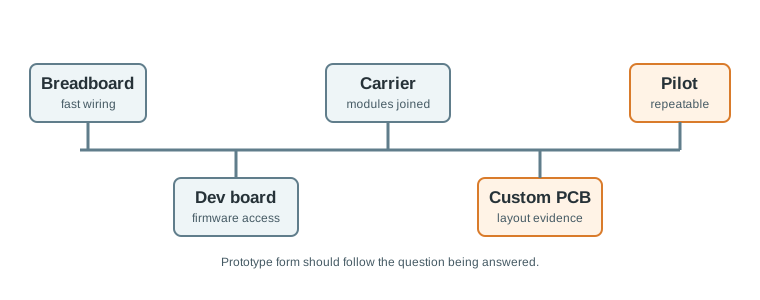
Hardware prototypes are useful when the build form matches the uncertainty.

  • Loose wiring is useful for that quick component check.
  • A development-board build can then put the same parts in a repeatable firmware and interface test, while a more integrated board addresses assembly and connection questions.
  • A breadboard with an ESP32 DevKit and an analog probe can answer whether the ADC readings change enough to be useful.

Why it matters

A breadboard can prove sensor behavior and basic wiring; a module carrier can reduce loose-wire faults; a custom board can test layout, power, connectors, and enclosure fit.

Prototype form should follow the evidence question: loose wiring for fast learning, stable carriers for repeatable integration, custom boards for layout evidence, and pilot units for handoff.
iotclass.org

Major section

Evidence Changes by Stage

Each stage changes the dominant error sources.

  • Early prototypes are limited by missing context; later prototypes are limited by repeatability, packaging, support, and manufacturing variation.
  • Electrical behavior: Breadboard capacitance, wire length, pull-up values, grounding, regulator response, and load transients can hide until the circuit is stressed.
  • Weak grounds can look like firmware instability.
iotclass.org

Major section

Evidence Changes by Stage (continued)

Moving the same circuit to a compact board changes trace length, return paths, regulator thermal behavior, and connector strain.

  • Operational behavior: A single lab unit does not test assembly notes, firmware programming, calibration, labeling, spare parts, or support handoff.
  • Decision quality: A prototype without setup records cannot be reproduced, so later teams cannot tell whether a change improved the design or merely changed the conditions.
  • A cable gland can change strain relief and water ingress risk.
iotclass.org

Major section

Evidence Changes by Stage (continued)

A pilot build adds process variation: soldering differences, label mistakes, firmware version drift, calibration steps, spare-part substitutions, and support tickets.

  • The deeper hardware skill is moving only the right assumptions forward and forcing the risky assumptions to meet stronger evidence before they reach a field pilot.
  • A custom PCB is therefore not just a neat breadboard; it is a new experiment about layout, power distribution, programming access, test points, and the way humans will assemble the device.
  • Under the hood, each stage asks whether the design still works after one more source of real-world variation is introduced.
iotclass.org

Major section

What Hardware Prototyping Is For

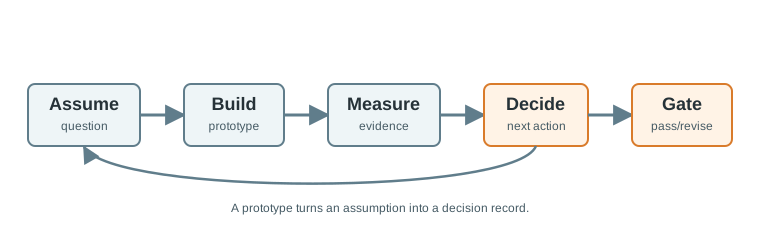
A prototype is valuable when it answers a question that a diagram, simulation, or parts list cannot answer alone.

  • The prototype is the test setup, not the conclusion.
  • The decision gate then records whether the claim passed or needs revision.
  • the Hardware prototyping evidence route diagram shows how a prototype turns an assumption into a decision.
  • If the result fails, return to the assumption or build and test again; changing a part without recording the old result loses the reason for the change.

Why it matters

This route matters because it makes an early bench experiment useful in later design review.

Hardware prototyping evidence route
iotclass.org

Major section

A Demo Is Not Automatically Evidence · How It Works: Stage a Hardware Prototype
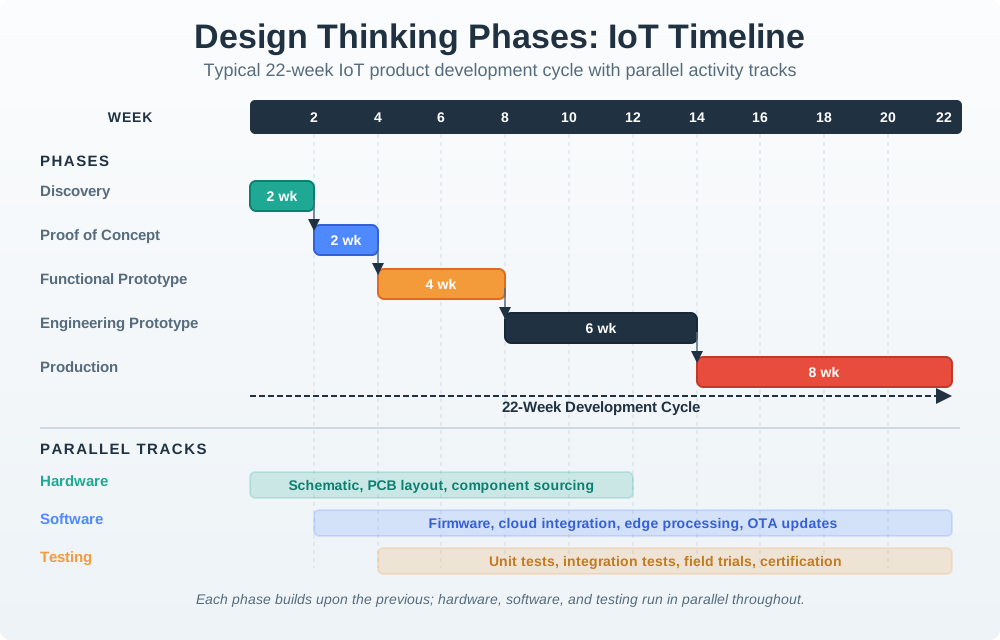
A demo can prove that something worked once.

  • A prototype review needs the setup, measurement, operating mode, failure notes, and next gate so the result can guide the next build.
  • Each stage increases realism and asks for stronger evidence.
  • The engineering prototype is closer to the intended physical design.
Design Thinking Phases: IoT Timeline
iotclass.org

Major section

Choose the Right Prototype Form · The Breadboard-to-Board Gap
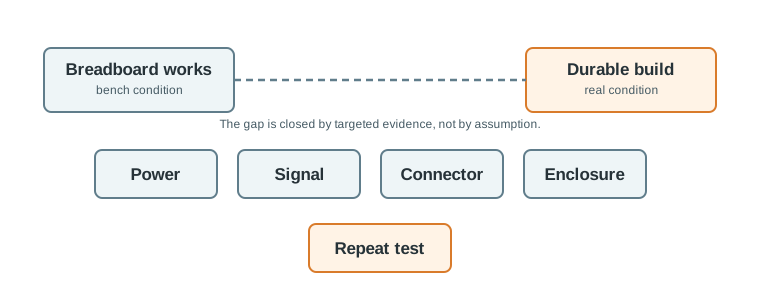
Prototype form should match the question being asked.

  • A breadboard is excellent for early circuit learning, but weak evidence for mechanical, power, radio, and field behavior.
  • A custom board can answer layout questions, but it is a slower way to test a vague concept.
  • The choice is not permanent.

Key terms

Breadboards and jumper wires
Breadboards and jumper wires are useful because they are easy to change.
Breadboard to durable board evidence gap
iotclass.org

Major section

Transition Rule · Prototype Review Decisions
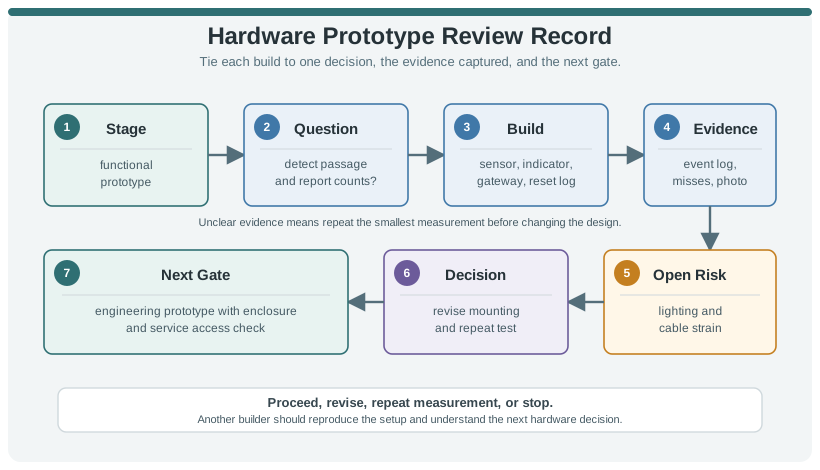
The goal is not polish; the goal is better evidence.

  • Proceed: The evidence answers the current question, and the next stage has a clear build plan.
  • Revise: The prototype found a fixable gap, and the next build should target that gap directly.
  • The question asks whether the prototype can detect passage and report counts.
Hardware prototype review record for the doorway occupancy functional prototype, connecting stage, question, build setup, event-log evidence, open lighting and cable-strain risks, review decision, and next engineering gate.
iotclass.org

Major section

Incremental Examples

A learner starts with a Raspberry Pi Pico, a TMP36 analog temperature sensor, a 10 kOhm resistor for a simple indicator circuit, and a breadboard LED.

  • This proof-of-concept should record the Pico board revision, ADC pin, supply voltage, threshold value, sample interval, and the observed raw ADC range.
  • It should not claim that the final device is calibrated, enclosed, manufacturable, or field-ready.
  • The staged prototype path keeps the team from confusing an early demo with durable hardware.
iotclass.org

Major section

Incremental Examples (continued)

The next gate is a functional prototype with the intended sensor package, wiring strain relief, and a repeatable measurement procedure.

  • Proof of concept: One sensing method is tested on the bench.
  • The record shows raw readings, false triggers, and the physical setup.
  • Functional prototype: The sensor, indicator, report message, and reset behavior are integrated.
iotclass.org

Major section

Incremental Examples (continued)

Engineering prototype: The build is mounted near a doorway.

  • Pilot build: Several units are assembled from the same notes.
  • The team compares readings, assembly errors, and support questions.
  • The prototype question is no longer "can BLE advertising work?" It is whether the physical build can survive charging, firmware updates, antenna detuning, button access, battery brownout, and wearer motion.
iotclass.org

Deck summary

Key takeaways

Hardware prototyping is a staged learning process.

  • Hardware prototypes are useful when the build form matches the uncertainty.
  • Each stage changes the dominant error sources.
  • Moving the same circuit to a compact board changes trace length, return paths, regulator thermal behavior, and connector strain.
  • A pilot build adds process variation: soldering differences, label mistakes, firmware version drift, calibration steps, spare-part substitutions, and support tickets.
iotclass.org

Retrieval practice

Recall check 1 of 4

Voltage Vera says: answer from memory, then check your reasoning.

Q1Per this chapter's worked example, an enclosure detunes a wearable BLE beacon's antenna gain by 4 dB, and the radio's RSSI log has a 1 dB quantization step (sigma_q = 1/sqrt(12) is about 0.289 dB). Considering quantization noise alone, with fading, motion, and other RSSI variation excluded, roughly how many standard deviations is the drop, and is it visible in a single reading?

AAbout 4 σ, treating the 1 dB step itself as the noise standard deviation.
BAbout 0.72 σ, treating a 4 dB drop as smaller than quantization noise.
CUnresolved until repeated field samples because motion and fading remain viable explanations for these readings.
DAbout 13.9 σ from 4/0.289, visible in one reading if quantization is the only noise.
Show answer

Answer: D see answers page

iotclass.org

Retrieval practice

Recall check 2 of 4

Voltage Vera says: answer from memory, then check your reasoning.

Q2Per this chapter, why does moving a working breadboard circuit to a compact custom PCB count as 'a new experiment' rather than just a tidier copy of the same circuit?

AReplacing the regulator and programmer changes the parts list, so testing those replacements alone proves all PCB electrical paths on the new layout and test access.
BShort traces and a ground plane remove jumper noise, so breadboard power and measurement results transfer to the PCB.
CContinuity and solder quality are the only new risks; a sound joint makes the PCB equivalent to the breadboard.
DPCB traces, returns, regulator heat, connector strain, power layout, access, test points and assembly differ, so hidden breadboard effects need retesting.
Show answer

Answer: D The chapter states: 'Breadboard evidence often hides parasitic effects and physical constraints.

iotclass.org

Retrieval practice

Recall check 3 of 4

Voltage Vera says: answer from memory, then check your reasoning.

Q3A team hands their prototype's wiring diagram, firmware build, and measurement log to a second engineer, who assembles an identical unit and gets the same readings. Per this chapter's list of prototype questions, which uncertainty does this test answer?

ACan it be repeated? -- another builder can reproduce the setup from the record and get the same result.
BCan it sense? -- the sensor, placement, calibration, and environment produce readings that support the intended decision.
CCan it survive? -- the build tolerates startup, reset, handling, cable strain, enclosure effects, and expected user behavior.
DCan it communicate? -- the device can exchange the needed messages with enough reliability for the target situation.
Show answer

Answer: A see answers page

iotclass.org

Retrieval practice

Recall check 4 of 4

Voltage Vera says: answer from memory, then check your reasoning.

Q4A breadboard demo reads a sensor correctly on the bench. The team wants to freeze the hardware design immediately. What is the main review concern?

AThe breadboard sensor result has no value, so discard every measurement before layout review.
BChange sensor families before reviewing power path, enclosure or repeated-build evidence.
CRewrite firmware first, treating the bench sensor result as complete hardware approval.
DIt has not tested layout, power path, enclosure, repeatability, or handoff.
Show answer

Answer: D A breadboard result can support the next gate, but it should not freeze the durable design without stronger evidence.

iotclass.org

Print reference

Answers 1 of 3

Answer key.

  1. D · almost 14 standard deviations, so a real 4 dB detuning shows up unmistakably in a single RSSI log, no averaging required.
iotclass.org

Print reference

Answers 2 of 3

Answer key.

  1. D · A custom PCB is therefore not just a neat breadboard; it is a new experiment about layout, power distribution, programming access, test points, and the way humans will assemble the device.
  2. A · Can it be repeated?
iotclass.org

Print reference

Answers 3 of 3

Answer key.

  1. D · A breadboard result can support the next gate, but it should not freeze the durable design without stronger evidence.
iotclass.org