Fundamentals · Study deck
Protocol Pioneers: Web, Email, and Routing
TCP/IP is the shared rule set that carries packets, or units of data, between networks.
Physics Phoebe is your guide for this deck.

After studying this chapter
Learning objectives
You will be able to:
- Explain: Today, he's working on: Solid -- a project to give users control over their personal data, addressing privacy concerns that have emerged 30+ years after the Web's creation.
- Explain: Safe redundancy needs one loop-free forwarding tree, a way to change it after failure, and a measured recovery time that meets the service need.
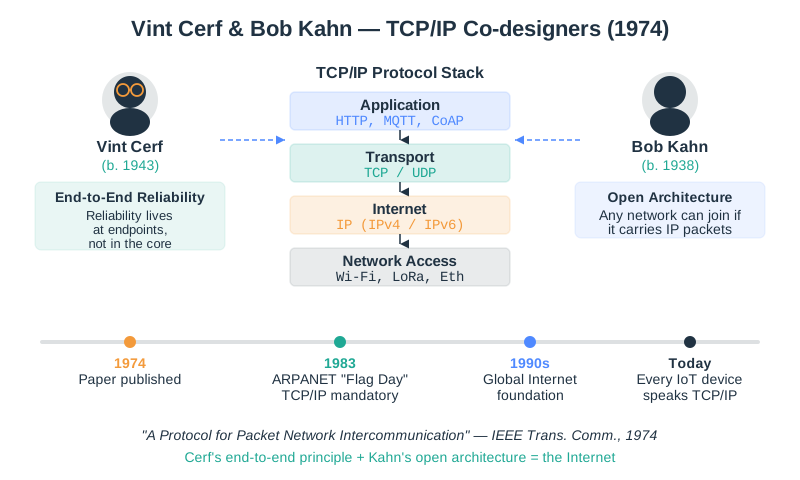
- Explain: The Open Architecture Principle (Kahn's Insight): Any network -- wired, wireless, satellite, smoke signals -- can join the Internet if it can carry IP packets.
- Explain: In 1989, CERN (the European physics lab) had thousands of researchers generating papers, datasets, and software.
Major section
Vint Cerf (1943-) and Bob Kahn (1938-): The Fathers of the Internet
TCP at each end orders data and sends a lost packet again.
- The network core can stay more simple.
- Kahn's open design lets Wi-Fi, cell, or satellite links take part if they forward IP.
- MQTT gives the app meaning.
- TCP gives ordered and sound delivery.
Major section
Vint Cerf (1943-) and Bob Kahn (1938-): The Fathers of the Internet (continued)
TCP/IP did not need one common physical network.
- Baran showed that packet networks could be resilient.
- The Open Architecture Principle (Kahn's Insight): Any network -- wired, wireless, satellite, smoke signals -- can join the Internet if it can carry IP packets.
- The network's job is simple: forward packets.
Major section
Vint Cerf (1943-) and Bob Kahn (1938-): The Fathers of the Internet (continued)
End-to-End Reliability (Cerf's Insight): Don't trust the network to be reliable.
- If a packet is lost, the receiving computer detects the gap (via sequence numbers) and asks the sender to retransmit.
- Vint Cerf is partially deaf from birth.
- The Internet is fundamentally about connecting people and ideas -- making sure messages get through despite imperfect infrastructure.".
Major section
Vint Cerf (1943-) and Bob Kahn (1938-): The Fathers of the Internet (continued)
"I've always been interested in communication because I understand what it's like when communication fails.
- This robustness reflects Cerf's personal understanding that communication cannot be taken for granted.
- By the 1990s, it was the foundation of the global Internet.
- Internet-connected devices use IP; constrained sensors may instead communicate through a gateway.
Major section
Tim Berners-Lee (1955-): World Wide Web Inventor
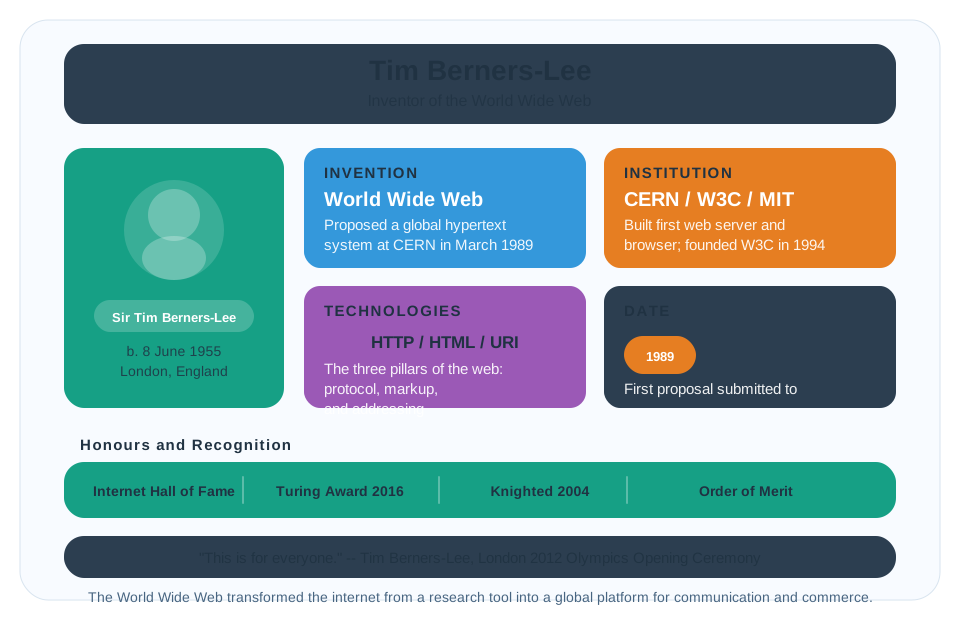
In 1989, CERN (the European physics lab) had thousands of researchers generating papers, datasets, and software.
- But there was no easy way to link related documents across different computers.
- If you read a paper that referenced another paper, you had to manually search for it on a different system.
- Knowledge was siloed.
Major section
Tim Berners-Lee (1955-): World Wide Web Inventor (continued)
HTTP is stateless -- each request is independent, making it simple and scalable.
- If CERN had patented it, the Web might have become a proprietary system like AOL or CompuServe -- walled gardens that eventually died.
- The ITU estimated 6 billion Internet users in 2025; that figure measures Internet use, not Web use specifically.
- ITU Facts and Figures 2025 Berners-Lee was knighted by Queen Elizabeth II in 2004 for his contribution to humanity.
Major section
What Berners-Lee Made Possible
Every web-based IoT dashboard, every REST API, every cloud platform UI you use is built on Berners-Lee's HTTP.
- REST APIs: When your IoT device sends data to a web service (POST /sensor-data), it's using HTTP as the application protocol.
- That simplicity was Berners-Lee's design choice, influenced by his goal to make the Web accessible to everyone, not just experts.
- Today, he's working on: Solid -- a project to give users control over their personal data, addressing privacy concerns that have emerged 30+ years after the Web's creation.
Major section
Ray Tomlinson (1941-2016): Email Inventor
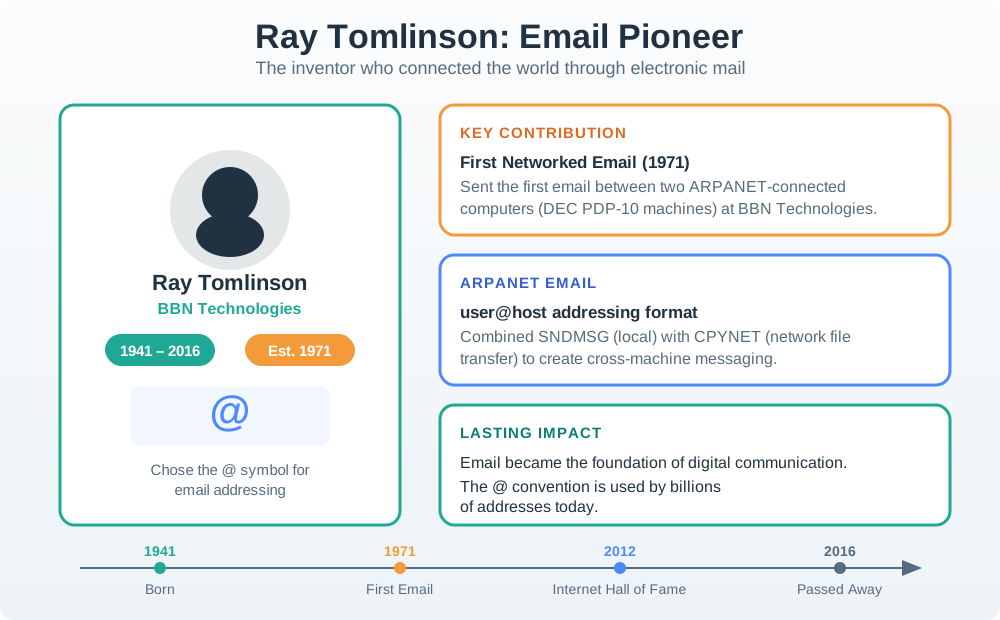
In 1971, computers could run local messaging programs -- users on the same computer could leave messages for each other.
- But ARPANET had connected computers at different sites.
- The @ symbol was perfect.
- Source Today, billions of people use email, all following Tomlinson's user@host format.
Major section
Radia Perlman (1951-): "Mother of the Internet"
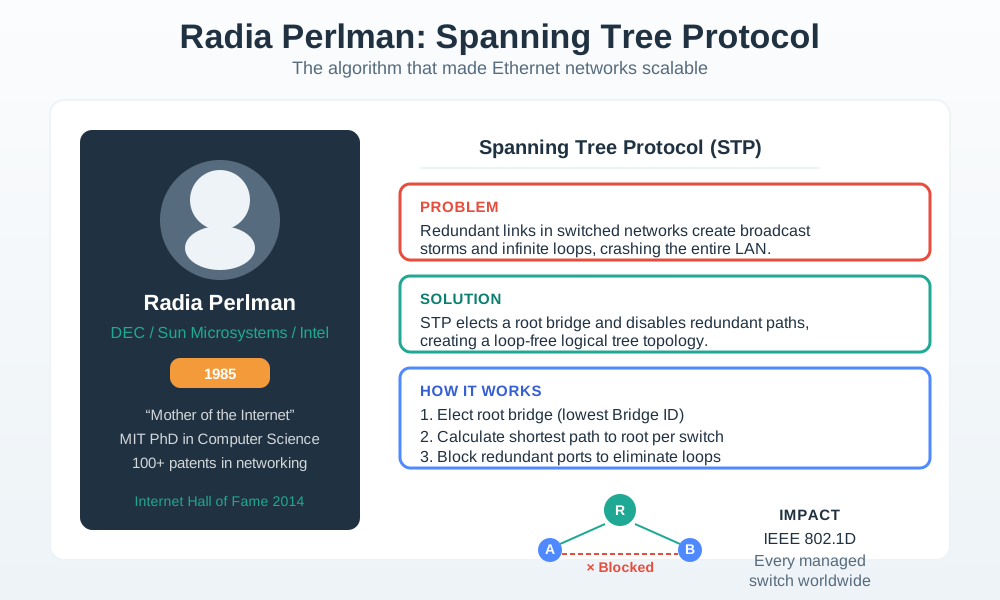
More than one path can aid recovery, but an Ethernet broadcast can loop and grow.
- STP makes switches find their peers and elect a root bridge.
- The link that would close a loop stays blocked.
- If a live link fails, the switches can open a backup path.
Major section
Radia Perlman (1951-): "Mother of the Internet" (continued)
Redundancy was risky -- if you added a backup link for resilience, you might accidentally create a loop that crashed everything.
- The blocked link is spare capacity, not wasted hardware.
- But graphs can have loops -- paths that circle back on themselves.
- Any link that would create a loop is automatically blocked (disabled).
Major section
Radia Perlman (1951-): "Mother of the Internet" (continued)
Safe redundancy needs one loop-free forwarding tree, a way to change it after failure, and a measured recovery time that meets the service need.
- Within seconds, a single packet can multiply into a broadcast storm that crashes the entire network.
- In the early 1980s, network engineers had to carefully plan network topologies to avoid loops.
- If a link fails, STP recalculates and unblocks backup paths.
Major section
What Perlman Made Possible
Industrial IoT: Factory networks use STP to ensure a single cable cut doesn't isolate machines.
- Home Networks: Managed switches in home labs use STP to prevent accidental loops when users connect cables.
- You can connect switches in any topology, add redundant links for failover, and STP ensures it just works.
- Without STP, every IoT deployment would require careful network topology planning to avoid loops -- slowing deployment and increasing costs.
Deck summary
Key takeaways
TCP at each end orders data and sends a lost packet again.
- TCP/IP did not need one common physical network.
- End-to-End Reliability (Cerf's Insight): Don't trust the network to be reliable.
- "I've always been interested in communication because I understand what it's like when communication fails.
- In 1989, CERN (the European physics lab) had thousands of researchers generating papers, datasets, and software.
Retrieval practice
Recall check

Physics Phoebe says: answer from memory, then check your reasoning.
Q1An IoT device sends POST /sensor-data to a web service. Which role does HTTP play?
Show answer
Answer: D The chapter uses this example to connect device requests to web services.
Q2A building network adds redundant switch uplinks. What problem does the chapter associate with spanning tree?
Show answer
Answer: B The examples connect redundant links with loop prevention and recovery.
Print reference
Answers
Answer key.
- D · The chapter uses this example to connect device requests to web services.
- B · The examples connect redundant links with loop prevention and recovery.