Fundamentals · Study deck
Protocol Pioneers: Packets and Internetworking
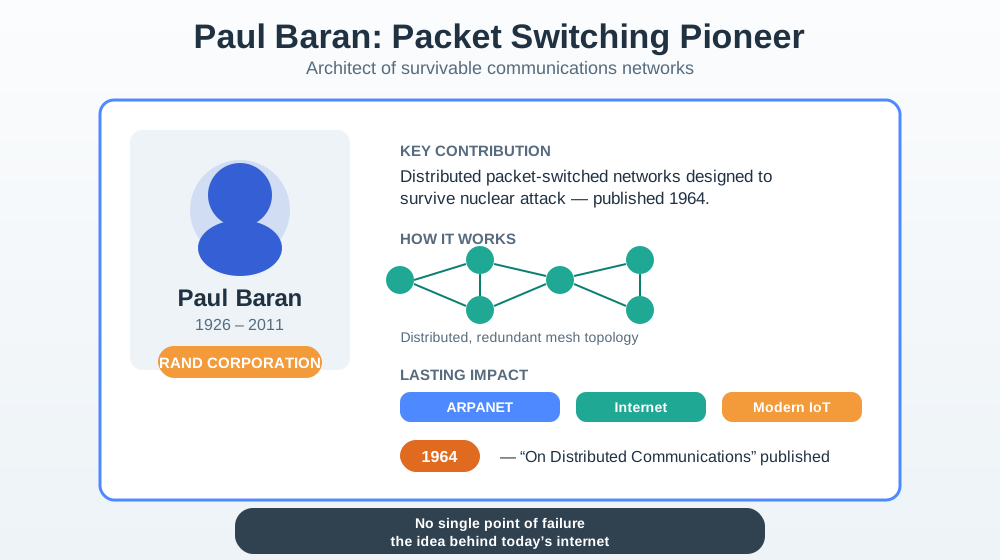
Paul Baran proposed dividing messages into small blocks that a network could send separately and route around damaged links.
Physics Phoebe is your guide for this deck.

After studying this chapter
Learning objectives
You will be able to:
- Identify the key Internet pioneers: Classify 10+ individuals by their foundational contributions to networking and protocol development
- Map people to protocols: Explain what each pioneer invented and justify why their design decisions still matter in modern IoT systems
- Analyze collaborative innovation: Describe how the Internet emerged through open collaboration rather than any single inventor's work
- Trace ideas through generations: Illustrate how each pioneer's work built on previous contributions and enabled subsequent innovations
Major section
In 60 Seconds
History matters when it explains why those rules still shape a design.
- Firmware means software stored on a device.
- A gateway means the bridge between a local device group and a wider network.
- Telemetry is the measurements and state a device reports over the network.
- Transmission Control Protocol (TCP) means a stream that checks order and delivery.
Major section
In 60 Seconds (continued)
Hypertext Transfer Protocol (HTTP) means a request-and-response format used by web systems.
- Internet Protocol means the addressing rules used to move network packets.
- IPv6 means version 6 of those rules.
- 6LoWPAN means a way to carry IPv6 over small low-power radios.
- Message Queuing Telemetry Transport (MQTT) means a lightweight message method for devices.
Major section
In 60 Seconds (continued)
This runway does not credit every contributor or settle each historical debate.
- The deeper timeline shows how the inventions, standards, and trade-offs connect to decisions engineers still make.
- The Internet was not invented by one person.
- Modern IoT inherits those choices every time a sensor publishes MQTT over TCP/IP, a Thread device compresses IPv6, or a dashboard speaks HTTP.
Major section
Minimum Viable Understanding
Core Concept: The Internet and IoT protocols we use today are the result of collaborative work by hundreds of engineers over 60+ years.
- Every protocol design decision has a human story.
- Key Takeaway: When you use MQTT, TCP/IP, HTTP, or email today, you're building on the work of specific, identifiable people who solved real problems.
- Learning their stories makes you a better engineer -- you understand not just what protocols do, but why they were designed that way.
Major section
Chapter Overview
Learning about protocol pioneers is like learning from master chefs.
- This chapter profiles 11 key pioneers whose work directly enables the IoT systems you build today.
- When you know Andy Stanford-Clark created MQTT because satellite bandwidth was expensive, you understand why MQTT headers are so compact.
- Understanding the people helps you understand the protocols.
Major section
Chapter Overview (continued)
But if I break messages into PACKETS and send them on different paths, some will always get through!" He drew maps showing multiple roads to the same destination.
- If I cut this phone line, your whole message fails.
- Sammy laughed: "That's how I send sensor readings!
- But he wanted everyone to use it.".
Major section
Chapter Overview (continued)
You could memorize recipes, or you could learn from the chefs who created them -- understanding why they combined ingredients in specific ways, what problems they were solving, and how they adapted when things went wrong.
- If one path is busy, the network finds another way!".
- Vint was hard of hearing, which made him extra passionate about communication technology.
- Bob said: "Our rule is simple: ANY computer should talk to ANY other computer, anywhere, anytime!".
Major section
Chapter Overview (continued)
Max added: "That's why my ESP32 can talk to a giant cloud server!
- Berners-Lee had patented the Web, he could have been a billionaire!
- Lila giggled: "sammy@iot-lab.com -- that @ symbol is almost 60 years old!".
- She invented the Spanning Tree Protocol that stops network loops.
Major section
Chapter Overview (continued)
He needed a way to separate the person's name from the computer name, so he chose the @ symbol. "Why @?" he asked. "Because nobody was using it for anything else!".
- The Network Nurse (Radia Perlman): Radia is called the "Mother of the Internet" (though she doesn't like that title).
- Max observed: "Every switch in every building runs Ms.
- The IoT Namer (Kevin Ashton): In 1999, Kevin was working at a company that made soap and lipstick.
Major section
Paul Baran (1926-2011): Packet Switching Pioneer
Multiple connections provide alternative routes instead of relying on one central point.
- If a Soviet nuclear strike destroyed a few key switching centers, the entire network would collapse.
- The Pentagon needed a communication system that could survive a nuclear war.
- If one path is destroyed, packets automatically route around the damage.
Major section
Paul Baran (1926-2011): Packet Switching Pioneer (continued)
Each node makes local decisions about where to forward packets based on current network conditions.
- Their response: "It won't work.": AT&T's engineers were the world's foremost experts in circuit-switched telephony.
- They couldn't imagine that chopping messages into pieces and sending them on unpredictable paths would be more reliable than dedicated circuits.
- Their entire system was analog, and they saw packet switching as chaos.".
Deck summary
Key takeaways
History matters when it explains why those rules still shape a design.
- Hypertext Transfer Protocol (HTTP) means a request-and-response format used by web systems.
- This runway does not credit every contributor or settle each historical debate.
- Core Concept: The Internet and IoT protocols we use today are the result of collaborative work by hundreds of engineers over 60+ years.
- Learning about protocol pioneers is like learning from master chefs.
Retrieval practice
Recall check

Physics Phoebe says: answer from memory, then check your reasoning.
Q1Paul Baran proposed packet switching to the U.S. military in the 1960s, but AT&T engineers rejected it as unworkable. Why did AT&T's experts miss this paradigm shift?
Show answer
Answer: A s engineers evaluated packet switching using circuit-switching metrics (dedicated paths, guaranteed bandwidth).
Print reference
Answers
Answer key.
- A · s engineers evaluated packet switching using circuit-switching metrics (dedicated paths, guaranteed bandwidth).