Fundamentals · Study deck
Protocol Pioneers: IoT and 6LoWPAN
Kevin Ashton named a world where objects report facts without a person typing them.
Physics Phoebe is your guide for this deck.

After studying this chapter
Learning objectives
You will be able to:
- Link Ashton's IoT idea to automatic object data.
- Explain how 6LoWPAN fits IPv6 packets onto small radio links.
- Explain: In 1999, the stock system could say an item was in store while the shelf was bare.
- Explain: This claim is more narrow than saying that all things should connect.
Major section
Kevin Ashton (1968-): Coined "Internet of Things"
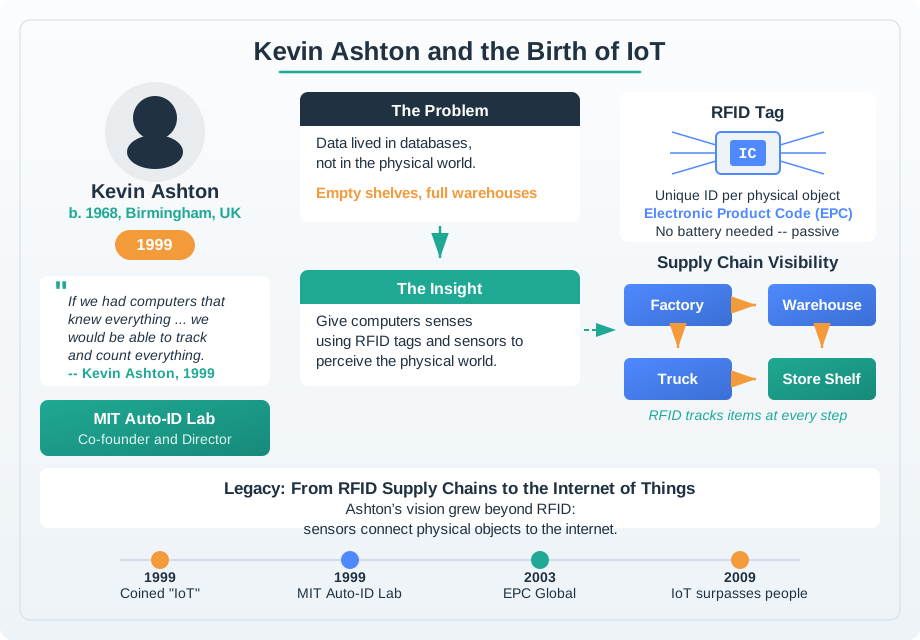
In 1999, the stock system could say an item was in store while the shelf was bare.
- A tagged item and reader can show place or presence without one more hand entry.
- That data lets the system find the gap and prompt a restock.
- Humans had to manually count products and update systems.
Major section
Kevin Ashton (1968-): Coined "Internet of Things" (continued)
This claim is more narrow than saying that all things should connect.
- Sensing and identity add value when they improve a real choice, not merely when an object can send data.
- He noticed a frustrating pattern: stockouts -- shelves ran out of popular products (like brown lipstick) while warehouses had plenty of inventory.
- The problem: Computers knew what inventory existed in databases, but they had no idea what was on store shelves.
Major section
Kevin Ashton (1968-): Coined "Internet of Things" (continued)
"Computers need to sense the physical world directly, without depending on humans to input data.
- If things could identify themselves and report their location automatically, supply chains would fix themselves.".
- He was experimenting with RFID (Radio Frequency Identification) tags -- tiny chips that broadcast unique IDs when queried by a reader.
- Shelves could detect when stock was low and automatically reorder.
Major section
Geoff Mulligan: 6LoWPAN Pioneer
An IEEE 802.15.4 frame is at most 127 bytes, while standard IPv6 and UDP headers total 48 bytes.
- Their share is 48 B/127 B=0.378, or about 38%, before application data and other framing costs.
- IPv6 headers alone are 40 bytes -- plus 8 bytes for UDP.
Major section
Geoff Mulligan: 6LoWPAN Pioneer (continued)
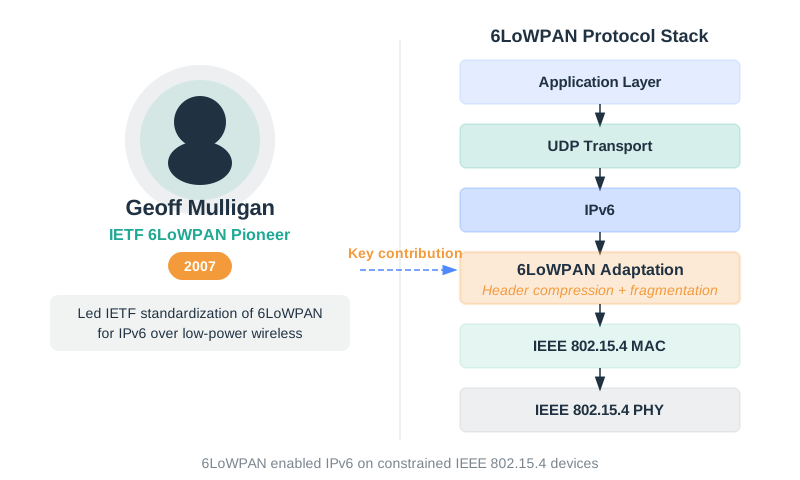
RFC 6282 Fragmentation and reassembly then bridge IPv6's 1280-byte minimum packet requirement to the smaller radio frames, while mesh support extends reach.
- The stack view supports Mulligan's contribution: constrained devices retain Internet-layer semantics by adding an adaptation contract rather than pretending the tiny link is ordinary Ethernet.
- Fragmentation and Reassembly: IPv6 packets can be 1280+ bytes, but 802.15.4 only allows 127 bytes.
- Mesh Routing Support 6LoWPAN enables mesh networks where devices route packets for each other, extending network range without infrastructure.
Major section
What Mulligan Made Possible
Matter Devices: A Matter-certified smart light or lock may use Thread, which runs 6LoWPAN over IEEE 802.15.4; Matter also supports Wi-Fi and Ethernet.
- Mulligan's insight -- "IoT needs IPv6, but IPv6 needs compression to fit in IoT packets" -- solved the tension between universal Internet connectivity (Cerf's vision) and resource-constrained devices (IoT reality).
- 6LoWPAN IPHC can compress the 40-byte IPv6 header to about 2-6 bytes in a suitable setup.
- The 2-byte minimum can apply when a shared context is installed for that mesh prefix, as Thread does; other addresses and routing details can need more.
Major section
Deep Dive: How Internet Standards Become Interoperable
A protocol travels a defined path before it becomes a standard.
- The pioneers who built the Internet did more than write code.
- They created a way to agree on open standards so machines from different makers could interoperate.
- RFCs also standardize how requirements are written.
- A proprietary protocol would offer no such guarantee across vendors.
Major section
Deep Dive: How Internet Standards Become Interoperable (continued)
That precision removes ambiguity that would otherwise break interoperability.
- Most core Internet protocols are published by the: IETF (Internet Engineering Task Force) as: RFCs (Requests for Comments), documents anyone can read and implement for free.
- The IETF's guiding motto, credited to David Clark, is "rough consensus and running code.": Standards are not decreed from above.
- The IETF has historically wanted to see multiple independent implementations interoperate before a specification advances.
Major section
Deep Dive: How Internet Standards Become Interoperable (continued)
That culture is why the Internet, and IoT on top of it, is built from interoperable protocols rather than one vendor's proprietary system.
- An author publishes an Internet-Draft; a working group discusses and revises it; if it reaches rough consensus it is published as an: RFC with a permanent number.
- Foundational protocols carry famous numbers: IP is RFC 791, TCP is RFC 793, SMTP is RFC 821, and FTP is RFC 959.
- Because it is an open RFC using RFC 2119 language, a sensor vendor and a cloud vendor can implement CoAP independently and still expect their products to interoperate.
Major section
Deep Dive: How Internet Standards Become Interoperable (continued)
RFC 2119 defines the capitalized keywords MUST, SHOULD, and MAY, so a spec can state precisely what an implementation is required to do versus what is recommended or optional.
- The "running code" half of the motto protects against paper standards that look fine but cannot be built or do not interoperate.
- A spec is only real when two teams who never coordinated can build it from the text alone and have it work.
- This matters intensely for IoT, where devices from dozens of makers must coexist for a decade.
- Caught at a plugfest, the spec can be clarified before publication.
Deck summary
Key takeaways
In 1999, the stock system could say an item was in store while the shelf was bare.
- This claim is more narrow than saying that all things should connect.
- "Computers need to sense the physical world directly, without depending on humans to input data.
- An IEEE 802.15.4 frame is at most 127 bytes, while standard IPv6 and UDP headers total 48 bytes.
- RFC 6282 Fragmentation and reassembly then bridge IPv6's 1280-byte minimum packet requirement to the smaller radio frames, while mesh support extends reach.
Retrieval practice
Recall check 1 of 3

Physics Phoebe says: answer from memory, then check your reasoning.
Q1Vint Cerf and Bob Kahn's TCP/IP design includes the end-to-end principle: reliability logic belongs in endpoints, not in the network core. Why is this principle important for IoT?
Show answer
Answer: D The end-to-end principle means the network's job is simple: forward packets.
Retrieval practice
Recall check 2 of 3
Physics Phoebe says: answer from memory, then check your reasoning.
Q2MQTT was designed for costly satellite links and has a fixed header as short as 2 bytes. How can that design help a constrained IoT link?
Show answer
Answer: C A fixed header as short as 2 bytes can reduce application overhead for small messages on a suitable IP link.
Retrieval practice
Recall check 3 of 3
Physics Phoebe says: answer from memory, then check your reasoning.
Q3Whose contribution defines local-link framing and access for nearby devices?
Show answer
Answer: B Ethernet defines local-link framing and access, so it belongs where nearby devices move frames.
Q4Complete the HTTP request demonstrating Berners-Lee's Web protocol:
Show answer
Answer: A HTTP GET retrieves resources from a server.
Print reference
Answers
Answer key.
- D · The end-to-end principle means the network's job is simple: forward packets.
- C · A fixed header as short as 2 bytes can reduce application overhead for small messages on a suitable IP link.
- B · Ethernet defines local-link framing and access, so it belongs where nearby devices move frames.
- A · HTTP GET retrieves resources from a server.