Fundamentals · Study deck
Protocol Pioneers: Ethernet and MQTT
Ethernet let many local machines share a link.
Physics Phoebe is your guide for this deck.

After studying this chapter
Learning objectives
You will be able to:
- Explain: For IoT specifically: When you connect an ESP32 running Arduino MQTT client to AWS IoT Core, it works despite the client being a hobbyist implementation and AWS being an enterprise platform.
- Explain: For ESP32 developers: When you use PubSubClient library to publish sensor data to sensors/room/temperature, you're using the protocol Stanford-Clark designed for oil pipelines 25 years ago.
- Explain: JSON Parsers: IoT platforms accept JSON with trailing commas or unquoted keys, even though strict JSON forbids this, because being "liberal in what you accept" improves interoperability.
Major section
Bob Metcalfe (1946-): Ethernet Inventor
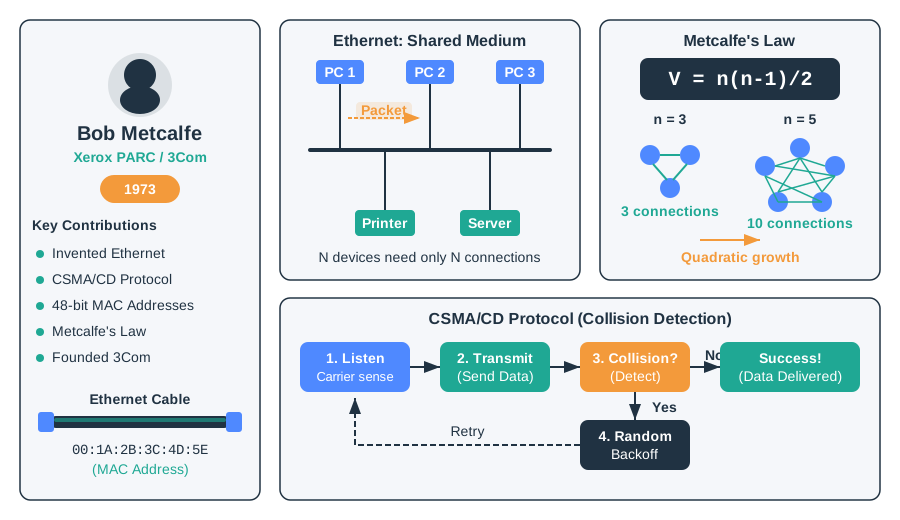
A full set of twenty peers needs N(N−1)/2=20×19/2=190 cables.
- The shared medium needs one link per device, or twenty links.
- Sharing adds contention, so each station must listen before it sends.
- On a clash, it stops, waits for a random time, and tries again.
- If someone else is talking, wait.
Major section
Bob Metcalfe (1946-): Ethernet Inventor (continued)
This requires only N connections instead of 2N(N−1).
- The last panel gives a rule of thumb for network value, not a count of physical links.
- Ethernet cut wire needs by controlling access to one medium, while value could grow as more peers became reachable.
- Each collision doubles the wait range.
Major section
Bob Metcalfe (1946-): Ethernet Inventor (continued)
In the early 1970s, Xerox PARC (Palo Alto Research Center) had dozens of computers and the world's first laser printer.
- Researchers wanted to share the printer, but there was no good way to network the machines.
- Point-to-point cables didn't scale -- connecting N devices requires 2N(N−1) cables.
- Collision Detection: If two devices start transmitting simultaneously (collision), both detect it and stop.
Major section
Bob Metcalfe (1946-): Ethernet Inventor (continued)
Exponential Backoff: After a collision, wait a random time before retrying.
- 48-Bit MAC Addresses: Ethernet interfaces commonly use 48-bit MAC addresses (like 00:1A:2B:3C:4D:5E).
- Universally administered addresses are intended to be unique, but locally administered addresses can be assigned or randomized.
- Actual value depends on whether those connections are useful.
Major section
Bob Metcalfe (1946-): Ethernet Inventor (continued)
Metcalfe's story explains why Ethernet then became valuable at scale: each compatible node made the shared ecosystem more useful.
- Translation: In Metcalfe's simple model, potential pairwise connections grow roughly with the square of the number of users.
- Example: A phone network with 10 people supports 45 possible calls (210×9).
- This explains why social networks grow explosively once they reach critical mass.
Major section
Putting Numbers to It
Possible interactions: 250×49=1,225 device pairs.
- Possible interactions: 2200×199=19,900 device pairs.
- Pair-count multiplier: 1,22519,900≈16.2× as many possible pairs.
- Competing LAN technologies gave buyers different choices in speed, cost, and vendor support.
Major section
What Metcalfe Made Possible
Industrial IoT: Factory machines use Industrial Ethernet variants (EtherCAT, PROFINET, Ethernet/IP) -- all descendants of Metcalfe's invention.
- Building Automation: BACnet/IP and Modbus TCP run over Ethernet, connecting HVAC systems, lighting, and access control.
- IoT Gateways: Raspberry Pi, ESP32 Ethernet modules, and industrial gateways use Ethernet to connect to the cloud.
- A user with 5 Matter devices from 1 vendor has 10 possible interactions (25×4).
Major section
Jon Postel (1943-1998): "God of the Internet"
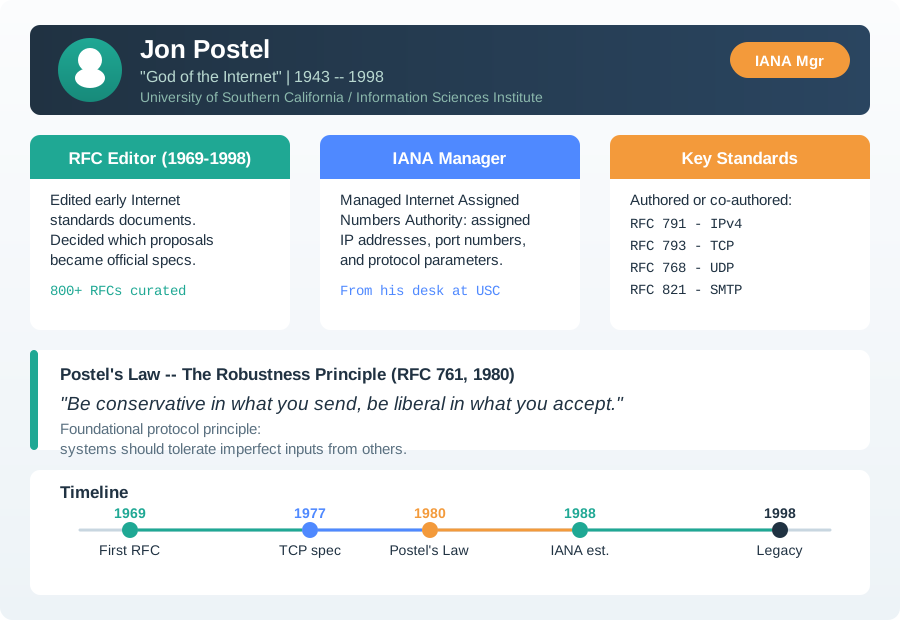
As RFC Editor, he helped turn ideas into reviewed rules that any builder could read.
- The lasting method is the set: rules define acts, a registry defines shared names, and systems expose both on the wire.
- Common protocols need sound records and care as well as good packet design.
- The Internet community trusted him to make fair decisions, and he did.
- Postel's Law keeps the Internet unified despite vendor diversity.
Major section
Jon Postel (1943-1998): "God of the Internet" (continued)
If every device rejected messages with minor formatting errors, the Internet would fragment into incompatible islands.
- Someone had to coordinate all this chaos.
- IANA Manager (1972-1998): He did this from his desk at USC (University of Southern California) with minimal staff.
- The U.S. Government was not amused.
Major section
Jon Postel (1943-1998): "God of the Internet" (continued)
"Jon Postel was the Internet.".
- "Be conservative in what you send, liberal in what you accept.".
- He proved that IANA's authority was personal -- based on trust and technical competence, not legal ownership.
- Every port number (443, 1883, 8883) was assigned by Postel's IANA.
Major section
How to Use: What Postel Made Possible
A client that sends a slightly malformed CONNECT packet might still connect if the broker can infer the intent.
- For IoT specifically: When you connect an ESP32 running Arduino MQTT client to AWS IoT Core, it works despite the client being a hobbyist implementation and AWS being an enterprise platform.
- That interoperability comes from both sides following Postel's Law -- AWS tolerates minor client deviations, and the Arduino library tries to be standards-compliant.
- JSON Parsers: IoT platforms accept JSON with trailing commas or unquoted keys, even though strict JSON forbids this, because being "liberal in what you accept" improves interoperability.
Major section
Andy Stanford-Clark: MQTT Co-creator
Postel's standards work explains how the Internet stays coordinated.
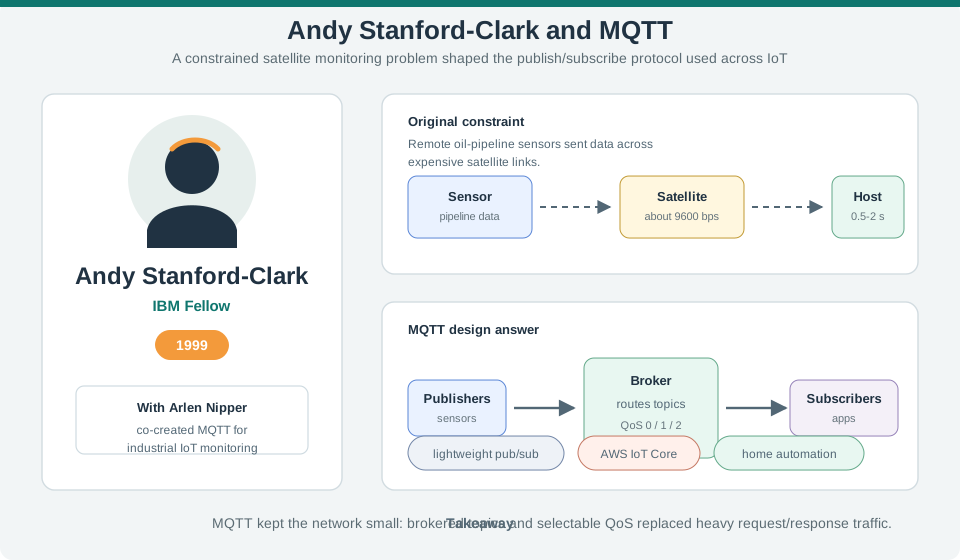
- Stanford-Clark's MQTT work shows what happens when those open-network foundations meet a severe IoT constraint: tiny messages over expensive links.
- A 200-byte HTTP header is 1600 bits.
- MQTT can start with a two-byte fixed header.
Major section
Andy Stanford-Clark: MQTT Co-creator (continued)
Small frames help, but delivery rules, session state, topic control, and measured full-path cost still decide fit.
- HTTP was too heavy -- each HTTP request had 200+ bytes of headers.
- For thousands of sensors sending frequent updates, HTTP was unusable.
- Quality of Service (QoS) Levels: Sensors can choose the right tradeoff between reliability and overhead.
Major section
What Stanford-Clark Made Possible
Smart Homes: Zigbee2MQTT, Tasmota, ESPHome all use MQTT to integrate devices with Home Assistant.
- Connected Vehicles: Tesla uses MQTT for vehicle-to-cloud communication.
- For ESP32 developers: When you use PubSubClient library to publish sensor data to sensors/room/temperature, you're using the protocol Stanford-Clark designed for oil pipelines 25 years ago.
- It works just as well for your $5 hobby project as it did for million-dollar industrial deployments.
Deck summary
Key takeaways
A full set of twenty peers needs N(N−1)/2=20×19/2=190 cables.
- This requires only N connections instead of 2N(N−1).
- In the early 1970s, Xerox PARC (Palo Alto Research Center) had dozens of computers and the world's first laser printer.
- Exponential Backoff: After a collision, wait a random time before retrying.
- Metcalfe's story explains why Ethernet then became valuable at scale: each compatible node made the shared ecosystem more useful.
Retrieval practice
Recall check

Physics Phoebe says: answer from memory, then check your reasoning.
Q1A building gateway links BACnet/IP devices over a wired network. Which contribution provides the local network foundation in the chapter?
Show answer
Answer: B The section connects building and industrial gateway networks to Ethernet.
Q2A battery sensor sends routine measurements and important alerts over MQTT. What design choice can distinguish their delivery needs?
Show answer
Answer: A The chapter contrasts power-conscious routine telemetry with acknowledged important alerts.
Print reference
Answers
Answer key.
- B · The section connects building and industrial gateway networks to Ethernet.
- A · The chapter contrasts power-conscious routine telemetry with acknowledged important alerts.