IoT Fundamentals · Study deck
Protocol Selection Scenarios
Begin with the product, not a technology name.
Physics Phoebe is your guide for this deck.

After studying this chapter
Learning objectives
You will be able to:
- Explain: For a wearable or body-to-phone sensor, the first question is usually whether BLE can satisfy alert timing, reconnect behavior, buffering, and phone operating-system limits without draining the tiny battery.
- Explain: The record should not claim a universal lowest-cost winner; it should show gateway quotes, installation constraints, service fees, maintenance assumptions, and the coverage results that justify any split.
- Explain: Common Pitfalls Treating a scenario winner as a universal winner: A choice that suits parking does not suit a body sensor, a warehouse tag, or a concrete-heavy building.
- Explain: All send small messages.
Major section
In 60 Seconds
A building control must work through walls.
- These jobs differ even when their messages are small.
- A familiar choice still fails when it cannot reach.
- A long-reach choice still fails when it cannot meet the action time.
- Another team should be able to repeat the reasoning.
Major section
In 60 Seconds (continued)
They should not need to trust a brand or a hidden score.
- This quick path uses one main connection per case.
- Real products may combine several.
- Practitioner work builds full records.
- Under the Hood examines edge cases, weights, and why a failed hard limit must overrule a high total score.
Major section
Start With the Story
All send small messages.
- They still need different connection choices.
- The place, power source, movement, timing, and owner change the answer.
- A buried parking sensor may need years of battery life.
- A wrist alarm may need a nearby phone and quick notice.
Major section
Start With the Story (continued)
A building control must fit local rules and walls.
- A good decision record links every choice to a measured need.
- It also states when the review must happen again.
- This first view gives each product one main path.
- Real products can combine paths and change after release.
Major section
Scenarios Test Reasoning, Not Protocol Names
Protocol-selection scenarios are practice cases, not answer keys to memorize.
- The same protocol can be the right choice in one scenario and the wrong choice in another when the environment, power source, mobility, or ownership model changes.
- The important idea is that a good scenario answer is a process, not a brand.
Major section
Scenarios Test Reasoning, Not Protocol Names (continued)
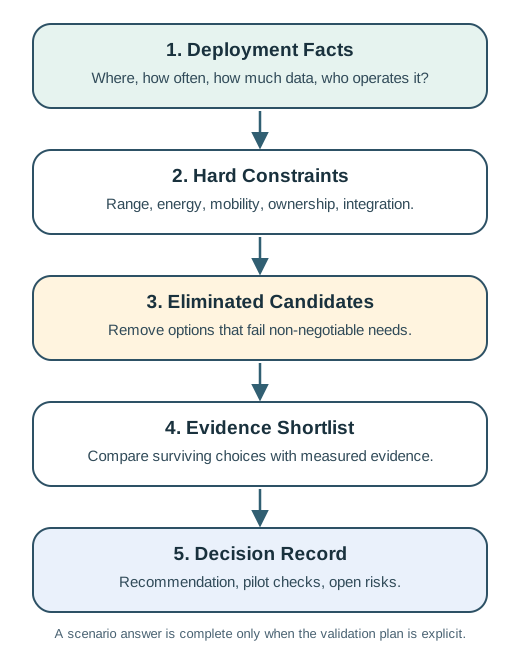
The final box includes pilot checks and open risks, so the recommendation comes with a validation plan.
- It turns deployment facts into hard constraints, eliminates options that fail them, compares the survivors with lifecycle and operations evidence, and records what must be validated before installation.
- A good answer explains the eliminations and the validation plan, not just the winner.
- A scenario answer that names a protocol without explaining the eliminations is incomplete.
Major section
Scenarios Test Reasoning, Not Protocol Names (continued)
For a wearable or body-to-phone sensor, the first question is usually whether BLE can satisfy alert timing, reconnect behavior, buffering, and phone operating-system limits without draining the tiny battery.
- For a building retrofit, Thread, Zigbee, BLE mesh, Wi-Fi, and wired gateway backhaul are not ranked in the abstract; they are tested against wall materials, channel congestion, approved IT boundaries, router density, and maintenance access.
- The One-Minute ViewFacts to constraints Extract the deployment facts, then mark which requirements are non-negotiable rather than merely desirable.
- If you grasp the loop, you can stop here.
Major section
Apply It: Four Scenario Families
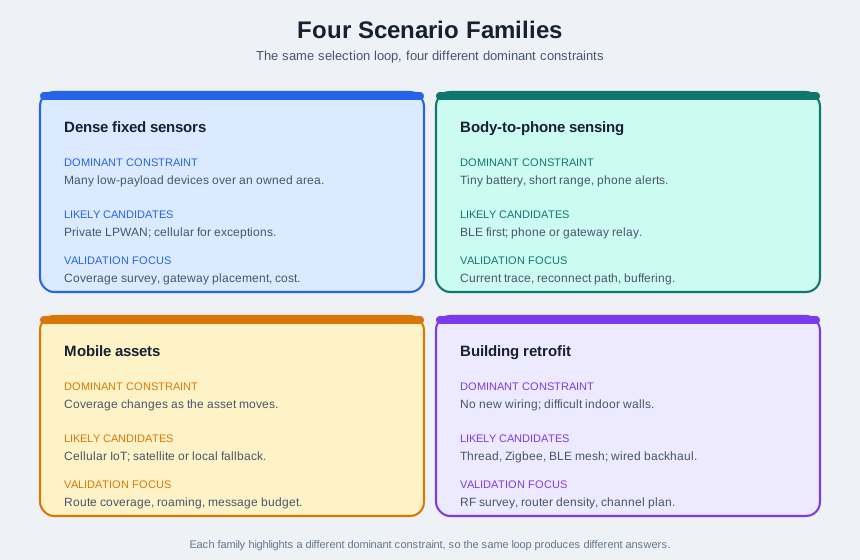
Below, mobile assets require route checks, while building retrofit depends on indoor radio conditions.
- Each panel pairs likely candidates with validation work, showing why one preferred protocol cannot settle every case.
- Coverage changes as the asset moves between outdoor, indoor, and remote zones.
- The payload is tiny, so bandwidth is not the constraint.
Major section
Apply It: Four Scenario Families (continued)
Mobile assetsThe dominant constraint is coverage transition.
- Each device sends a small status message when a space changes state and may spend years in the field; some spaces are near concrete structures.
- The real questions are coverage, maintenance interval, ownership, and field operations.
- For health-related products, protocol choice is only one engineering input.
Major section
Apply It: Four Scenario Families (continued)
Private LPWAN is strong when the owner can place gateways, tune coverage, and absorb gateway operations; infrastructure cost does not grow one-for-one with device count.
- Cellular IoT is strong when local gateway ownership is impractical or difficult zones need carrier-supported penetration, but recurring service and SIM operations must be in the record.
- Wi-Fi or short-range mesh is usually weak for battery street sensors unless power and access-point density already exist.
- Wi-Fi is usually eliminated by energy and antenna limits, and wide-area radios are mismatched to a direct body-to-phone link.
Major section
Apply It: Four Scenario Families (continued)
A defensible recommendation starts with an owned LPWAN design for surface sensors, marks enclosed or underground spaces as exception zones, and uses cellular IoT or a local gateway only where coverage tests prove the exception.
- The record should not claim a universal lowest-cost winner; it should show gateway quotes, installation constraints, service fees, maintenance assumptions, and the coverage results that justify any split.
- The recommendation is "BLE fits the link, then prove the alert and reconnect behavior.".
- The record needs a route-coverage matrix and a radio-selection state machine.
Major section
Apply It: Four Scenario Families (continued)
The Other Three, in BriefBody-to-phone sensor BLE is the primary candidate because it is phone-native and low-energy.
- Building retrofitThe problem is indoor path diversity and ownership, not raw range.
- Regulatory, clinical, privacy, cybersecurity, and human-factors requirements need separate expert review before any real product decision.
- If you can run a scenario to a recommendation, you can stop here.
Major section
Under the Hood: Decision Records and Edge Cases
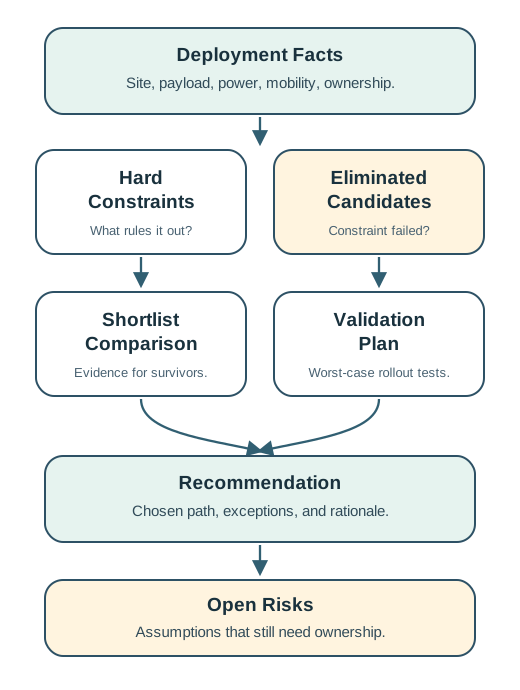
The output of a scenario review should be a record another engineer can audit.
- It should show what was assumed, what was measured, what was eliminated, and what remains uncertain.
- Hard constraints then explain why a candidate is ruled out; the eliminated-candidate field records the failed constraint.
Major section
Under the Hood: Decision Records and Edge Cases (continued)
The recommendation records the chosen path and its exceptions, while the validation plan names rollout tests.
- This order lets another engineer trace the result back to facts and measurements instead of accepting a protocol ranking on trust.
- "It should probably work" or "the vendor says it is long range.".
- Lifecycle cost categories, operations plan, risk notes, pilot results.
- A lab demo in conditions that do not match the deployment.
Major section
Under the Hood: Decision Records and Edge Cases (continued)
Lifecycle cost is useful only with local assumptions and context, never as a universal protocol ranking.
- If the answer changes when device count, service term, gateway count, or replacement interval changes, the record should say so.
- When the Recommendation ChangesScenario reasoning should make clear what would flip the answer.
- If most parking sensors move into deep garages, carrier-supported cellular or local gateways may outrank an outdoor LPWAN design.
Major section
Under the Hood: Decision Records and Edge Cases (continued)
If a wearable must report without a nearby phone, the architecture may need a gateway, a cellular path, or store-and-forward.
- If logistics assets never leave controlled yards, local wireless and periodic dock uploads may replace wide-area connectivity.
- Common PitfallsTreating a scenario winner as a universal winner: A choice that suits parking does not suit a body sensor, a warehouse tag, or a concrete-heavy building.
- Confusing pilot success with operational readiness: A prototype that sends data once is not a deployment plan; production needs provisioning, keys, updates, monitoring, and replacement.
Deck summary
Key takeaways
A building control must work through walls.
- A defensible recommendation starts with an owned LPWAN design for surface sensors, marks enclosed or underground spaces as exception zones, and uses cellular IoT or a local gateway only where coverage tests prove the exception.
- The record should not claim a universal lowest-cost winner; it should show gateway quotes, installation constraints, service fees, maintenance assumptions, and the coverage results that justify any split.
Retrieval practice
Recall check 1 of 3

Physics Phoebe says: answer from memory, then check your reasoning.
Q1What makes a scenario answer strong rather than just a protocol name?
Show answer
Answer: C Scenarios test the reasoning: eliminations, evidence, and a validation plan, not a memorized winner.
Retrieval practice
Recall check 2 of 3
Physics Phoebe says: answer from memory, then check your reasoning.
Q2In the dense parking scenario, which evidence should decide between an owned LPWAN design and cellular IoT for difficult locations?
Show answer
Answer: B The hard question is whether practical gateway placement reaches the real sensor locations, and whether gateway operations or recurring service costs win over the deployment life.
Retrieval practice
Recall check 3 of 3
Physics Phoebe says: answer from memory, then check your reasoning.
Q3A logistics tracker moves through roads with cellular coverage, controlled yards with Wi-Fi, and remote segments with no terrestrial network. What is the most appropriate architecture?
Show answer
Answer: D Coverage transition is the dominant constraint, so the device needs cellular, a remote fallback, and local wireless, chosen by a documented selection rule.
Print reference
Answers
Answer key.
- C · Scenarios test the reasoning: eliminations, evidence, and a validation plan, not a memorized winner.
- B · The hard question is whether practical gateway placement reaches the real sensor locations, and whether gateway operations or recurring service costs win over the deployment life.
- D · Coverage transition is the dominant constraint, so the device needs cellular, a remote fallback, and local wireless, chosen by a documented selection rule.