IoT Fundamentals · Study deck

Protocol Anti-Patterns

Picture a team choosing a radio for a coin-cell tracker.

Physics Phoebe is your guide for this deck.

protocolframeworkantipatterns
Physics Phoebe, the module guide, in a scene from this chapter.
iotclass.org

After studying this chapter

Learning objectives

You will be able to:

  • Explain: Reversibility and Lock-In Some choices are easy to change, such as a software protocol parameter, while others are hard, such as a radio chip, a certified module, or a provider contract.
  • Explain: In protocol selection, almost every anti-pattern shares one root: the protocol was chosen from familiarity, marketing, or a single impressive number, instead of from the deployment's actual requirements.
  • Explain: The battery model includes reserve, the payload test reports delivered event timing rather than headline rate, the site survey forces a second gateway, and recovery tests force an owned runbook.
iotclass.org

Major section

In 60 Seconds

None of those facts yet proves that the tracker will report from a metal store room for three years.

  • A coverage map or peak figure is only a lead for the test.
  • Familiarity can cut learning time, but it cannot erase a mismatch.
  • This opening does not name one best choice for every site.
iotclass.org

Major section

When a Reasonable-Sounding Choice Is the Wrong One
An anti-pattern is a choice that feels reasonable and is common, yet predictably leads to rework.

  • In protocol selection, almost every anti-pattern shares one root: the protocol was chosen from familiarity, marketing, or a single impressive number, instead of from the deployment's actual requirements.
  • Anti-Pattern Root Cause Knowledge Check.

Key terms

anti-pattern
anti-pattern is a choice that feels reasonable and is common, yet predictably leads to rework.

Why it matters

A new protocol is adopted because it is exciting, but few tools or vendors support it yet.

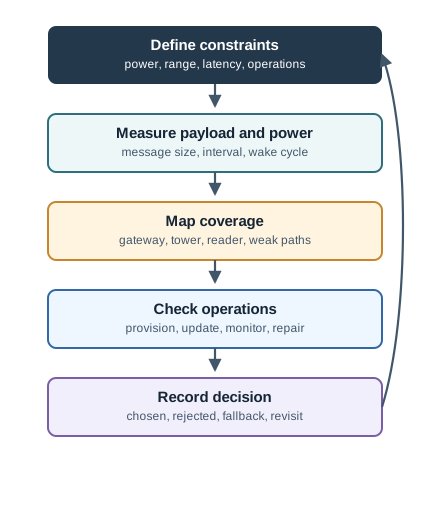
A 120-bay parking pilot turns a one-gateway range claim into measured release conditions, an exchange trace, a battery budget, competing coverage architectures, recovery tests, and a reversible decision.
iotclass.org

Major section

When a Reasonable-Sounding Choice Is the Wrong One (continued)

The mistake is letting one true claim replace the full requirement match.

  • A protocol is not "good" or "bad" in the abstract.
  • The anti-pattern is skipping those requirements and reasoning from one attractive attribute.
  • If this gives you the warning signs, you can stop here.
iotclass.org

Major section

When a Reasonable-Sounding Choice Is the Wrong One (continued)

A realistic IoT anti-pattern often starts with a true statement that is used outside its boundary.

  • LoRaWAN can be a strong fit for sparse battery sensors, but that does not make it suitable for dense low-latency control.
  • Wi-Fi can move more data, but that does not make it the default for a coin-cell device.
  • Cellular coverage may exist in the area, but that does not prove signal inside a metal cabinet.
  • The tempting claim is that LoRaWAN's long range makes one gateway enough for 120 sealed sensors on two concrete basement levels.
iotclass.org

Major section

When a Reasonable-Sounding Choice Is the Wrong One (continued)

The Headline Anti-Patterns Use what we know Choosing the team's usual protocol regardless of whether it fits this deployment.

  • Trust the spec number Treating a best-case range or peak data rate as what you will actually get.
  • The closing: Correct with evidence band shows that every shortcut returns to the same full requirement match.
  • Beginner Examples A protocol that worked for a short-range product is reused for a long-range one without checking the range.
  • A high-speed radio is chosen for a job that mostly needs reliable, low-power short messages.
iotclass.org

Major section

Apply It: Catch Each Anti-Pattern With Evidence

The practical job is to recognize each anti-pattern, name the evidence that would expose it, and apply a safer corrective move.

  • The unifying habit is to derive requirements first and replace claims with measurements where it matters.
  • "We already use it.".
  • "The provider says it is covered.".

Key terms

If your job
If your job is to vet a protocol choice, you can stop here.
The parking pilot's evidence ledger records power, payload, coverage, and operations claims with their tests, measured results, decision impacts, and final decision record.
iotclass.org

Major section

Apply It: Catch Each Anti-Pattern With Evidence (continued)

Prefer reversible decisions under uncertainty.: When requirements or ecosystem are unsettled, favor choices that are cheaper to change later.

  • "It is the newest and best.".
  • "It has the lowest power" (or longest range).
  • If your job is to vet a protocol choice, you can stop here.
iotclass.org

Major section

Apply It: Catch Each Anti-Pattern With Evidence (continued)

Incremental Practice Beginner For a long-range, low-data sensor, name the requirement a high-speed protocol would fail to justify itself against.

  • Each row retains the original claim, the named test, its result, and the way that result changes the decision; a green result without those four fields is not evidence.
  • The battery model includes reserve, the payload test reports delivered event timing rather than headline rate, the site survey forces a second gateway, and recovery tests force an owned runbook.
  • Advanced Build a requirements-versus-candidate scoring table and mark which cells need measured evidence rather than datasheet claims.
iotclass.org

Major section

Under the Hood: Why Each Mismatch Bites

Peak Versus Sustained Throughput An advertised data rate is a best-case figure for a single link, at short distance, with low overhead.

  • Best-Case Versus Real Range A rated range assumes line of sight, an ideal antenna, and no obstacles, which is optimistic indoors.
  • Nothing has been built yet.
  • Every deployed device is involved.

Why it matters

The deeper layer explains the mechanism behind each anti-pattern, because knowing why a number misleads is what makes the corrective move convincing.

iotclass.org

Major section

Under the Hood: Why Each Mismatch Bites (continued)

Real range depends on path loss, obstacles, fading, and interference, so it must be measured on site rather than read from a datasheet.

  • Coverage Map Versus On-Site Reality Wide-area coverage maps are modeled or aggregated and cannot capture a specific basement, a metal enclosure, or a rural edge.
  • Coverage is location-specific, and only an on-site test settles whether a given install point has a usable signal.
  • Spec Maturity Versus Interoperability A young protocol may have an unstable specification, few interoperable implementations, thin tooling, and uncertain long-term support.
iotclass.org

Major section

Under the Hood: Why Each Mismatch Bites (continued)

Reversibility and Lock-In Some choices are easy to change, such as a software protocol parameter, while others are hard, such as a radio chip, a certified module, or a provider contract.

  • Treating one impressive number as the decision.: Range, throughput, and power must all be satisfied together.
  • Accepting claims where measurements are cheap.: Field range, goodput, and on-site coverage are testable.
  • Underweighting ecosystem maturity.: Tooling, interoperability, and longevity are requirements, not afterthoughts.
iotclass.org

Major section

Summary

A protocol anti-pattern is a common, reasonable-sounding choice that predictably leads to rework, usually rooted in deciding from familiarity, marketing, or one spec number.

  • A protocol is a fit or a mismatch for a specific requirement set, not good or bad in the abstract.
  • The headline anti-patterns are familiarity-driven choice, range overconfidence, peak-throughput assumption, coverage-map overconfidence, and immature-ecosystem risk.
  • The cure is to derive the full requirement set first, then score candidates against all of it with real evidence.
  • Field range tests, measured sustained goodput, and on-site coverage tests replace optimistic claims where it matters most.
iotclass.org

Deck summary

Key takeaways

None of those facts yet proves that the tracker will report from a metal store room for three years.

  • An anti-pattern is a choice that feels reasonable and is common, yet predictably leads to rework.
  • The mistake is letting one true claim replace the full requirement match.
  • A realistic IoT anti-pattern often starts with a true statement that is used outside its boundary.
  • The Headline Anti-Patterns Use what we know Choosing the team's usual protocol regardless of whether it fits this deployment.
iotclass.org

Retrieval practice

Recall check 1 of 3

Physics Phoebe says: answer from memory, then check your reasoning.

Q1What is the common root cause behind most protocol-selection anti-patterns?

AGathering range, power, latency, node-count, and ecosystem constraints before comparing protocols
BPiloting candidate links in the actual site before choosing the production radio or provider
CStarting from familiarity, marketing claims, or one spec number before listing requirements
DRecording rejected candidates with the measured reason each one failed a deployment constraint
Show answer

Answer: C Most anti-patterns trace back to deciding before the full requirement set is established.

iotclass.org

Retrieval practice

Recall check 2 of 3

Physics Phoebe says: answer from memory, then check your reasoning.

Q2A team plans capacity from a wide-area provider's coverage map, but devices will be installed in basements and at the rural edge of the area. Which evidence most directly tests the plan?

AAn on-site signal test at the actual install points.
BThe provider's marketing brochure
CThe protocol's peak data-rate figure
DThe team's past experience in a different city
Show answer

Answer: A Coverage is location-specific, so the real install sites are what must be measured.

iotclass.org

Retrieval practice

Recall check 3 of 3

Physics Phoebe says: answer from memory, then check your reasoning.

Q3A protocol's advertised peak data rate is much higher than the throughput a deployment actually achieves. Which set of factors best explains the gap?

AOnly the color of the enclosure and the dashboard theme
BProtocol overhead and acknowledgements, retransmissions.
CThe peak figure is a typo repeated in every datasheet
DNothing; the advertised peak equals delivered throughput
Show answer

Answer: B The peak is a best-case figure; each of these real-world factors reduces usable goodput.

iotclass.org

Print reference

Answers

Answer key.

  1. C · Most anti-patterns trace back to deciding before the full requirement set is established.
  2. A · Coverage is location-specific, so the real install sites are what must be measured.
  3. B · The peak is a best-case figure; each of these real-world factors reduces usable goodput.
iotclass.org