Design Methodology · Study deck

IoT Project Planning: Brief and Viability

A project brief links a user problem to the work the team can fund.

Blueprint Bina is your guide for this deck.

thinkingprojectplanning
Blueprint Bina, the module guide, in a scene from this chapter.
iotclass.org

After studying this chapter

Learning objectives

You will be able to:

  • Explain: The device communicates with pedestrian crossing lights so a user knows when it is safe to cross, and it can give step-by-step directions and bus route and pickup times through the paired phone.
  • Explain: Together they explain why An evidence board keeps the project brief, research notes, unresolved risks, and next checks in one readable structure matters to: Brief Fields.
  • Explain: French startup Handisco built a Bluetooth-connected, GPS-enabled cane attachment called Sherpa so blind and vision-impaired pedestrians could navigate their communities more independently.
  • Explain: Collected data is necessary for the stated outcome.
iotclass.org

Major section

Build the Project Brief
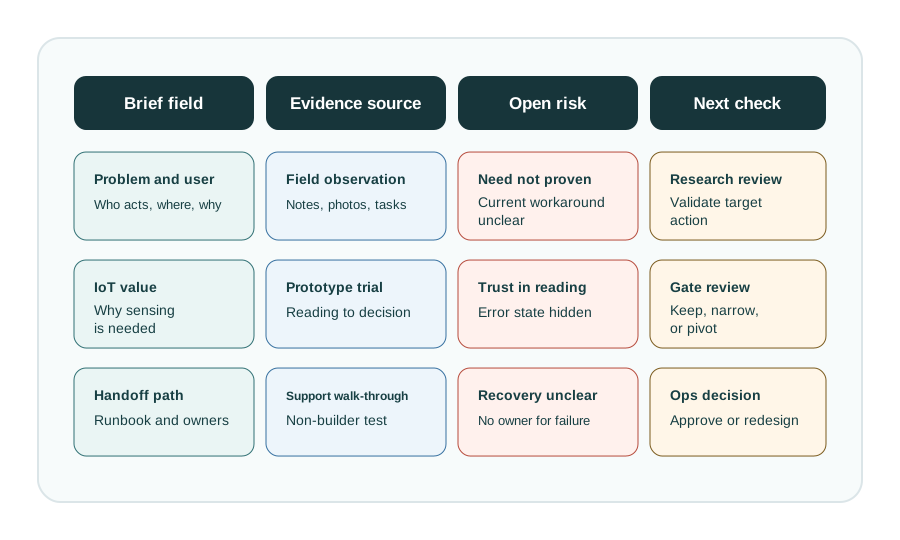
The project brief is the planning anchor.

  • User group, context, pain, current workaround, and desired change.
  • The statement would still make sense if the proposed technology were removed.
  • Primary users, secondary users, maintainers, installers, support staff, and data owners.
  • Each user group has a need, constraint, or decision that affects the plan.

Why it matters

The boundary prevents accidental expansion when new ideas appear.

An evidence board keeps the project brief, research notes, unresolved risks, and next checks in one readable structure.
iotclass.org

Major section

Build the Project Brief (continued)

Together they explain why An evidence board keeps the project brief, research notes, unresolved risks, and next checks in one readable structure matters to: Brief Fields.

  • The measure is tied to user value, not only device activity.
  • Unknowns about desirability, feasibility, data quality, deployment, security, privacy, and support.
  • Each gap has an owner and an evidence check.
iotclass.org

Major section

Check Commercial Viability with a Business Model Canvas

The project brief proves a release is technically and operationally ready to build.

  • Design Thinking Introduction names desirability, feasibility, and viability as three lenses a connected product has to satisfy together.
  • Viability -- can the organization sustain this as a business, not just as a working pilot -- has not had its own tool yet.
  • A business model canvas is that tool: a one-page way to make the commercial case reviewable alongside the brief.
iotclass.org

Major section

Worked Example: A Cane Attachment for Independent Navigation

French startup Handisco built a Bluetooth-connected, GPS-enabled cane attachment called Sherpa so blind and vision-impaired pedestrians could navigate their communities more independently.

  • The device communicates with pedestrian crossing lights so a user knows when it is safe to cross, and it can give step-by-step directions and bus route and pickup times through the paired phone.
  • That gap is not a flaw in the canvas; it is exactly what the assumption map in this chapter's project brief exists to catch.
  • A canvas block with no evidence behind it is still an assumption, not a fact.
iotclass.org

Major section

Align Stakeholders, Hold Scope

IoT projects cross physical devices, software services, data governance, field operations, and support.

  • Stakeholder alignment is therefore more than approval.
  • Whether the workflow is useful and understandable.
  • Whether the device can be installed, supported, and recovered.
  • Whether data is collected, retained, shared, and deleted appropriately.
iotclass.org

Major section

Map Assumptions Before Scheduling Work

This prevents optimistic plans that hide the hardest questions.

  • Users will respond to an alert while still able to act.
  • The sensor can produce usable data in the deployment environment.
  • Collected data is necessary for the stated outcome.
  • Collect, reduce, aggregate, or remove data field.
iotclass.org

Major section

Turn Scope Into Work Packages

Once the brief and assumption map are clear, split the project into work packages.

  • A work package is not just a task.
  • Problem frame and evidence gaps are agreed by user and sponsor representatives.
  • Prototype shows the required behavior under realistic constraints.
  • Users can complete the target action without extra explanation.
iotclass.org

Major section

Risk Register and Release Gates

The risk register connects uncertainty to action.

  • Each risk needs a trigger, mitigation, owner, and gate.
  • Without a gate, the register becomes a list that people read but do not use.
  • User action is unclear.
  • Users cannot say what they would do with the alert.
iotclass.org

Deck summary

Key takeaways

The project brief is the planning anchor.

  • Together they explain why An evidence board keeps the project brief, research notes, unresolved risks, and next checks in one readable structure matters to: Brief Fields.
  • The project brief proves a release is technically and operationally ready to build.
  • French startup Handisco built a Bluetooth-connected, GPS-enabled cane attachment called Sherpa so blind and vision-impaired pedestrians could navigate their communities more independently.
  • IoT projects cross physical devices, software services, data governance, field operations, and support.
iotclass.org

Retrieval practice

Recall check 1 of 4

Blueprint Bina says: answer from memory, then check your reasoning.

Q1A team has a list of device features, but no user action, no evidence gaps, and no out-of-scope list. What is the best planning response?

AStart implementation because the features are already listed.
BTurn the list into a project brief before implementation planning.
CAdd more features so stakeholders have more options.
DSkip stakeholder review until the first device is built.
Show answer

Answer: B A ready planning brief connects problem, user action, evidence gaps, scope boundary, ownership, and gates.

iotclass.org

Retrieval practice

Recall check 2 of 4

Blueprint Bina says: answer from memory, then check your reasoning.

Q2During a gate review, the team learns that users do not trust the sensor reading enough to act. What should the plan do next?

AContinue rollout because the sensor data is being collected.
BPause expansion and test placement, calibration, and confidence messaging.
CRemove the decision log to avoid slowing the team down.
DMove the risk to a later phase without assigning an owner.
Show answer

Answer: B Evidence gates exist so the team can continue, narrow, pivot, or stop.

iotclass.org

Retrieval practice

Recall check 3 of 4

Blueprint Bina says: answer from memory, then check your reasoning.

Q3Place each planning record where it lives so you can align the team, bound uncertainty, and govern changes with named evidence.

AProject brief
BMarketing banner
CDevice packaging
DRelease celebration
Show answer

Answer: A The three regions separate shared intent, explicit boundaries, and change governance so you can keep a project plan reviewable as evidence and risks evolve.

iotclass.org

Retrieval practice

Recall check 4 of 4

Blueprint Bina says: answer from memory, then check your reasoning.

Q4Complete the Python function so it returns True only when a planning brief has required fields, visible assumptions, risks, and owners for risk follow-up.

Amissing = [field for field in REQUIRED_FIELDS if not record.get(field)]
Bmissing = []
Cmissing = list(record.keys())
Dmissing = [field for field in record if field not in REQUIRED_FIELDS]
Show answer

Answer: A The readiness check requires core brief fields, assumptions, risks, and owner plus next-check metadata for each risk.

iotclass.org

Print reference

Answers

Answer key.

  1. B · A ready planning brief connects problem, user action, evidence gaps, scope boundary, ownership, and gates.
  2. B · Evidence gates exist so the team can continue, narrow, pivot, or stop.
  3. A · The three regions separate shared intent, explicit boundaries, and change governance so you can keep a project plan reviewable as evidence and risks evolve.
  4. A · The readiness check requires core brief fields, assumptions, risks, and owner plus next-check metadata for each risk.
iotclass.org