Integration & Gateways · Study deck
Industrial Ethernet Family Design
A protocol is a shared set of rules for sending data.
Gateway Gus is your guide for this deck.

After studying this chapter
Learning objectives
You will be able to:
- compare PROFINET, EtherCAT, EtherNet/IP with CIP, and TSN as a control-evidence choice, not a speed choice
- run the selection workflow and build a release record ledger for an industrial Ethernet family
- record the role, processing, and boundary evidence specific to each protocol family
- identify the motion or control consequence that a protocol choice cannot miss
Major section
Start With the Motion You Cannot Miss
A protocol is a shared set of rules for sending data.
- A gateway is a device or service that passes data between unlike systems.: Firmware means software stored on a device.
- Its control message has a hard time limit.
- A dashboard update does not.
- A real line may have more timing groups and safety rules.
Major section
Start With the Motion You Cannot Miss (continued)
The later levels show exact cycle, sync, topology, and gateway records.
- Both may share Ethernet, but a fast link alone does not prove that the belt will stop on time.
- Industrial Ethernet is a family of ways to use Ethernet for machine work.
- A safe stop needs its own design and proof.
Major section
Start With the Motion You Cannot Miss (continued)
PROFINET, EtherCAT, EtherNet/IP, and Time-Sensitive Networking (TSN) make different choices about timing and control.
- This Overview treats each traffic type as either time-critical control or slower support data.
- A fast normal message must not be used as proof of a safe stop.
- Industrial Ethernet choices should start with that control story.
Major section
Overview: Industrial Ethernet Is A Control-Evidence Choice
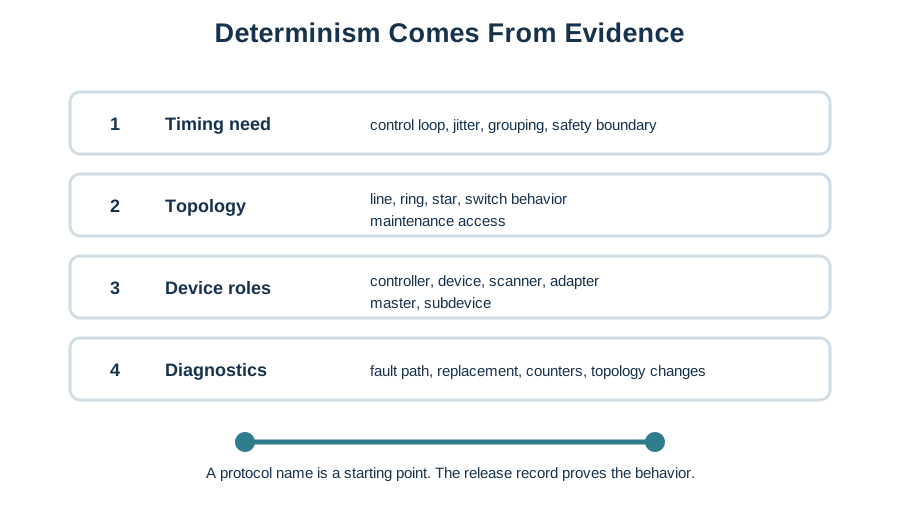
Industrial Ethernet is not a single protocol.
- The review question is not "which protocol is fastest?" The useful question is "which control behavior is proven for this machine, device set, topology, maintenance model, and integration boundary?".
- The protocol decision should not collapse those into one speed number.
Major section
Overview: Industrial Ethernet Is A Control-Evidence Choice (continued)
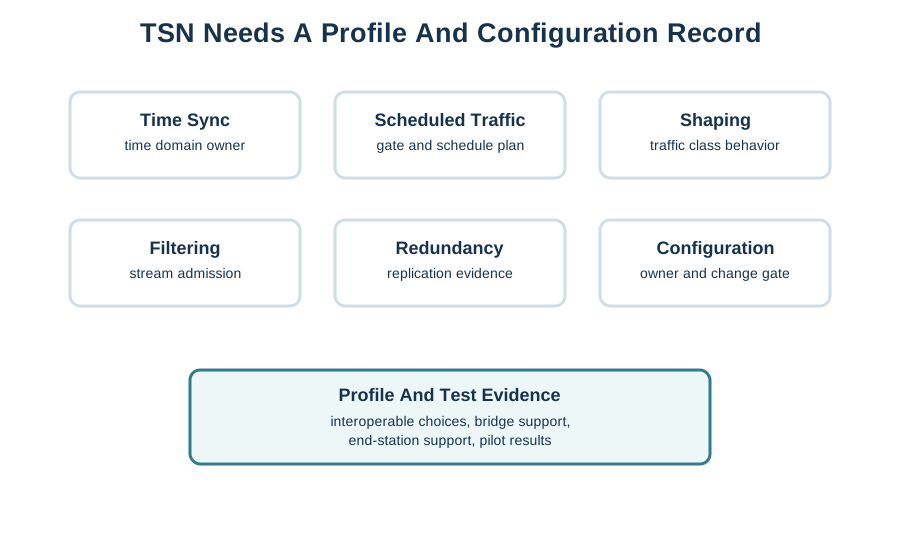
TSN Review the selected IEEE 802.1 tools, profile, schedules, bridges, end stations, configuration owner, and change process.
- For example, a packaging cell might need a 4 ms update for servo handoff, 20 ms status updates for remote IO, and dashboard publishing every second.
- If you only need the intuition, this layer is enough: choose Industrial Ethernet by evidence.
- Together they explain Determinism is a release claim, not a protocol slogan.
Major section
Practitioner: Build The Selection And Release Record
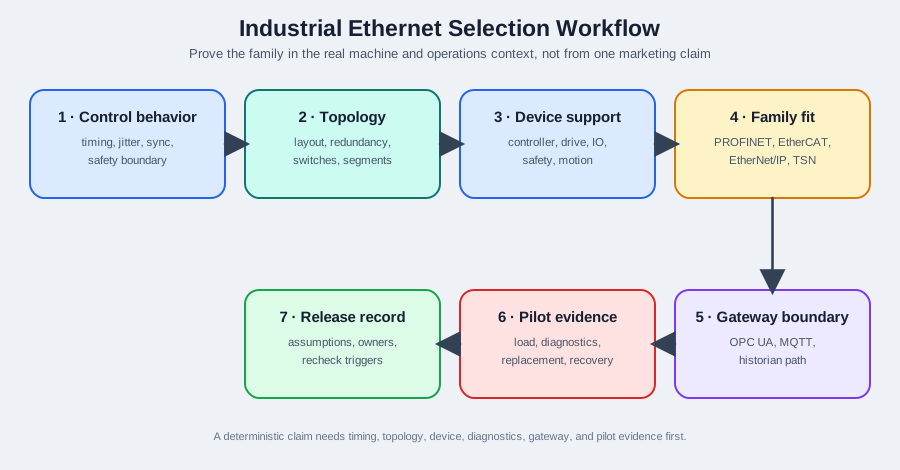
A durable Industrial Ethernet decision separates control-network behavior from supervisory integration.
- The same machine may use an Industrial Ethernet family for cyclic control, OPC UA for information modeling, MQTT for event distribution, and a historian path for long-term review.
- The release record keeps those boundaries explicit.
Major section
Practitioner: Build The Selection And Release Record (continued)
Selection Workflow Define control behavior.: Record timing need, jitter tolerance, update grouping, synchronization, and safety boundary.
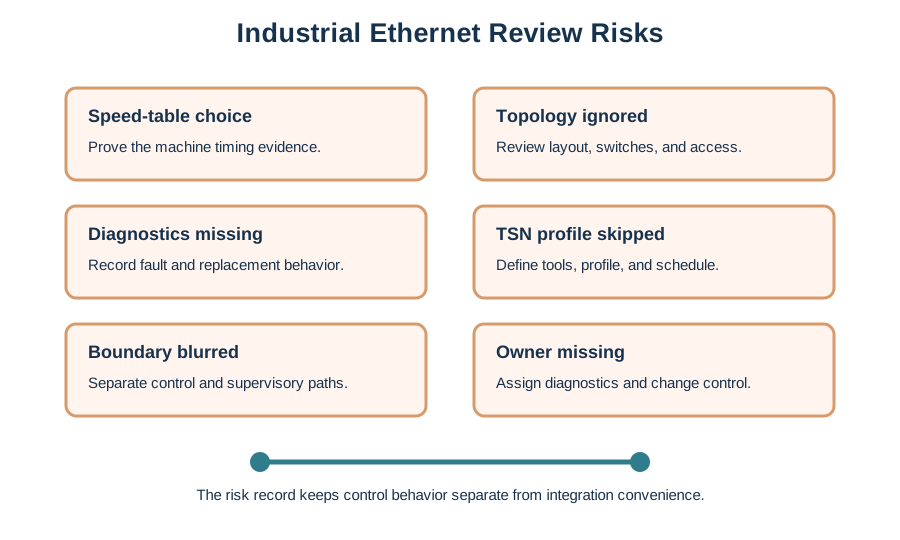
- The team may confuse advertised capability with deployed behavior.
- Replacement, troubleshooting, or expansion can break the control claim.
- Gateway or device ambiguity can hide who owns state and alarms.
Major section
Under The Hood: Family Records And Boundary Evidence
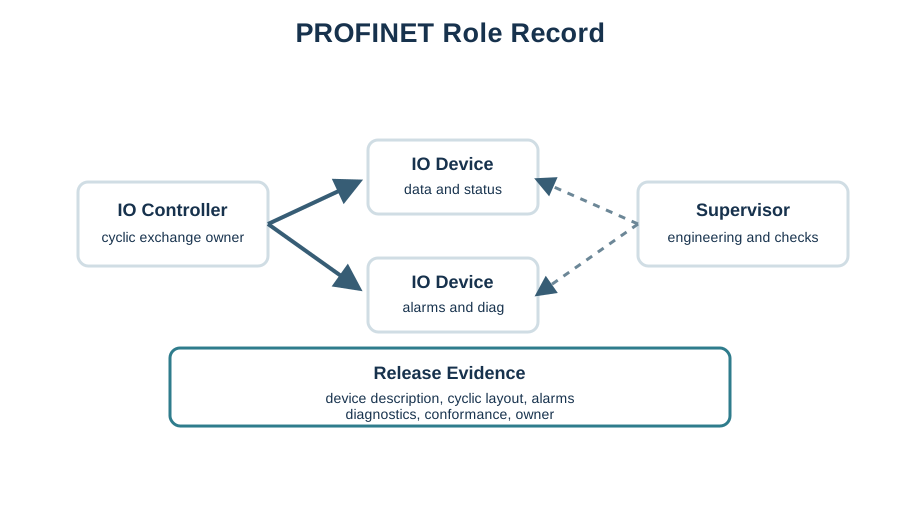
Industrial Ethernet families are reviewed through different internal records.
- A good design does not flatten PROFINET, EtherCAT, EtherNet/IP, and TSN into a single ranking table.
- It records the specific behavior each family must prove in the deployed topology.
- A PROFINET review starts with roles, device description, cyclic data, and alarms.
Major section
Under The Hood: Family Records And Boundary Evidence (continued)
An EtherCAT review starts with the frame path, process image, working counter, and clock behavior.
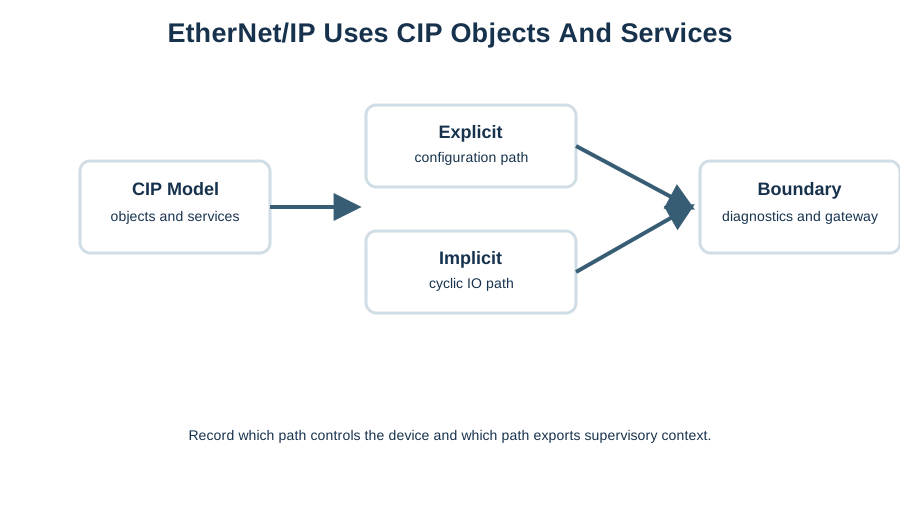
- An EtherNet/IP review starts with CIP objects, assemblies, services, and connection behavior.
- A TSN review starts with selected IEEE 802.1 tools, profiles, schedules, bridge support, and configuration ownership.
- Mixing those records hides the real release risk.
Major section
Under The Hood: Family Records And Boundary Evidence (continued)
The subsequent hand-off from “IO Device” to “data and status” explains PROFINET review centers on controller-device relationships, device descriptions, cyclic data, alarms, diagnostics, topology, and conformance evidence.
- For PROFINET, document the IO Controller, IO Device, and IO Supervisor roles; module or submodule configuration; cyclic data layout; alarm and diagnostic behavior; topology assumptions; and change procedure for replacement or firmware drift.
- For EtherCAT, document main device and subdevice order, process image ownership, expected working-counter behavior, clock synchronization evidence where required, cable or port diagnostics, and recovery when one segment is unavailable.
- The two comparisons clarify TSN is a toolbox.
Major section
Under The Hood: Family Records And Boundary Evidence (continued)
Its named elements “CIP Model” and “objects” frame the claim that EtherNet/IP brings CIP object, service, and connection concepts onto Ethernet/IP networks; gateway mapping should preserve context and authority.
- Their order turns EtherNet/IP brings CIP object, service, and connection concepts onto Ethernet/IP networks; gateway mapping should preserve context and authority into a reviewable path.
- In the “cip model”–“objects” decision, use the same stops to locate evidence and assign the recheck.
- A release decision about the “time sync”–“time domain owner” decision needs “Scheduled Traffic”, not a slogan.
- The evidence buckets differ because the mechanisms differ.
Deck summary
Key takeaways
A protocol is a shared set of rules for sending data.
- The later levels show exact cycle, sync, topology, and gateway records.
- PROFINET, EtherCAT, EtherNet/IP, and Time-Sensitive Networking (TSN) make different choices about timing and control.
- Industrial Ethernet is not a single protocol.
- TSN Review the selected IEEE 802.1 tools, profile, schedules, bridges, end stations, configuration owner, and change process.
Retrieval practice
Recall check 1 of 3

Gateway Gus says: answer from memory, then check your reasoning.
Q1A team chooses an Industrial Ethernet family because a table says it has the smallest cycle time. What is the strongest correction?
Show answer
Answer: D The protocol family must be proven in the actual machine and operations context.
Retrieval practice
Recall check 2 of 3

Gateway Gus says: answer from memory, then check your reasoning.
Q2A machine builder must coordinate drives and IO with tight update grouping, preserve diagnostic evidence, and expose status to a plant dashboard through a gateway. What is the strongest review conclusion?
Show answer
Answer: C Tight control behavior and plant-dashboard integration are separate concerns.
Retrieval practice
Recall check 3 of 3

Gateway Gus says: answer from memory, then check your reasoning.
Q3Which evidence item best matches a TSN-based Industrial Ethernet release record?
Show answer
Answer: B TSN is a set of tools, so the released profile and configuration evidence matter.
Print reference
Answers
Answer key.
- D · The protocol family must be proven in the actual machine and operations context.
- C · Tight control behavior and plant-dashboard integration are separate concerns.
- B · TSN is a set of tools, so the released profile and configuration evidence matter.