Cloud, SDN & Production Architectures · Study deck
Production Architecture Case Studies
Picture ten leak sensors becoming ten thousand units across many buildings.
Cloud Clara is your guide for this deck.

After studying this chapter
Learning objectives
You will be able to:
- Read production IoT case studies as proof records rather than stories.
- Compare safety timing, fleet scale-up, update lifecycle, identity lifecycle, and incident-learning cases.
- Identify the architecture decision, proof used, fallback behavior, and remaining uncertainty in each case.
- Explain why prototype success does not prove production readiness.
Major section
Start With the Scale-Up Proof
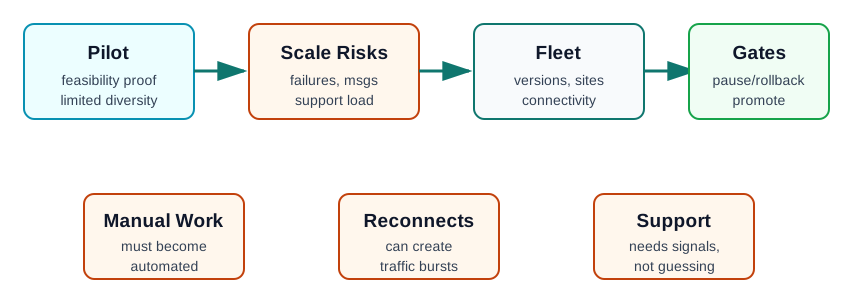
A production case study is not a success story until it survives scale-up.
- The service team now faces missed updates, changed owners, weak links, old records, and faults that arrive together.
- A production case must explain how those changes were controlled.
- The case is useful when the proof shows how the system stayed controllable.
Major section
Case Pattern 1: Safety Timing Proof
Safety-related cases should avoid vague "fast enough" assertions.
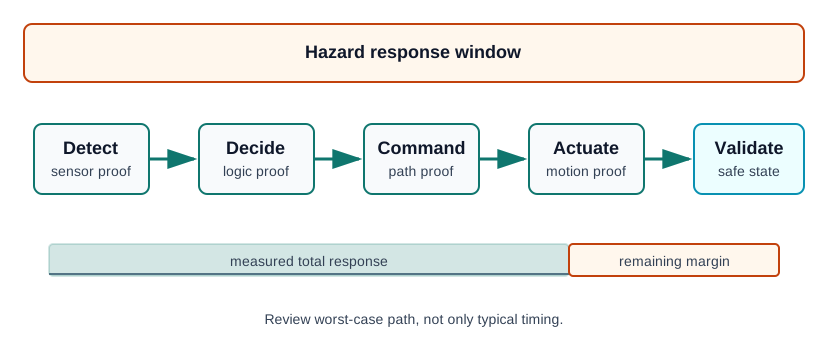
- The case record should list each detection, decision, communication, and actuation step in the response path and compare the total with the allowed response window.
- Detection needs sensor proof, decision needs logic proof, and command delivery needs path proof.
- Actuation then needs evidence that the physical motion occurred, followed by validation of a safe state.
- If the total path exceeds the window, the architecture decision must change even if each component seems fast in isolation.
Major section
Observability and Incident Learning
Production management depends on signals that explain what changed.
- A case study should connect symptoms to proof and corrective action.
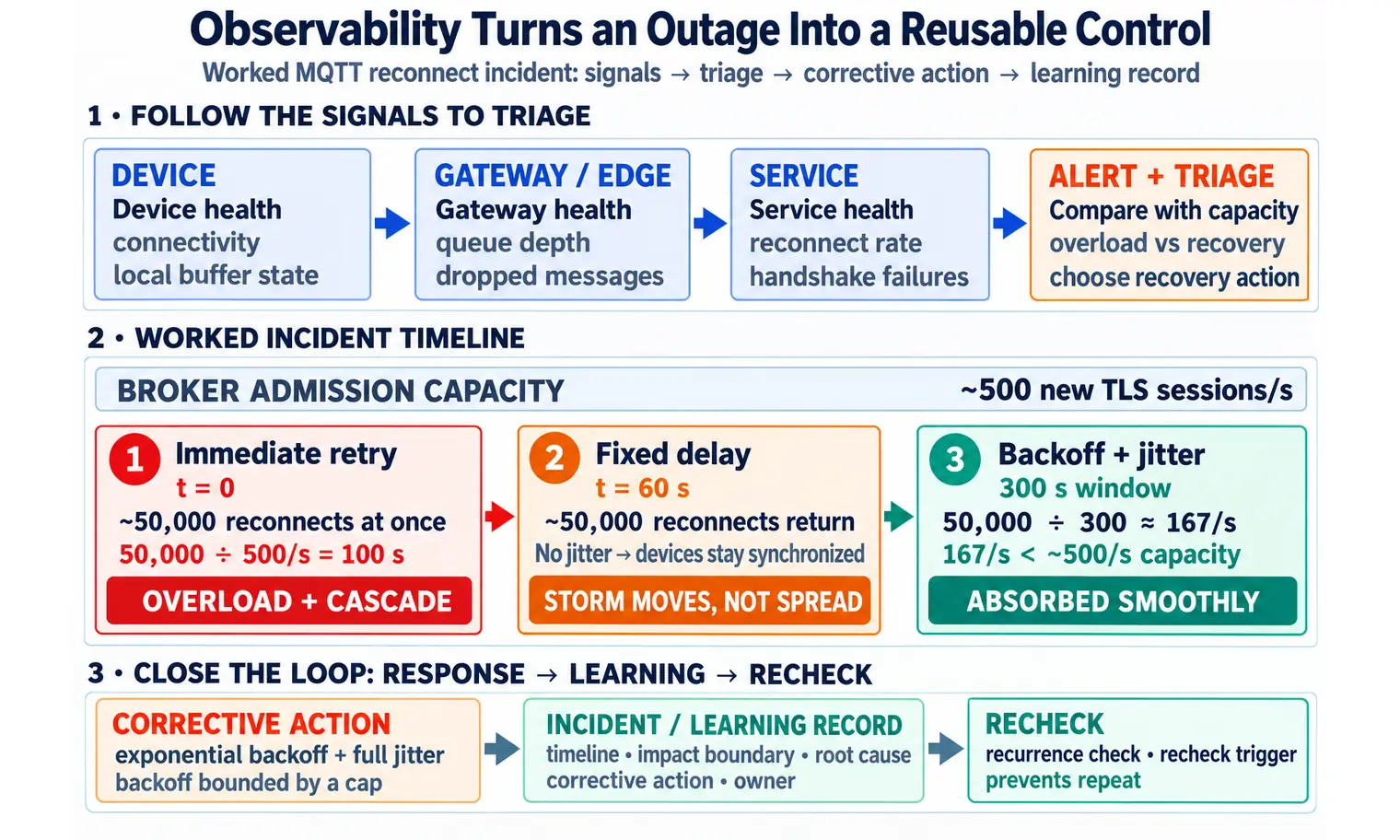
- Device health shows connectivity and local buffer state; gateway metrics show queue depth and drops; service metrics show reconnect rate and TLS handshake failures.
- Triage uses these records to choose a recovery action.
Major section
Production Case Study Record
It makes the case reusable for future architecture decisions.
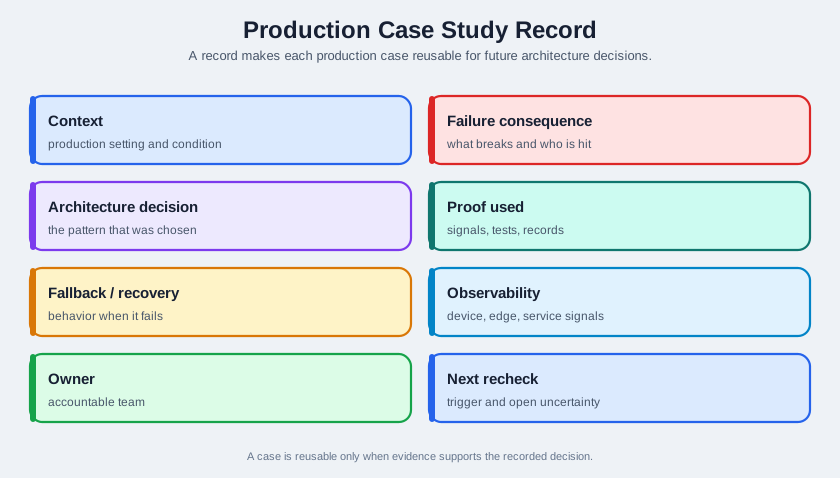
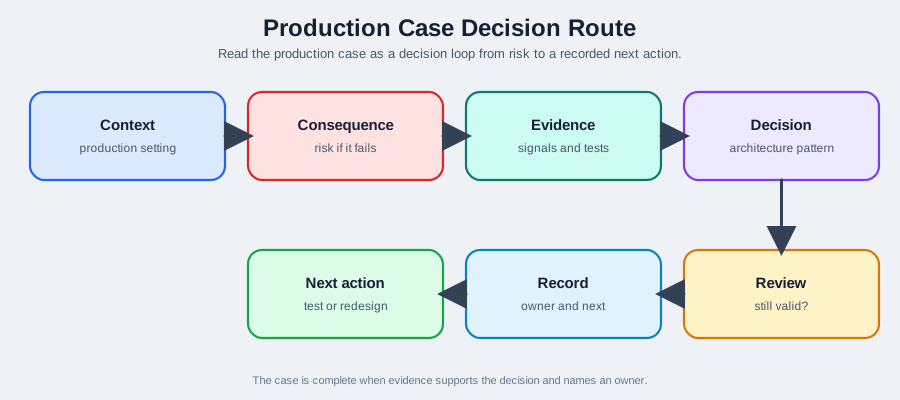
- It makes the decision concrete by showing production case study record, so the relationships can be checked before they are turned into a design claim.
- Context names the setting and operating condition; failure consequence says what breaks and who is affected.
- the Production case study record diagram captures why a production pattern was chosen and when it needs review.
- The architecture decision is then tied to signals, tests, and records rather than an anecdote.
Major section
Common Pitfalls
A case study should preserve proof and decisions, not only a memorable story.
- Costs, contracts, and market conditions change.
- Updates, identity, configuration, and retirement need recovery paths before fleet launch.
- A pilot may not expose fleet diversity, support load, reconnect storms, alert fatigue, or update failure modes.
Major section
Managing a 50k MQTT Fleet
A connected-appliance maker runs 50,000 devices that hold persistent MQTT connections (over TLS) to a broker cluster.
- In production, the hard problems are not the happy path but the fleet's lifecycle at scale: keeping tens of thousands of TLS sessions alive, pushing firmware without bricking devices, and rotating credentials before they expire.
- At this scale, a minor per-device event becomes a fleet-wide incident.
- the Read the production case as a decision loop: context and consequence define the risk, evidence justifies the architecture decision, and the record assigns the next review or action diagram uses measured events to justify a production architecture change.
- The MQTT fleet in the Read the production case as a decision loop: context and consequence define the risk, evidence justifies the architecture decision, and the record assigns the next review or action diagram shows how a small per-device event becomes a capacity decision.
Major section
Managing a 50k MQTT Fleet (continued)
The reusable lesson is not the exact fleet size.
- A restart or network blip brings many clients back together; a fixed retry delay can preserve that burst.
- The worked evidence compares those arrivals with broker admission capacity, then tests backoff and jitter to spread reconnects.
- That record also keeps the case from becoming a vendor anecdote.
Major section
Managing a 50k MQTT Fleet (continued)
The same route includes a separate campus rule-table case, where endpoint policy exceeds switch capacity and aggregated rules need review.
- In both cases, the decision follows event, measured limit, test, and recheck signal.
- Backoff with jitter distributes attempts across a wider window, but the real arrival rate and failure count still need observation against the broker limit.
- A case is reusable only when the evidence supports a recorded decision.
Major section
Managing a 50k MQTT Fleet (continued)
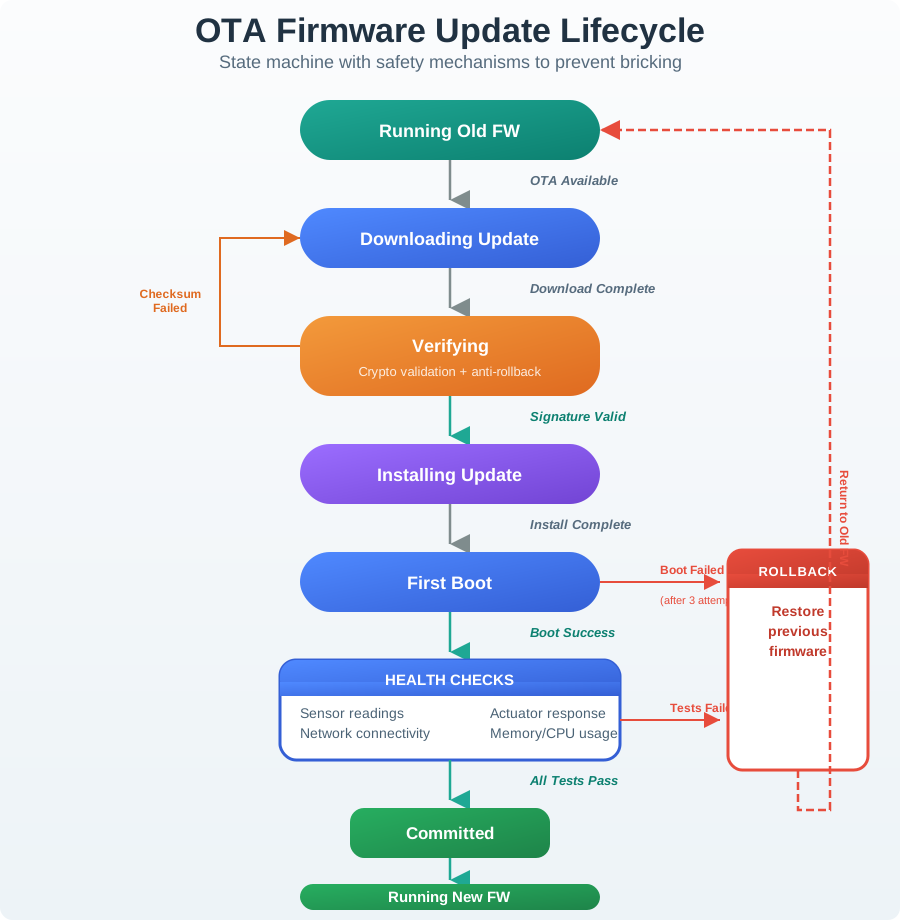
The three mechanisms that define production readiness are reconnection handling (surviving an outage), staged OTA updates (changing firmware safely), and certificate rotation (renewing identity before expiry).
- The case record should therefore preserve the trigger, the multiplied load, the capacity or lifecycle limit, the chosen control, the owner, and the recheck signal.
- Another fleet may use a different broker, update service, certificate authority, or support tool, but it still needs evidence for simultaneous reconnects, staged change, identity renewal, recovery ownership, and what happens when the first mitigation fails.
- If those evidence fields cannot be mapped, the case is inspiration rather than reusable proof.
Major section
Reconnect Storms and Jitter
If all 50,000 immediately reconnect, they hit the broker with a simultaneous wall of TLS handshakes — the most CPU-expensive operation a broker does.
- Say the cluster can absorb ~500 new TLS sessions/second: 50,000 at once is a 100-second overload that starves healthy traffic and often triggers a cascade of further disconnects.
- The fix is exponential backoff with jitter: each device waits a random, growing delay before retrying, spreading the reconnection over time.
- The random jitter is the essential ingredient; it decorrelates the devices so they arrive spread out.
Major section
Reconnect Storms and Jitter (continued)
Worked example: Note the middle row: a fixed delay without jitter is a classic mistake — every device waits the same 60 seconds and then stampedes together, so the storm is merely rescheduled.
- Production clients therefore use backoff bounded by a cap, plus full jitter, so recovery is smooth regardless of fleet size.
- The case record should include the tested retry window, broker admission capacity, reconnect success rate, failure retry cap, and the support action when recovery exceeds the expected window.
- Those signals decide whether to wait, shed optional traffic, widen broker capacity, or pause another rollout.
Major section
Staged OTA and Cert Rotation
Pushing new firmware to all 50,000 at once means a single bad build bricks the entire fleet with no way back; staging bounds the blast radius to the canary.
- Certificate rotation is the quieter killer.
- Devices authenticate with X.509 certificates that expire.
- The OTA and certificate records should be joined.
Major section
Staged OTA and Cert Rotation (continued)
Two lifecycle mechanisms prevent self-inflicted fleet outages.
- If a batch was provisioned with certificates all expiring on the same date, they will all fail authentication and drop off simultaneously — a mass outage with no attacker involved.
- The fix is to renew certificates well before expiry (over the air, during normal check-ins) and to stagger expiry dates so renewals are spread rather than cliff-edged.
- Under the hood, the decision is about bounding blast radius.
Major section
Staged OTA and Cert Rotation (continued)
Worked example: A vendor ships 50,000 devices in one production run, all with two-year certificates dated identically.
- Twenty-three months later the operations team must rotate every certificate before the shared expiry, or the whole fleet disconnects on one day.
- The lesson of the case: at scale, anything that happens to all devices at the same time is the risk.
- A device that cannot update may also be a device that cannot receive a new trust bundle before expiry.
- The case is reusable when those controls are measurable, not when the story merely says the rollout was careful.
Deck summary
Key takeaways
A production case study is not a success story until it survives scale-up.
- Safety-related cases should avoid vague "fast enough" assertions.
- Production management depends on signals that explain what changed.
- It makes the case reusable for future architecture decisions.
- A case study should preserve proof and decisions, not only a memorable story.
Retrieval practice
Recall check 1 of 5

Cloud Clara says: answer from memory, then check your reasoning.
Q1A cold-storage pilot worked with ten devices, and the team wants to reuse the case study for a regional fleet. What should the production case record compare first?
Show answer
Answer: A Production architecture case studies transfer as proof records.
Retrieval practice
Recall check 2 of 5
Cloud Clara says: answer from memory, then check your reasoning.
Q2A pilot works with a small group of devices. The team wants to launch the same architecture across a large fleet. What is the best production case-study decision response?
Show answer
Answer: A A production case study should identify what changes from pilot to fleet: automation, observability, lifecycle controls, failure multiplication, rollout gates, support load, and recovery behavior.
Retrieval practice
Recall check 3 of 5
Cloud Clara says: answer from memory, then check your reasoning.
Q3Why do production fleet problems differ from single-device testing?
Show answer
Answer: A Scale turns small, individually-harmless events into simultaneous, system-level failures.
Retrieval practice
Recall check 4 of 5
Cloud Clara says: answer from memory, then check your reasoning.
Q4After an outage, why is a fixed 60-second reconnect delay (no jitter) still a problem?
Show answer
Answer: A Without random jitter the devices stay synchronised; jitter is what decorrelates them.
Retrieval practice
Recall check 5 of 5
Cloud Clara says: answer from memory, then check your reasoning.
Q5Why can identical X.509 certificate expiry dates across a fleet cause an outage?
Show answer
Answer: A Shared expiry creates a cliff; staggered dates and early over-the-air renewal prevent it.
Print reference
Answers
Answer key.
- A · Production architecture case studies transfer as proof records.
- A · A production case study should identify what changes from pilot to fleet: automation, observability, lifecycle controls, failure multiplication, rollout gates, support load, and recovery behavior.
- A · Scale turns small, individually-harmless events into simultaneous, system-level failures.
- A · Without random jitter the devices stay synchronised; jitter is what decorrelates them.
- A · Shared expiry creates a cliff; staggered dates and early over-the-air renewal prevent it.