Privacy & Compliance · Study deck
Privacy and Compliance Route Map
Imagine a care service that records when a door opens at night.
Privacy Priya is your guide for this deck.

After studying this chapter
Learning objectives
You will be able to:
- Map an IoT data flow from device collection to downstream use.
- Separate data purpose, consent or notice, retention, access, sharing, and deletion questions.
- Recognize privacy risks in mobile sensing, location data, identifiers, telemetry, and inferred behavior.
- Connect safeguards and zero-trust boundaries to privacy outcomes.
Major section
Key Concepts
It may also reveal a person's sleep, movement, and daily life.
- Privacy work begins before the first record is made.
- Include the device, phone, central service, report, support view, outside partner, export, backup, and deletion route.
- For each step, record who can see it, why, how long it stays, and who owns a mistake.
Major section
Key Concepts (continued)
The service should block broad access, mark doubt, keep an audit record, and offer a clear help route.
- A purpose that sounds helpful can still widen the promise.
- Plain language is part of the proof.
- This route map cannot decide every law or edge case.
- Practitioner turns the flow into controls and review questions.
Major section
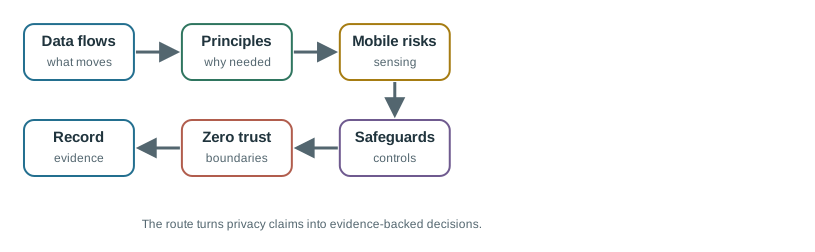
Module Route
Safeguards and zero-trust boundaries protect the justified path, while the review record preserves purpose, evidence, limits, ownership, and reopening conditions.
- The route connects the module's chapter groups to one continuing task: prove that each data use remains necessary, bounded, protected, and reviewable.
Major section
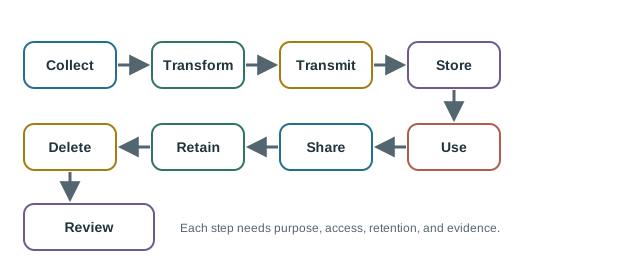
Data Lifecycle
Privacy review starts with data movement.
- A safeguard at one stage cannot stand in for the others.
- The ordered questions below turn each lifecycle transition into evidence a reviewer can request.
Major section
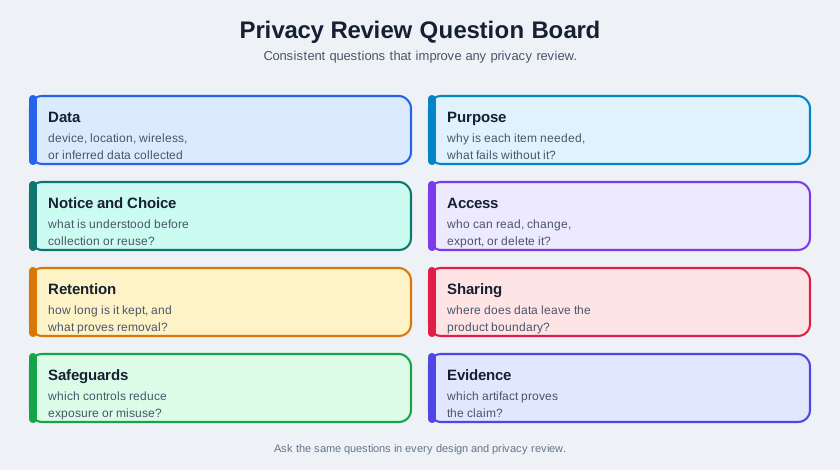
Review Questions
The quickest way to improve a privacy chapter or design review is to ask consistent questions.
- The record fields that follow preserve the answers so later changes can be compared against the original decision.
Major section
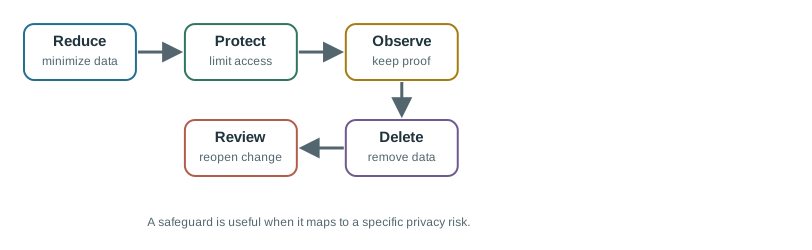
Safeguard Map
Reduction removes unnecessary exposure; protection constrains justified data; observation reveals misuse or drift; deletion ends the approved lifetime.
- This makes safeguards a lifecycle argument rather than a shopping list, and it supplies the control and evidence fields in the review record below.
- Trigger review when collection, purpose, sharing, region, retention, or user population changes.
Major section
Overview: Privacy Is More Than Encryption
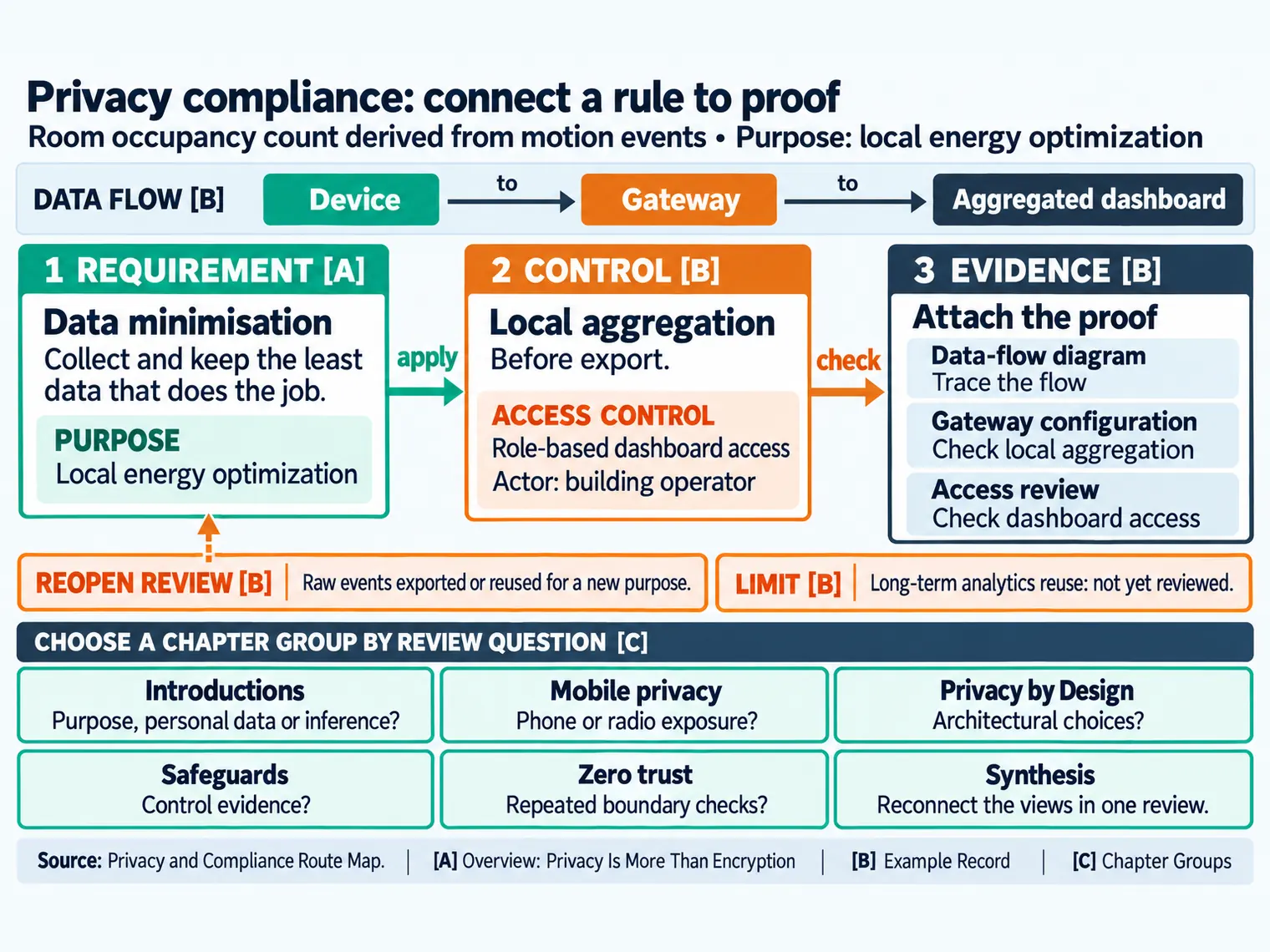
Data minimisation says collect and keep the least data that does the job.
- De-identification says weaken the link between records and the people they describe.
- Regulations like the GDPR encode these as principles, but they are good engineering regardless of jurisdiction.
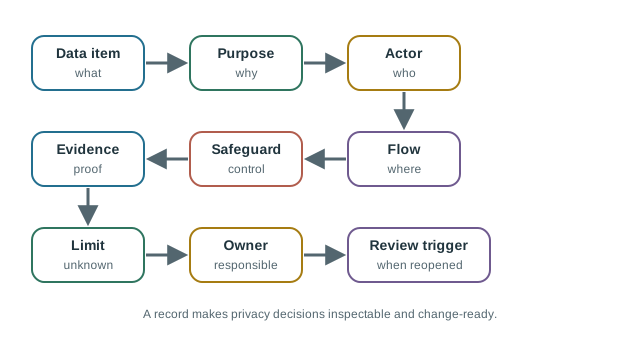
- A useful compliance record is therefore not a legal slogan.
Major section
Overview: Privacy Is More Than Encryption (continued)
If a door sensor only needs hourly occupancy counts for energy control, the record should make raw motion events, permanent identifiers, and unrelated analytics exports look suspicious until someone explains why they are needed.
- That record also has to name the people affected by the system, not only the account owner.
- The final step is not “done”: it records the change that reopens the decision.
- Intuition: the safest data is the data you never collected.
Major section
Practitioner: Pseudonymisation, Anonymisation, and k-Anonymity
Good de-identification is also purpose-specific.
- A fault-diagnosis export may need timestamp order but not exact home address.
- A public benchmark may need region, device class, and month but not full ZIP code or raw event time.
- A retention policy can keep short-lived raw logs for support while publishing only aggregated summaries.
Major section
Practitioner: Pseudonymisation, Anonymisation, and k-Anonymity (continued)
These decisions should be visible in the review: which fields were generalised, which were suppressed, which remain reversible, who holds the mapping, and which downstream use is not allowed without a fresh privacy review.
- Worked example: raising k by generalising A row with { age: 34, ZIP: 90210, sex: F, diagnosis } may be unique -> re-identifiable, k = 1.
- Generalise the quasi-identifiers: age 34 -> age range 30-39 ZIP 90210 -> region 902 Now many rows share { 30-39, 902, F }, so any one record is hidden among, say, 20 others -> k = 20.
- The lesson: removing the name is not anonymisation.
Major section
Under the Hood: Differential Privacy and Its Guarantee
Ad hoc masking keeps failing to re-identification, which is why modern privacy leans on techniques with provable guarantees.
- The published mechanism should behave almost the same in both cases.
- The privacy budget is the operational control.
- A large epsilon gives more accuracy but weaker privacy.
Major section
Under the Hood: Differential Privacy and Its Guarantee (continued)
The promise is not that every answer is exact; the promise is that one person's participation has a bounded effect on what outsiders can learn from the released output.
- A small epsilon gives stronger privacy but adds more noise, so the result may be less useful for fine-grained engineering decisions.
- Repeated releases spend budget, and overlapping queries can leak information through differencing, so production systems need query limits, aggregation thresholds, audit logs, and a documented reason for each release.
- Extensions like l-diversity and t-closeness patch this, but the arms race shows the limits of generalisation alone.
Major section
Under the Hood: Differential Privacy and Its Guarantee (continued)
Differential privacy works best when it is paired with minimisation, retention limits, access control, and a clear decision about which statistics are worth publishing.
- k-anonymity's own weaknesses If all k matching records share the same sensitive value (a homogeneity attack), you learn it anyway.
- Differential privacy Add calibrated random noise so that whether any single individual is in the dataset barely changes any published result.
- It gives a provable guarantee rather than hoping no combination re-identifies someone.
- Even aggregates can leak Releasing many overlapping statistics allows differencing attacks that isolate one person.
Deck summary
Key takeaways
It may also reveal a person's sleep, movement, and daily life.
- The service should block broad access, mark doubt, keep an audit record, and offer a clear help route.
- Safeguards and zero-trust boundaries protect the justified path, while the review record preserves purpose, evidence, limits, ownership, and reopening conditions.
- Privacy review starts with data movement.
- The quickest way to improve a privacy chapter or design review is to ask consistent questions.
Retrieval practice
Recall check 1 of 5

Privacy Priya says: answer from memory, then check your reasoning.
Q1A team asks whether an IoT product is privacy-ready. What is the strongest first review step?
Show answer
Answer: A A privacy review needs a data-flow map before controls or obligations can be evaluated.
Retrieval practice
Recall check 2 of 5

Privacy Priya says: answer from memory, then check your reasoning.
Q2A device originally collected local occupancy counts for energy control. The team now wants to export raw motion events for analytics. What should happen?
Show answer
Answer: A Privacy records should be reopened when data detail, purpose, sharing, access, or retention changes.
Retrieval practice
Recall check 3 of 5

Privacy Priya says: answer from memory, then check your reasoning.
Q3Why is strong encryption alone insufficient to protect privacy?
Show answer
Answer: B Privacy also concerns what authorised viewers can infer about individuals and whether excessive data was collected at all; minimisation and de-identification address those.
Retrieval practice
Recall check 4 of 5

Privacy Priya says: answer from memory, then check your reasoning.
Q4A dataset has names removed but keeps exact birth date, ZIP code, and sex. Why might individuals still be re-identifiable?
Show answer
Answer: C The combination of quasi-identifiers (birth date + ZIP + sex) is unique for a large share of people, so records link back to individuals; generalisation or k-anonymity is needed.
Retrieval practice
Recall check 5 of 5

Privacy Priya says: answer from memory, then check your reasoning.
Q5What guarantee does differential privacy provide that ad hoc data masking does not?
Show answer
Answer: A By adding calibrated noise it provably limits how much one individual's presence or absence can change an output (tuned by epsilon), rather than hoping no attribute combination re-identifies someone.
Print reference
Answers 1 of 2
Answer key.
- A · A privacy review needs a data-flow map before controls or obligations can be evaluated.
- A · Privacy records should be reopened when data detail, purpose, sharing, access, or retention changes.
- B · Privacy also concerns what authorised viewers can infer about individuals and whether excessive data was collected at all; minimisation and de-identification address those.
Print reference
Answers 2 of 2
Answer key.
- C · The combination of quasi-identifiers (birth date + ZIP + sex) is unique for a large share of people, so records link back to individuals; generalisation or k-anonymity is needed.
- A · By adding calibrated noise it provably limits how much one individual's presence or absence can change an output (tuned by epsilon), rather than hoping no attribute combination re-identifies someone.