Control, Gateways & Networked Systems · Study deck
PID Tuning and Applications
Picture a room heater that reaches its target quickly but overshoots into an unsafe temperature.
Gateway Gus is your guide for this deck.

After studying this chapter
Learning objectives
You will be able to:
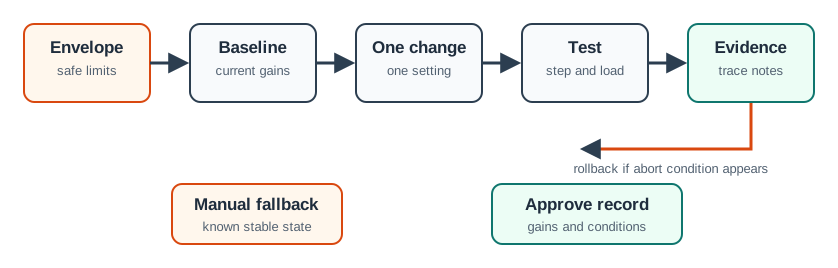
- Plan a PID tuning session with safe limits, test signals, and rollback criteria.
- Use manual tuning and Ziegler-Nichols style tests as starting methods, not final proof.
- Match P, PI, PD, or PID configurations to application dynamics and measurement quality.
- Document tuning records so later changes can be checked without guesswork.
Major section
Start With a Safe Test Change
Faster response is not an improvement when the physical result becomes risky.
- An actuator means a part that turns an electrical command into physical action.
- This runway does not prove that one tuning method suits every process.
- The deeper sections explain each term, safe procedures, saturation, windup, noise, disturbances, and application limits.
Major section
Phoebe's Field Notes: What the Cold-Room Valve's Radio Actually Spends
The mathematical gist.: Under a 20 dBm EIRP ceiling, a 0 dBi antenna may conduct 20 dBm = 100 mW.
- A 6 dBi patch must conduct only $20-6=14$ dBm = 25.1 mW, a 3.98× reduction.
Major section
What Tuning Changes
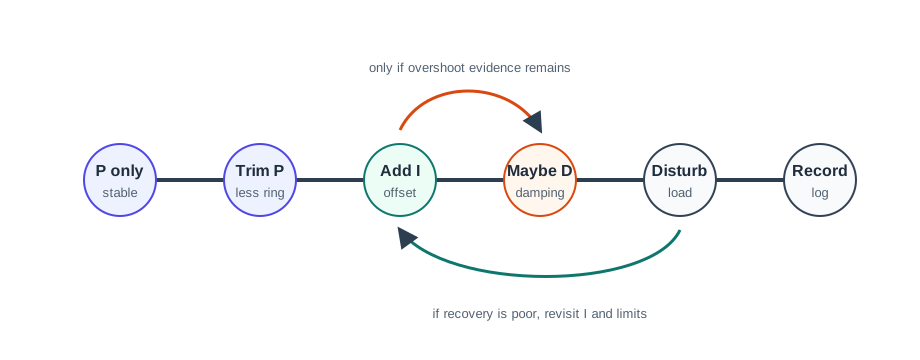
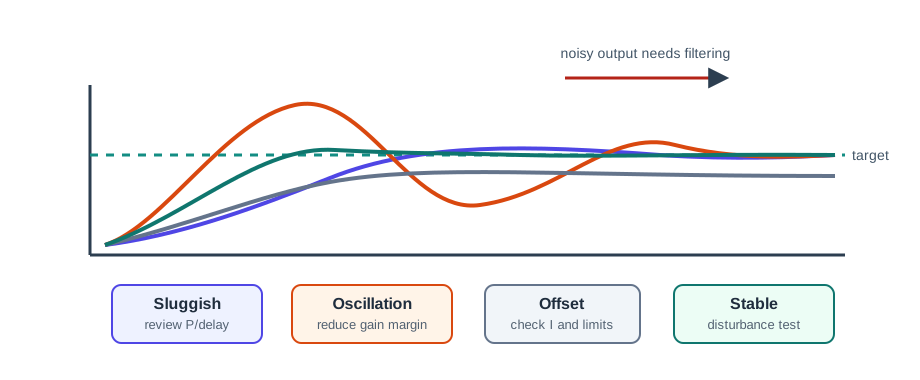
Tuning chooses controller gains and supporting limits so the closed loop behaves well for the real application.
- The gains are only part of the decision; sample period, output clamps, anti-windup, derivative filtering, sensor placement, and fallback behavior must be checked together.
- Too little gives sluggish response or offset.
- Removes persistent offset.
- Adds damping from a rate estimate.
Major section
Tuning Session Safety
Tune only when the loop has clear boundaries.
- If a test can damage equipment, spoil product, or create an unsafe state, do not perform an aggressive oscillation test on the production loop.
Major section
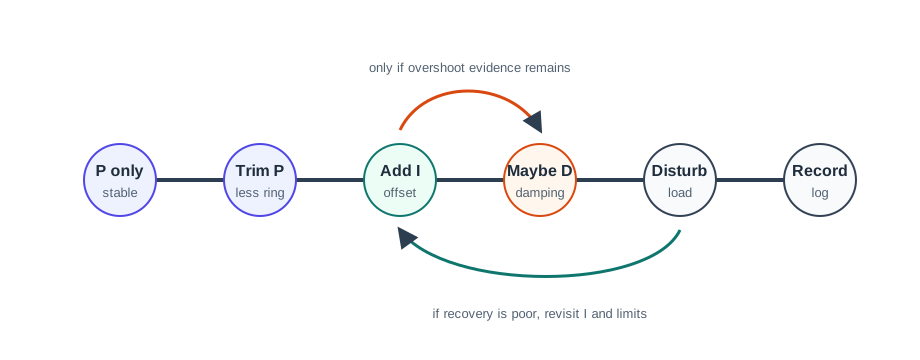
Manual Tuning Route
Manual tuning is useful when the process can be tested safely and when the team needs to understand how the loop reacts.
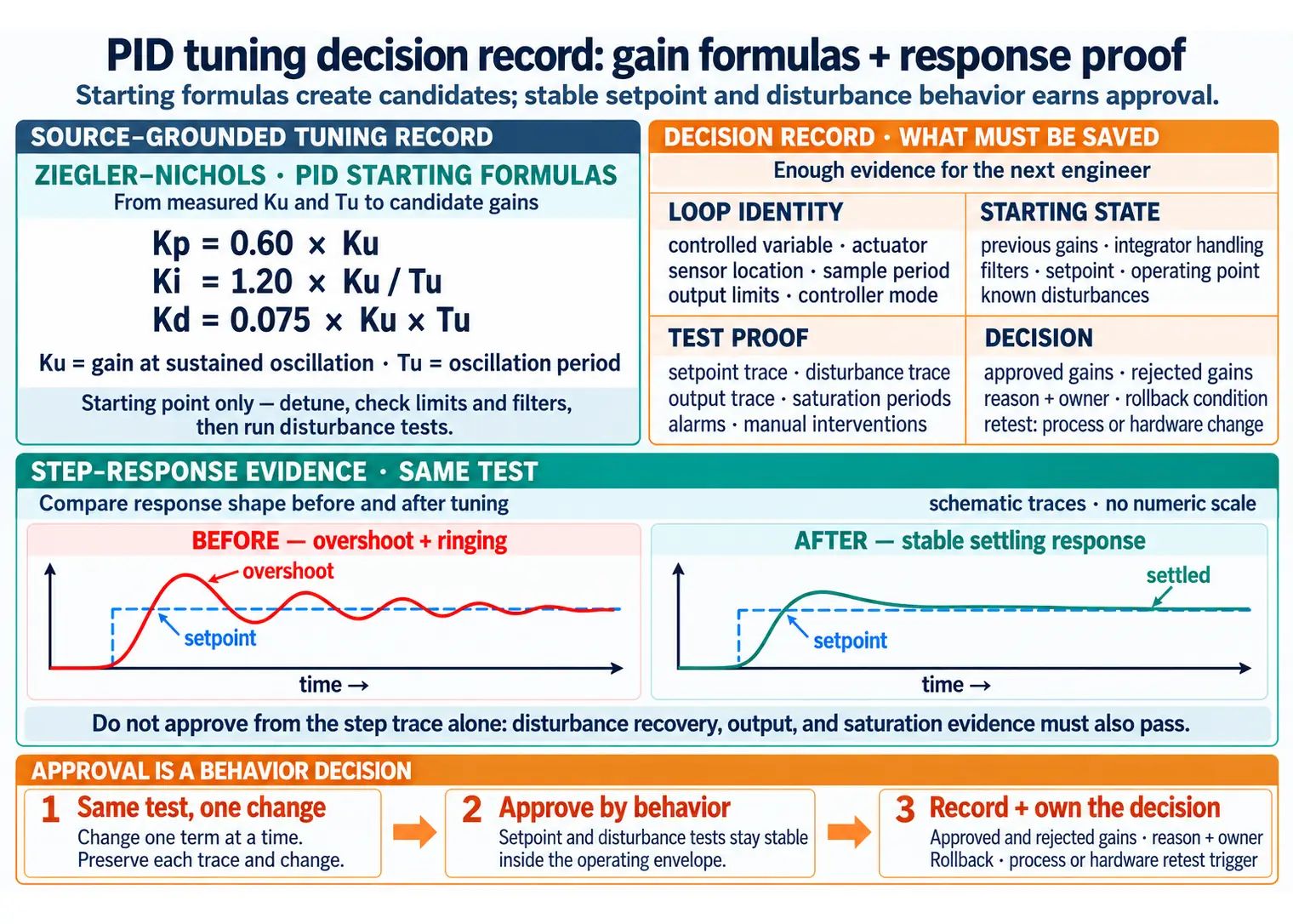
- Retest under disturbance.: A setpoint step is not enough; load and disturbance rejection must also be checked.
Major section
Ziegler-Nichols As a Starting Method
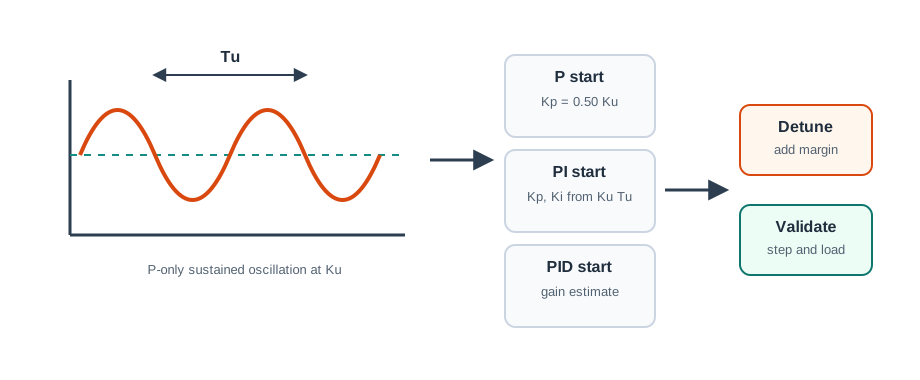
The classic closed-loop Ziegler-Nichols method raises proportional gain until the loop reaches sustained oscillation.
- That gain is the ultimate gain Ku; the oscillation period is Tu.
- These values are not a deployment certificate.
- Ziegler-Nichols is useful only when its measured oscillation and later safety margin remain visible.
Major section
Application Patterns
Application context changes what "good" means.
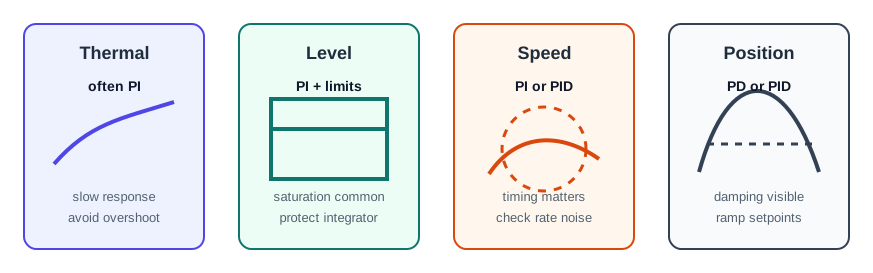
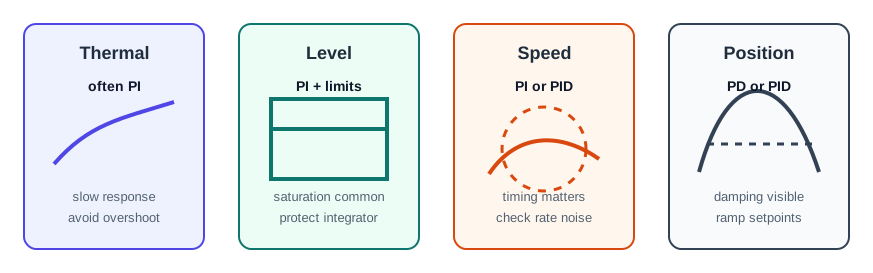
- A thermal loop may accept slow settling if it avoids overshoot.
- A position loop may need damping and fast recovery.
- A level loop may prioritize avoiding overflow and actuator cycling.
- The same numerical gains do not mean the same thing on a heater, tank, motor, and position axis.
Major section
Application Patterns (continued)
Damping, output limits, ramped setpoints, and mechanical backlash checks are usually important.
- Thermal is often: PI and trades slow response against overshoot;: Level highlights saturation and the instruction to protect integrator.: Speed makes timing and rate noise visible, whereas: Position calls for damping and ramp setpoints.
- Disturbance rejection and actuator limits matter.
- Overshoot and ringing are visible.
Major section
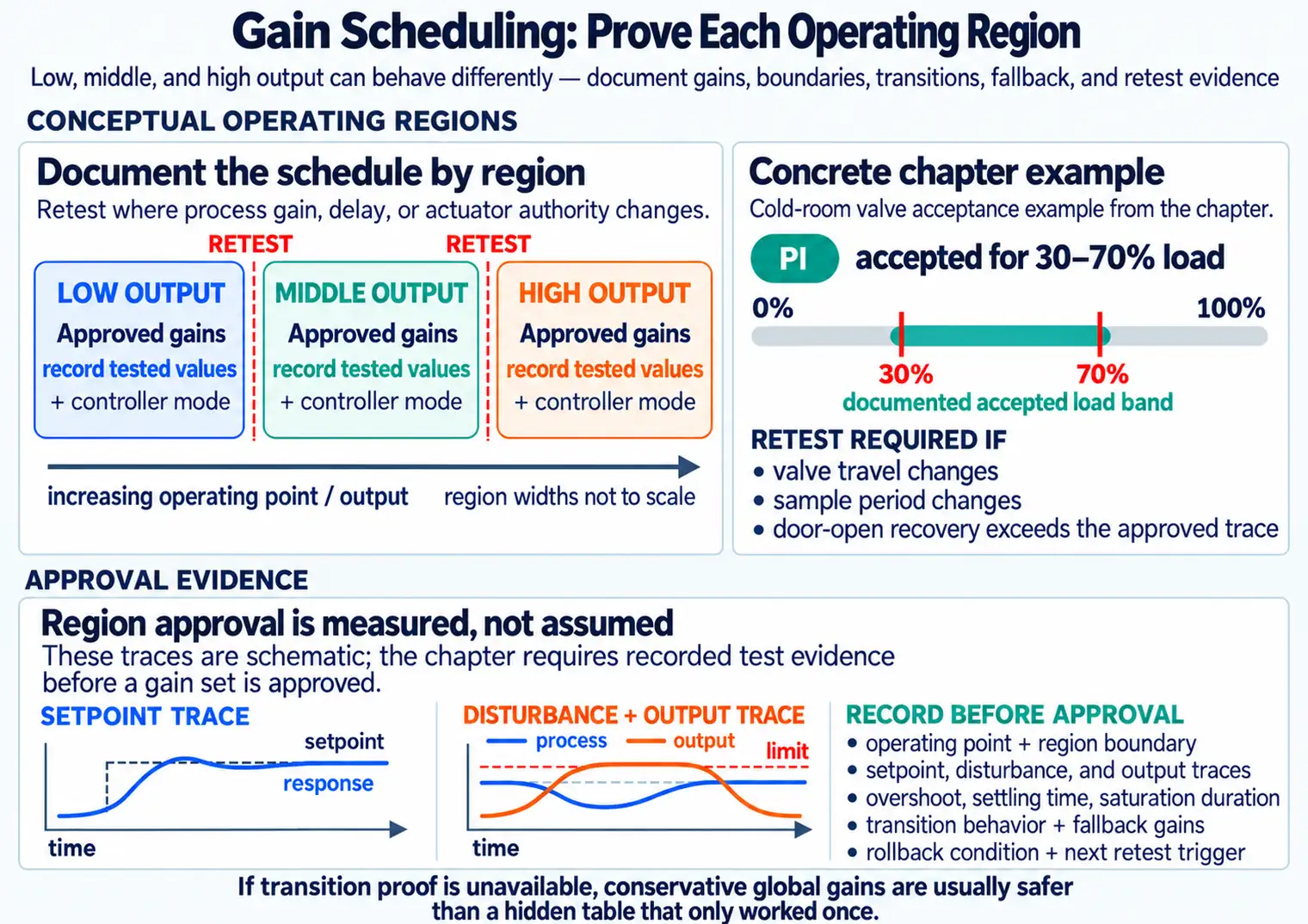
Operating Points and Gain Scheduling
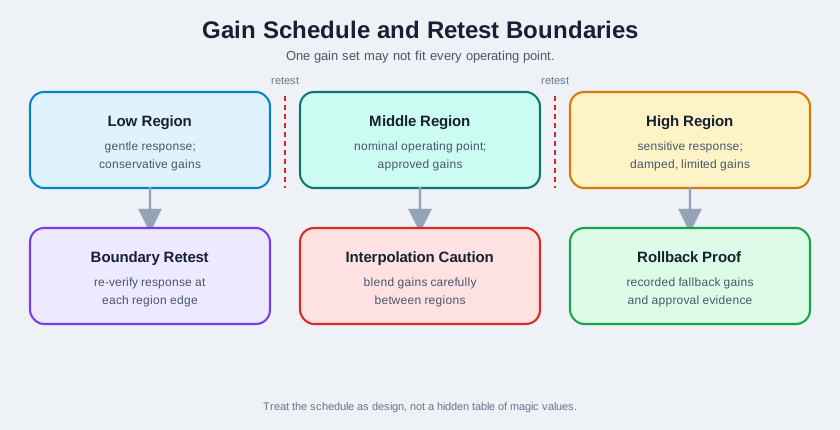
One set of gains may not work everywhere.
- A process can be gentle near one operating point and sensitive near another.
- When the response shape changes across the allowed range, use conservative global gains or a documented gain schedule.
Major section
Tuning Decision Record
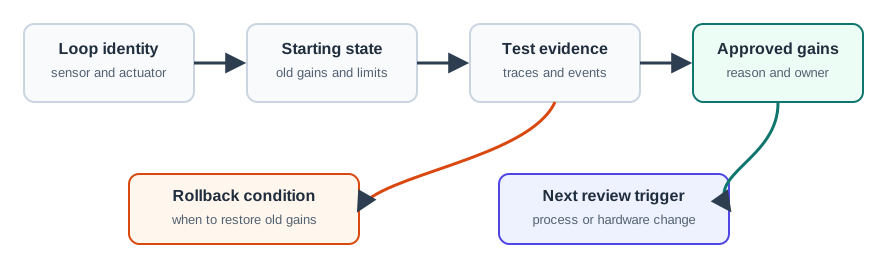
Each accepted tuning change should leave a decision record.
- The record does not need to be long, but it must be enough for another engineer to understand what was changed and why.
- Loop identity.: Controlled variable, actuator, sensor location, sample period, output limits, and controller mode.
Major section
Common Pitfalls
The method gives starting gains.
- Loops can behave differently at low, middle, and high output.
- Retest where process gain, delay, or actuator authority changes.
- If the actuator is clamped, the integrator may keep accumulating.
- Saturation and recovery proof must be part of the tuning record.
Major section
Common Pitfalls (continued)
Damping requires a trustworthy rate estimate.
- If rate noise dominates the command, use PI, filtering, setpoint shaping, or sensor improvements.
- Production tuning needs previous gains, abort criteria, and a way to return to a known stable state.
- Future maintainers need to know the condition that justified each gain.
Major section
Overview: Tuning Is Acceptance Proof
That makes tuning a proof process.
- Every accepted change should connect a symptom to a term, a term to a recorded response, and the recorded response to an operating decision.
- Without that chain, the numbers become private lore that the next maintainer cannot safely reuse.
Major section
Single Traces Can Overfit
The same gains can become fragile when the process moves to a different load, delay, or saturation condition.
- The accepted gains should have margin against noise, delay, output clamps, and expected disturbances.
- If the process behaves differently across regions, a gain schedule needs transition proof; if the proof is not available, conservative global gains are usually safer than a hidden table that only worked once.
- A gain set can look excellent on one step test because the operating point, disturbance shape, actuator authority, and sensor noise happen to match that run.
Deck summary
Key takeaways
Faster response is not an improvement when the physical result becomes risky.
- The mathematical gist.: Under a 20 dBm EIRP ceiling, a 0 dBi antenna may conduct 20 dBm = 100 mW.
- Tuning chooses controller gains and supporting limits so the closed loop behaves well for the real application.
- Tune only when the loop has clear boundaries.
- Manual tuning is useful when the process can be tested safely and when the team needs to understand how the loop reacts.
Retrieval practice
Recall check 1 of 3

Gateway Gus says: answer from memory, then check your reasoning.
Q1A PI loop is clean on a setpoint step, but after a disturbance the actuator saturates for a long time and the process overshoots on recovery. What is the best next diagnostic step?
Show answer
Answer: A Long saturation and recovery overshoot after a disturbance point to output limits, integrator state, and anti-windup behavior.
Retrieval practice
Recall check 2 of 3

Gateway Gus says: answer from memory, then check your reasoning.
Q2A PI loop reaches the setpoint during a clean setpoint step, but after a disturbance the actuator stays saturated for a long time and the process overshoots during recovery. What is the best next diagnostic step?
Show answer
Answer: B A clean setpoint step does not prove the loop is ready.
Retrieval practice
Recall check 3 of 3

Gateway Gus says: answer from memory, then check your reasoning.
Q3A warehouse heating loop has a clean setpoint trace at mild outdoor temperature, but during a cold morning the valve saturates and recovery overshoots. What should the tuning record do before approving the gains?
Show answer
Answer: A PID tuning acceptance should include disturbance and saturation recovery proof across the relevant operating range, plus retest boundaries when one gain set may not remain valid.
Print reference
Answers
Answer key.
- A · Long saturation and recovery overshoot after a disturbance point to output limits, integrator state, and anti-windup behavior.
- B · A clean setpoint step does not prove the loop is ready.
- A · PID tuning acceptance should include disturbance and saturation recovery proof across the relevant operating range, plus retest boundaries when one gain set may not remain valid.