IoT Fundamentals · Study deck
How to Read Research Papers
Picture a design meeting where someone cites a paper to prove that a network choice is best.
Physics Phoebe is your guide for this deck.

After studying this chapter
Learning objectives
You will be able to:
- Choose the right paper-guide lane for a WSN, protocol, architecture, or security question.
- Apply a three-pass reading workflow before investing deep reading time.
- Separate paper contribution, assumption, evidence, and modern follow-up check.
- Use citation history as context without treating it as an engineering ranking.
Major section
In 60 Seconds
The study may be careful, but it tested a different place, device set, and year.
- A strong paper can still be weak evidence for the decision in front of the team.
- A protocol is an agreed set of message and timing rules.
- This method does not make one paper final proof.
- Later work or field evidence may disagree.
Major section
Start With the Story
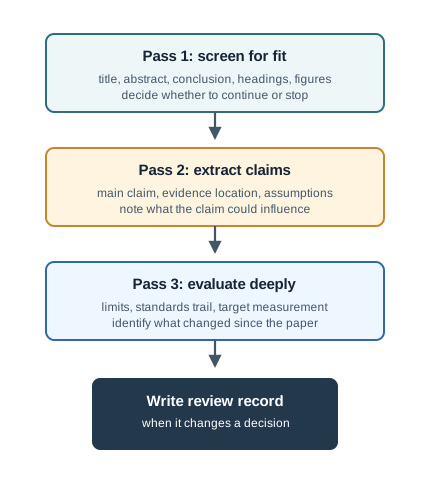
You will read a research paper in three passes and produce a record of its claims, evidence, assumptions, and limits.
- Relevance begins with a question, but the folklore panel shows what happens when a memorable claim loses its test conditions.
- Three passes recover the problem, method, evidence, assumptions, and limits.
Major section
The Three-Pass Workflow
The first pass screens title, abstract, introduction, conclusion, headings, figures, and tables to record the paper's role, system scope, and a reason to continue or stop.
- The second pass extracts the main claim, evidence location, assumptions, evaluation setup, and the part of the design it could influence.
- The final review record is the product of reading.
Major section
Build A Review Record
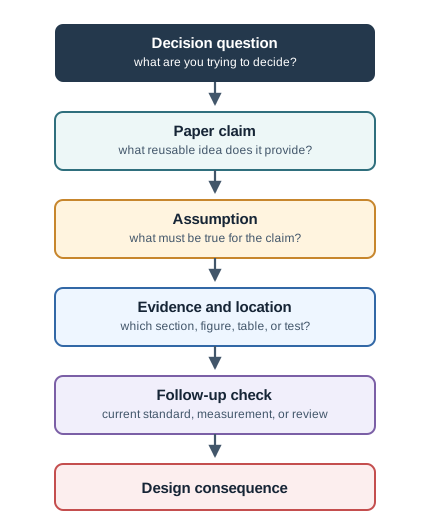
The review record is the useful artifact.
- It keeps paper reading from turning into trivia and makes it possible to revisit decisions later.
- Aggregation is good.
- The application can tolerate summaries and still diagnose outliers or failures.
Major section
Deep Dive: Map Paper Claims To Standards Owners
Placing a technology with its standards owner tells you what kind of document to read and where authoritative definitions, conformance language, and later corrections will live.
- The practical habit is to read from the design decision backward.
- If the decision is whether a sensor network should use 6LoWPAN and RPL, start with IETF terminology and RFC trails.
- If the decision is radio range or interference, expect IEEE 802.15.4 or 802.11 material.
Major section
Deep Dive: Map Paper Claims To Standards Owners (continued)
A paper claim such as "we send CoAP over Thread" spans several bodies.
- The standards owner does not make a paper true, but it tells you what current source must be checked before you reuse the claim.
- A 2009 WSN routing paper may still explain energy pressure and topology trade-offs, but its radio assumptions, security defaults, and deployment tooling may be obsolete.
- Every layer carries different evidence rules.
Major section
Deep Dive: Map Paper Claims To Standards Owners (continued)
A single light bulb can therefore embody four organizations' work at once.
- The review record separates the durable idea from the follow-up check needed before reusing it in a modern IoT design.
- CoAP is an IETF RFC, Thread is defined by the Thread Group, and Thread itself runs on IEEE 802.15.4 radios.
- When you read a survey lamenting fragmentation or celebrating convergence, it is describing this multi-SDO reality.
Major section
Deep Dive: Map Paper Claims To Standards Owners (continued)
Strong design work uses all three kinds of evidence without letting any one source do the job of the others.
- That immediately tells you the claim is about an open IETF application protocol layered on an alliance-defined mesh over an IEEE radio, and it tells you where to find the authoritative specification for each piece.
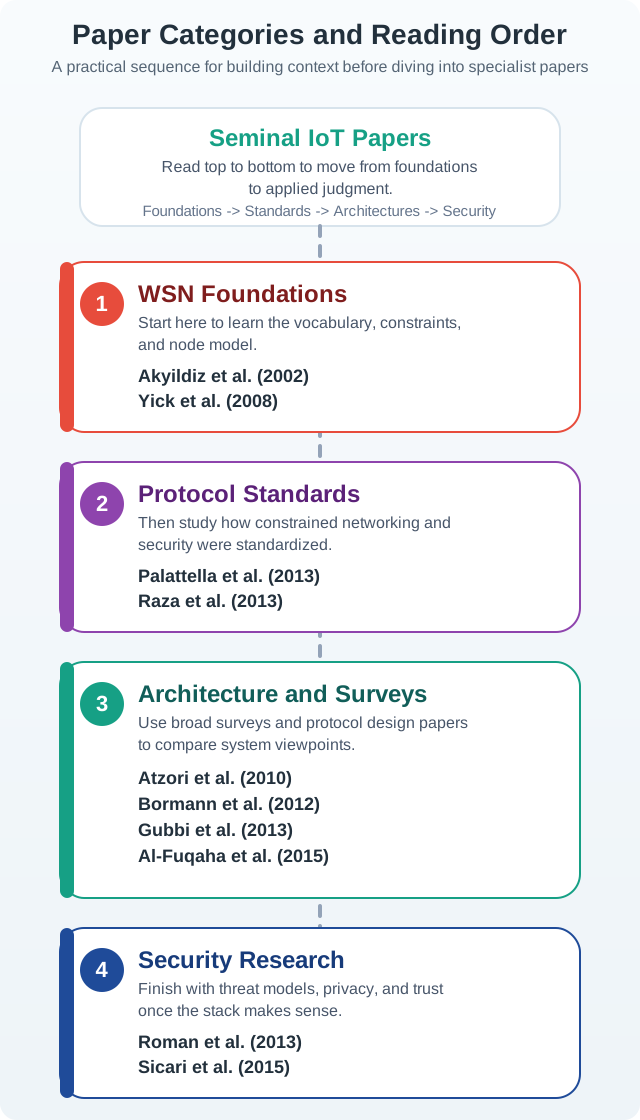
- That small map changes what you verify: protocol papers need RFC or specification follow-up, architecture surveys need boundary and vocabulary checks, and empirical WSN papers need measurement-context checks.
- A network-layer claim depends on addressing, fragmentation, routing state, retransmission behavior, and congestion.
Major section
Deep Dive: Map Paper Claims To Standards Owners (continued)
If the paper makes a performance claim, ask whether the standards version, PHY, channel plan, security mode, payload size, and duty-cycle limits match your target.
- If it makes an interoperability claim, ask which layer is actually interoperable: radio, IP adaptation, transport, application payload, commissioning, or cloud API.
- A peer-reviewed paper can explain a design insight; an RFC, IEEE standard, 3GPP technical specification, OASIS specification, or alliance document defines the interface; and a deployment report shows what happened under field constraints.
- Knowing the map lets you see exactly which layers a new standard is trying to unify.
Major section
Deep Dive: Map Paper Claims To Standards Owners (continued)
Matter, the smart-home interoperability layer from the CSA, then runs on top of Thread or Wi-Fi using IPv6.
- A radio-layer claim depends on channel model, antenna placement, transmit power, duty cycle, receiver sensitivity, and interference.
- An application-layer claim depends on payload schema, security context, commissioning flow, and user-visible compatibility.
- When a paper reports one layer's success, do not silently promote it into proof for the whole stack.
Deck summary
Key takeaways
The study may be careful, but it tested a different place, device set, and year.
- You will read a research paper in three passes and produce a record of its claims, evidence, assumptions, and limits.
- The first pass screens title, abstract, introduction, conclusion, headings, figures, and tables to record the paper's role, system scope, and a reason to continue or stop.
- The review record is the useful artifact.
- Placing a technology with its standards owner tells you what kind of document to read and where authoritative definitions, conformance language, and later corrections will live.
Retrieval practice
Recall check 1 of 3

Physics Phoebe says: answer from memory, then check your reasoning.
Q1What should a learner identify early when reading an IoT research paper?
Show answer
Answer: A Research reading starts by separating claims, methods, evidence, and limits.
Retrieval practice
Recall check 2 of 3
Physics Phoebe says: answer from memory, then check your reasoning.
Q2What is the main purpose of the first pass when reading an IoT research paper?
Show answer
Answer: A The first pass is a relevance screen.
Retrieval practice
Recall check 3 of 3
Physics Phoebe says: answer from memory, then check your reasoning.
Q3What is the safest way to use a useful claim from an older foundational IoT paper?
Show answer
Answer: A Older papers should be read as design evidence.
Print reference
Answers
Answer key.
- A · Research reading starts by separating claims, methods, evidence, and limits.
- A · The first pass is a relevance screen.
- A · Older papers should be read as design evidence.