IoT Fundamentals · Study deck
WSN Papers Guide
Picture a team choosing how small field sensors should share readings.
Physics Phoebe is your guide for this deck.

After studying this chapter
Learning objectives
You will be able to:
- Read WSN surveys as historical design evidence rather than as current bill-of-material guidance.
- Explain why node energy, local processing, communication, and topology were central WSN concerns.
- Separate abstract WSN models from later hardware, operating-system, and protocol evidence.
- Compare Akyildiz's field-setting view with Yick's practical-maturity view.
Major section
In 60 Seconds
Someone finds a well-known paper and says its design is proven.
- The paper may be sound, but its batteries, radios, traffic, and test site may be very different from this project.
- A protocol is an agreed set of rules for an exchange.
- These details tell you whether the result can guide the new site.
Major section
In 60 Seconds (continued)
When a paper compares protocol choices, write down the message size, send rate, node count, power source, link conditions, and failure case.
- A short review can catch a missing limit before it becomes a design rule.
- The simple reading card cannot replace a full review of method or later research.
- Under the Hood examines how their models and evidence should, and should not, move into a current design.
Major section
Start With the Story
You will use wireless sensor network surveys to explain node, routing, and energy constraints without treating historical results as current measurements.
- Each survey explains a distinct set of node, routing, aggregation, and deployment pressures, but its platform assumptions cannot specify today’s hardware.
Major section
Reading Contract
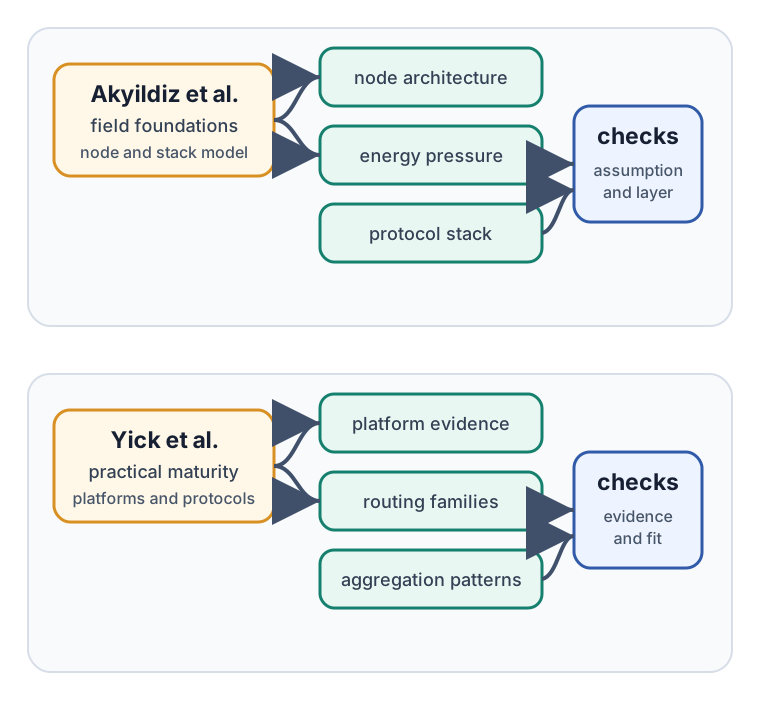
The Akyildiz lane starts with the sensor node and its stack.
- Its labels ask how energy, radio behavior, node count, and unattended use shaped early designs.
- It also shows sensing-area models and open issues.
Major section
Standards And Follow-Up Trail
The useful move is to ask: "What design pressure did the survey identify, and what later evidence would prove the design today?".
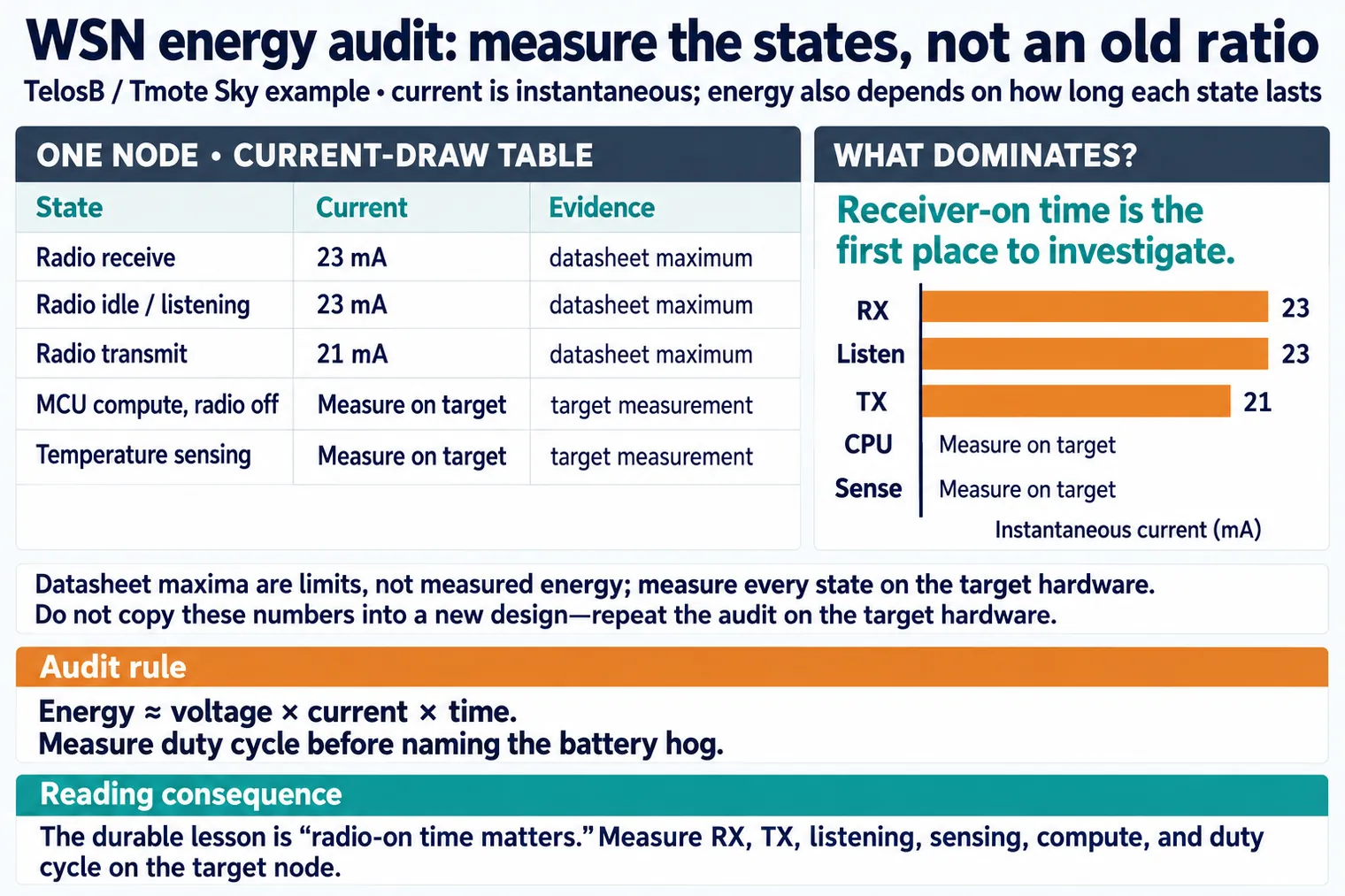
- Radio sends, retries, idle listen, and clock sync may lead on one node.
- Local work or data merge may lead on another.
Major section
Lane 2: Yick et al.
This stops a local result from becoming a whole-system rule.
- In the merge example, fewer sends help only when nearby readings overlap and local work keeps enough quality.
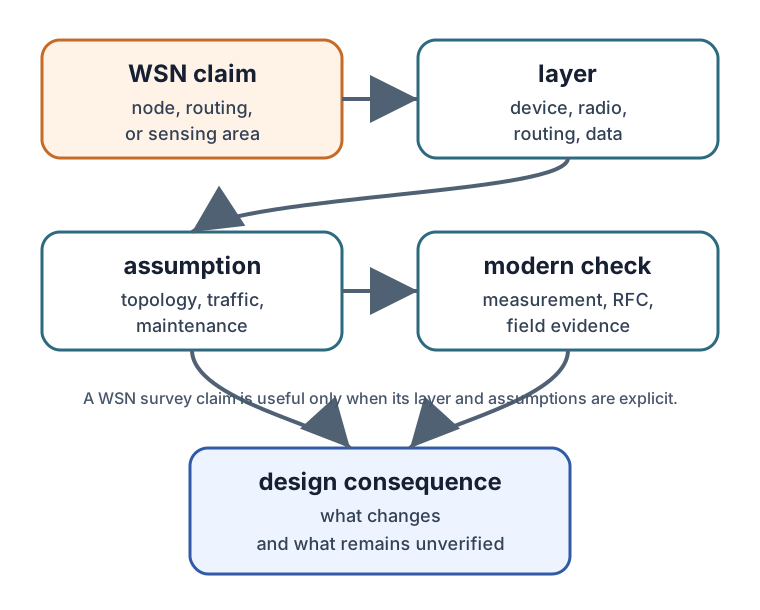
- The last fields state what will change and what remains unproved.
- A survey becomes design proof only through a clear, bounded record that can be opened again.
Major section
Cross-Paper Synthesis
Akyildiz helps you see why WSN became a distinct research field.
- Yick helps you see which early ideas gained practical shape, which remained research-heavy, and which required later standards or deployment evidence.
- Assumption: Nearby readings are similar enough that summary values preserve the decision signal.
- Design consequence: Aggregation is useful only when the quality contract is explicit and the system keeps enough evidence for diagnosis.
Major section
Common Pitfalls
The surveys explain why communication often dominates WSN energy, but exact ratios depend on device, radio, payload, sleep state, channel, and software.
- They do not prove that a routing family, aggregation method, or topology is the right design for your system.
- Real systems also need placement records, calibration, updates, replacement plans, gateway recovery, and data-quality checks.
- WSNs are not only networks.
- A routing design is not useful if it saves transmissions while losing the evidence the application needed.
Major section
Deep Dive: Translate WSN Surveys Into Measurement Plans
A wireless sensor network is a collection of many small, battery-powered nodes that sense their surroundings and relay readings, often over multiple hops, to a sink or base station.
- The most reusable WSN idea is not a specific protocol table.
- In-network aggregation shows the core WSN trade.

Major section
Deep Dive: Translate WSN Surveys Into Measurement Plans (continued)
A routing model that averages energy across all nodes can hide sink-near depletion.
- Fifty temperature nodes in a field can each forward one reading toward the sink, creating a traffic concentration near the sink.
- Survey tables should therefore be treated as triage maps.
- A MAC schedule can save energy but increase latency.
Major section
Deep Dive: Translate WSN Surveys Into Measurement Plans (continued)
If intermediate nodes compute an average, maximum, or count and forward one aggregated value, the network spends a little local computation to avoid a lot of radio time.
- If a claim depends on low-power links, check the relevant IEEE 802.15.4 profile and radio behavior.
- If it depends on time-slotted industrial operation, look at 6TiSCH work rather than assuming a generic WSN MAC.
- A radio in receive mode can draw current close to its transmit state, so a node that listens continuously drains quickly even if it rarely sends.
Major section
Deep Dive: Translate WSN Surveys Into Measurement Plans (continued)
A routing repair can restore connectivity but cause bursts of control traffic.
- With the MCU on, the listed maximum is 23 mA for idle listening (RX) and 21 mA for transmit (TX), a difference of 2 mA.
- A node that waits with its receiver on therefore spends nearly transmit-level current even when no useful packet arrives.
- In-network aggregation can lower packet volume but erase the raw evidence needed for anomaly diagnosis.
Major section
Deep Dive: Translate WSN Surveys Into Measurement Plans (continued)
Radio-off sleep draws far less, which is why duty-cycled MAC designs coordinate short wake windows rather than optimizing transmission alone.
- Nodes closest to the sink must forward other nodes' traffic, so they can deplete first; when they die, the sink can be cut off even though distant nodes still have power.
- In a linear pipeline reporting to a sink at one end, the node nearest the sink may relay all upstream traffic and exhaust its battery much earlier than the rest.
- A sink move can balance relay load but change custody of data and gateway availability.
Major section
Deep Dive: Translate WSN Surveys Into Measurement Plans (continued)
A designer may add redundant nodes near the sink, rotate relay roles, change sink placement, or rebalance routing so useful lifetime is not bounded by one overloaded relay.
- The under-the-hood reading question is whether the paper's model closes the loop between physics, protocol state, and operations.
- A sensing-area model that assumes perfect coverage can hide calibration drift, failed nodes, vegetation, enclosures, and gateway outages.
- Those omissions are not always flaws in the paper; they are assumptions that must be carried into the review record.
Deck summary
Key takeaways
Someone finds a well-known paper and says its design is proven.
- When a paper compares protocol choices, write down the message size, send rate, node count, power source, link conditions, and failure case.
- You will use wireless sensor network surveys to explain node, routing, and energy constraints without treating historical results as current measurements.
- The Akyildiz lane starts with the sensor node and its stack.
- The useful move is to ask: "What design pressure did the survey identify, and what later evidence would prove the design today?".
Retrieval practice
Recall check

Physics Phoebe says: answer from memory, then check your reasoning.
Q1When reading Akyildiz et al., what is the safest way to use the paper's energy discussion?
Show answer
Answer: A Akyildiz et al.
Q2How does Yick et al. complement the earlier Akyildiz survey?
Show answer
Answer: B Yick et al.
Print reference
Answers
Answer key.
- A · Akyildiz et al.
- B · Yick et al.