IoT Fundamentals · Study deck
Security Papers Guide
Imagine a team using an old research paper to approve a new connected lock.
Physics Phoebe is your guide for this deck.

After studying this chapter
Learning objectives
You will be able to:
- Explain: Sicari's security-privacy-trust framing adds a second discipline: every control should be checked for what it protects, what it exposes, and what evidence makes it trustworthy over the device lifecycle.
- Explain: Sicari's triad adds the cases where a secure channel still enables privacy harm because the product collects too much data, keeps it too long, or exposes inference through logs and analytics.
- Explain: Where public-key operations are still too costly, pre-shared keys can reduce handshake cost, but they raise lifecycle questions about uniqueness, rotation, compromise blast radius, and manufacturing control.
Major section
In 60 Seconds
The paper may explain a lasting risk, but its devices and controls may no longer match the product.
- A protocol is a set of rules for exchanging messages.
- Say what the paper helps you believe.
- Say what it does not prove.
- This guide does not turn two surveys into current deployment rules.
Major section
In 60 Seconds (continued)
Research supports judgment; it does not replace product evidence.
- This chapter helps you read two IoT security survey papers without turning them into outdated deployment recipes.
- Roman et al. Focus on why distributed IoT systems are difficult to secure when devices are exposed, heterogeneous, and not always governed by one central authority.
- Sicari et al. Show why security, privacy, and trust must be reviewed together rather than as separate checkboxes.
Major section
Start With the Story
You will turn security and privacy survey claims into explicit trust boundaries and checks for a connected product.
- Their security and privacy concerns remain useful, but the mismatch panel exposes device, gateway, and trust assumptions that no longer describe the connected lock.
- The bounded record keeps each claim attached to its evidence and limits.
Major section
Reading Contract
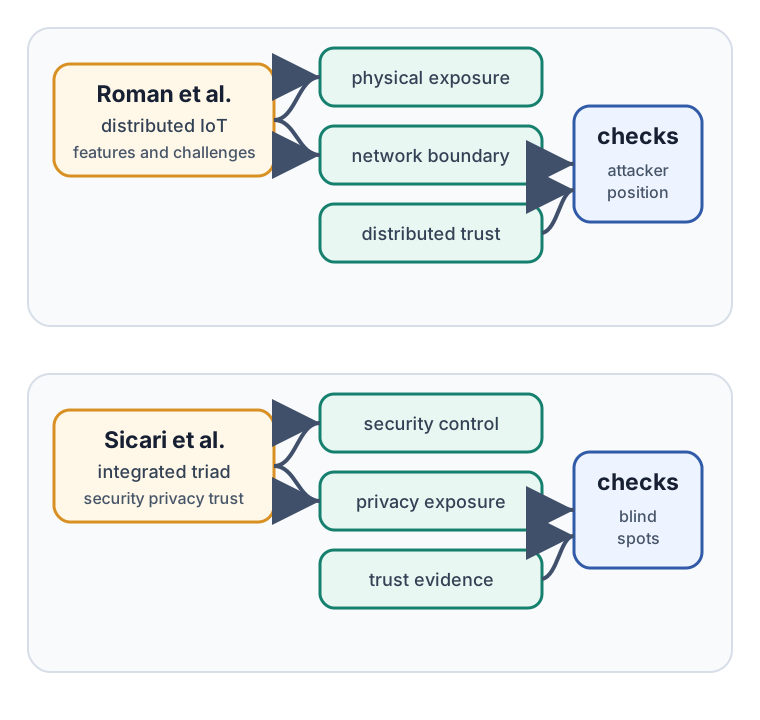
Roman et al. Starts with the system shape, network boundary, and distributed trust path; the reading check asks where an attacker is assumed to stand.
- Sicari et al. Places security, privacy, and trust controls together, then asks where a gain in one dimension could weaken another.
Major section
Standards And Framework Trail
The goal is not to memorize every later document.
- The goal is to see when a paper's vocabulary needs a modern standard, baseline, or product-specific evidence check.
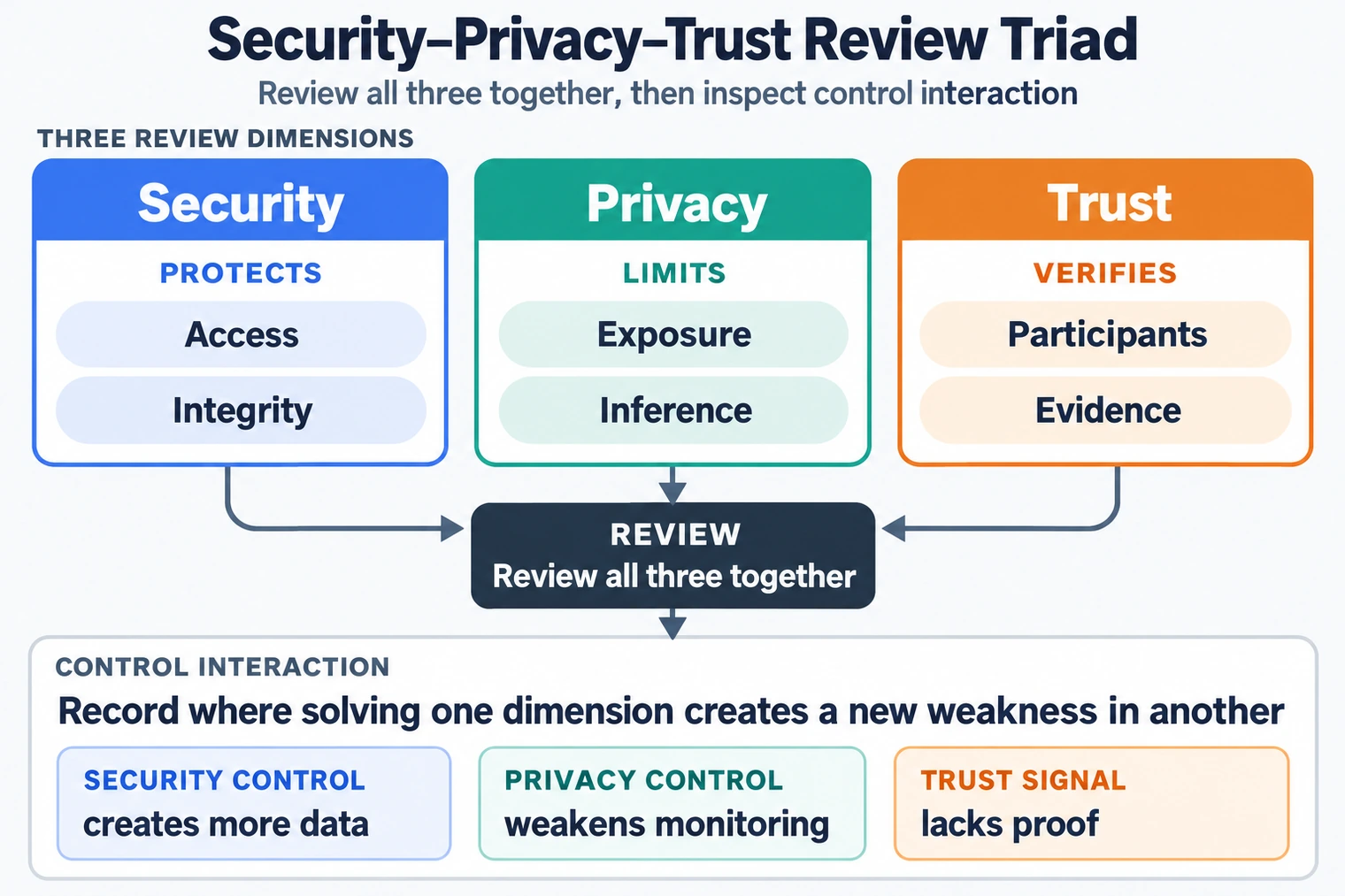
- Privacy limits what data may reveal.
- The three overlap, but one cannot stand in for another.
- More logs may create more personal data.
Major section
Lane 1: Roman et al.
The paper asks what changes when sensing, actuation, communication, and local decision-making are spread across many constrained and physically exposed nodes.
- Skim the system features before the threat sections so the risk analysis has context.
- Finish by recording which claims need a modern baseline, protocol, or implementation check.
- It changes where evidence is needed.
Major section
Lane 2: Sicari et al.
Sicari et al. Are useful because they show that IoT security decisions often fail when security, privacy, and trust are reviewed separately.
- Encryption can protect data in transit while still enabling unnecessary data collection.
- Privacy controls can reduce exposure while still accepting unauthenticated input.
- Trust labels can be meaningless without evidence.
Major section
Cross-Paper Synthesis
Roman helps you locate where IoT trust breaks down in distributed environments.
- Sicari helps you prevent one-dimensional fixes by reviewing security, privacy, and trust together.
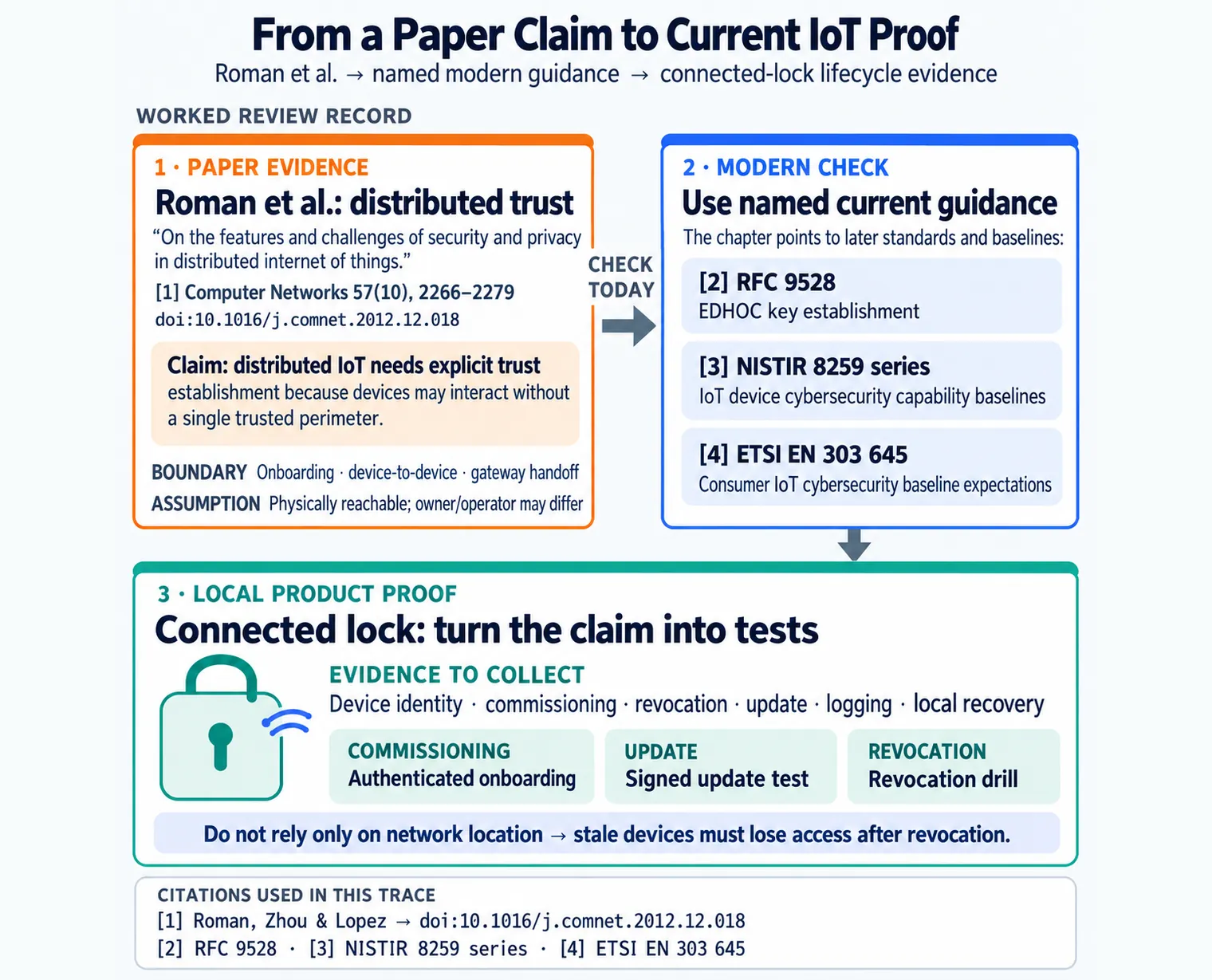
- Assumption: Devices can be physically reachable and may not share the same owner or operator.
- Design consequence: The design cannot rely only on network location.
Major section
Common Pitfalls
Survey papers organize the problem space; they do not freeze best practice.
- Encryption and authentication can still support surveillance or excessive retention if the data model is wrong.
- Trust is not only device onboarding.
- A design also needs update, revocation, ownership transfer, monitoring, and recovery evidence.
Major section
Deep Dive: Security Papers As Boundary Evidence
The classic CIA triad still matters: confidentiality protects who can read data, integrity protects whether data can be changed undetected, and availability protects whether the system keeps working.
- Roman's distributed-IoT framing starts with boundary loss: sensors, gateways, users, and services may sit under different owners, in exposed locations, and on constrained networks where a traditional enterprise perimeter is a weak assumption.
- A CoAP sensor makes the distinction concrete.
- Cryptography alone is not security.
Major section
Deep Dive: Security Papers As Boundary Evidence (continued)
Sicari's security-privacy-trust framing adds a second discipline: every control should be checked for what it protects, what it exposes, and what evidence makes it trustworthy over the device lifecycle.
- A sensor can be stolen, a gateway can bridge trust zones, a cloud service can retain too much data, and a device identity can remain active after ownership changes.
- A control can sit on the device, in the gateway, in the cloud service, in manufacturing, or in operations.
- Roman helps you ask whether a device can trust its neighbor, gateway, update channel, or cloud endpoint.
Major section
Deep Dive: Security Papers As Boundary Evidence (continued)
At the protocol layer, the papers' trust language becomes concrete key-establishment and identity evidence.
- Sicari helps you ask whether that trust proof also respects privacy and whether the control creates new data that needs retention and access rules.
- If the sensor uses coaps://, CoAP is protected by DTLS, the datagram cousin of TLS.
- Strong authentication often rests on public-key cryptography, but classic RSA keys are large and slow for small microcontrollers.
Major section
Deep Dive: Security Papers As Boundary Evidence (continued)
Confidentiality and integrity come from DTLS record protection; authentication can use a pre-shared key, raw public key, or certificate depending on provisioning cost and fleet-management needs.
- If the design uses OSCORE instead, the review record should say that object security protects CoAP messages across proxies while DTLS protects a transport channel.
- The paper note should not say "use encryption"; it should say which endpoint is authenticated, who provisions credentials, how keys rotate, and how a lost or sold device loses access.
- The highest-quality synthesis is a trace from paper claim to testable evidence.
Major section
Deep Dive: Security Papers As Boundary Evidence (continued)
Where public-key operations are still too costly, pre-shared keys can reduce handshake cost, but they raise lifecycle questions about uniqueness, rotation, compromise blast radius, and manufacturing control.
- Roman's distributed-boundary problem includes physical tampering, debug ports, firmware extraction, radio replay, gateway compromise, cloud API misuse, and human onboarding errors.
- Sicari's triad adds the cases where a secure channel still enables privacy harm because the product collects too much data, keeps it too long, or exposes inference through logs and analytics.
- That trace prevents a survey citation from turning into a vague "secure by design" assertion.
Major section
Deep Dive: Security Papers As Boundary Evidence (continued)
The fix is architectural: unique per-device credentials, authenticated commissioning, encrypted transport, signed firmware, local recovery, and revocation that can remove a stale or transferred device.
- The review record should also ask what the lock logs, whether access events reveal occupancy patterns, who can view those logs, and when they are deleted.
- A Roman-inspired claim about distributed trust should end in tests for onboarding, key storage, gateway handoff, revocation, update rollback, and offline behavior.
- A Sicari-inspired claim about security-privacy-trust interaction should end in tests for collection limits, authorization scopes, audit accountability, and residual-risk signoff.
Major section
Summary
Roman et al. And Sicari et al. Are most useful when they make your review more precise.
- Roman helps you find distributed trust and boundary problems.
- Sicari helps you keep security, privacy, and trust from drifting apart.
- Together they support a disciplined reading workflow: extract the claim, identify the assumption, check current guidance, and record what the design must prove.
Deck summary
Key takeaways
The paper may explain a lasting risk, but its devices and controls may no longer match the product.
- Research supports judgment; it does not replace product evidence.
- You will turn security and privacy survey claims into explicit trust boundaries and checks for a connected product.
- Roman et al. Starts with the system shape, network boundary, and distributed trust path; the reading check asks where an attacker is assumed to stand.
- The goal is not to memorize every later document.
Retrieval practice
Recall check 1 of 2

Physics Phoebe says: answer from memory, then check your reasoning.
Q1When reading Roman et al., what should you extract first from a distributed IoT threat discussion?
Show answer
Answer: C Roman et al.
Retrieval practice
Recall check 2 of 2
Physics Phoebe says: answer from memory, then check your reasoning.
Q2Why is Sicari et al.'s security-privacy-trust triad useful for IoT design reviews?
Show answer
Answer: D Sicari et al.'s triad is useful because it prevents one-dimensional security reviews. It asks whether security, privacy, and trust evidence all exist and whether a control in one dimension creates risk in another.
Print reference
Answers
Answer key.
- C · Roman et al.
- D · Sicari et al.'s triad is useful because it prevents one-dimensional security reviews. It asks whether security, privacy, and trust evidence all exist and whether a control in one dimension creates risk in another.