IoT Fundamentals · Study deck
Protocol Papers Guide
Picture a paper that claims a field network saves energy and still delivers every warning.
Physics Phoebe is your guide for this deck.

After studying this chapter
Learning objectives
You will be able to:
- Explain: The stack is shaped by a physical constraint: an IEEE 802.15.4 frame has a 127-byte maximum physical-layer packet size before MAC headers, security fields, addressing, and checksums consume space.
- Explain: When it says security overhead is acceptable, ask whether the overhead appears as a larger link-layer frame, extra 6LoWPAN fragments, a longer handshake, persistent state in RAM, or more radio-on time.
- Explain: When a paper says scheduling improves reliability, ask whether it means TSCH slot timing, 6TiSCH schedule negotiation, RPL parent stability, CoAP retransmission behavior, or the application sampling policy.
Major section
In 60 Seconds
The title and chart are not enough.
- A reader needs to know the devices, traffic, failures, measurements, and limits behind that claim.
- Internet Protocol means the addressing rules used to move network packets.
- IPv6 means version 6 of those rules.
- 6LoWPAN means a way to carry IPv6 over small low-power radios.
Major section
In 60 Seconds (continued)
Routing Protocol for Low-Power and Lossy Networks (RPL) means rules for choosing paths in such a network.
- Constrained Application Protocol (CoAP) means a compact request method for small devices.
- Transport layer security means protection for a network exchange.
- This runway does not decide whether the paper is correct.
Major section
Start With the Story
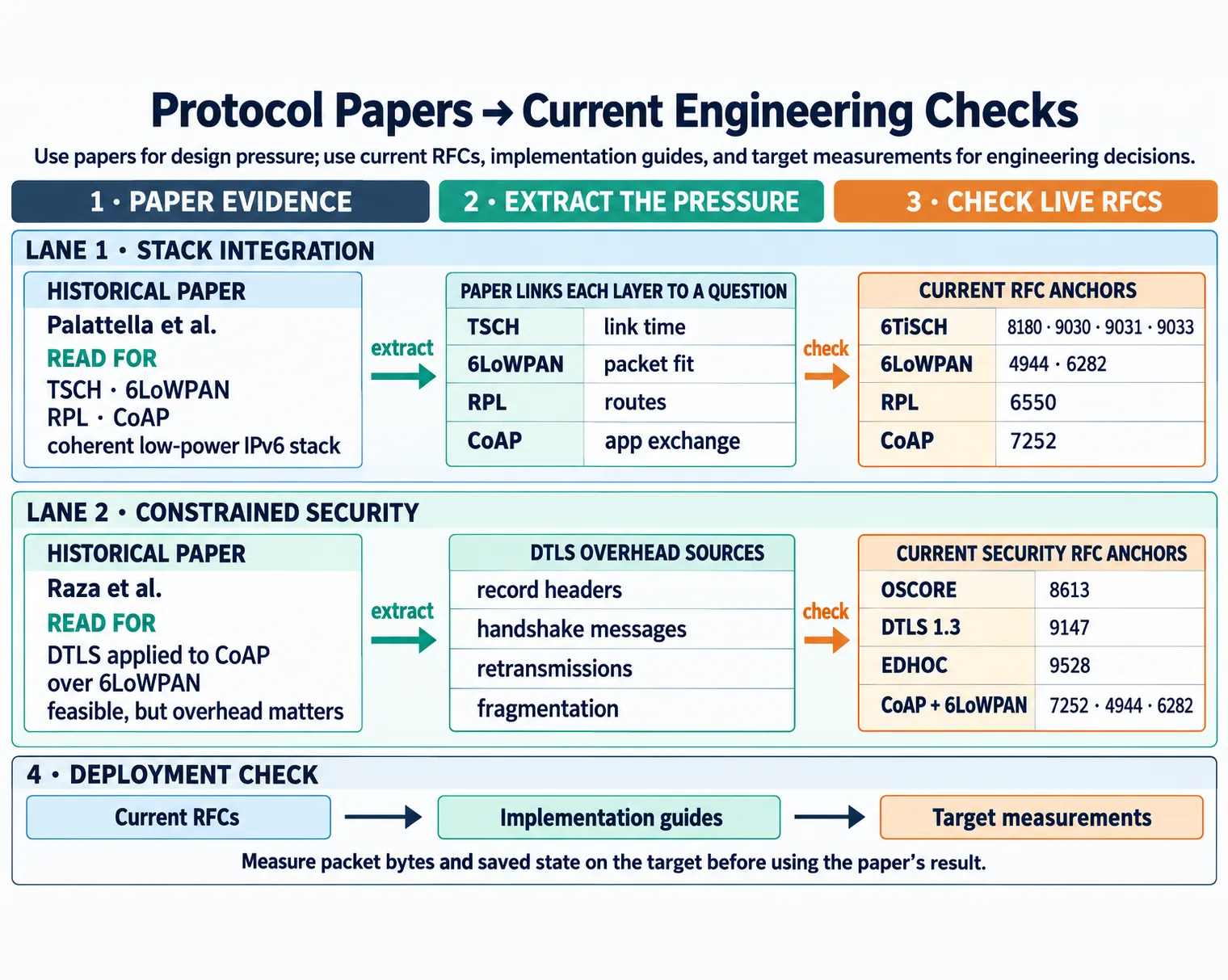
You will extract stack-design and security-overhead lessons from protocol papers, then identify the standards and implementation checks needed today.
- Current RFCs, implementations, and measurements then carry the decision, preserving the papers as reasoning evidence without treating them as deployment authority.
- The papers expose stack-design and security-overhead pressures, but the boundary in the second panel prevents either proposal from becoming an automatic specification.
Major section
Reading Contract
The paper links TSCH, 6LoWPAN, RPL, and CoAP to link time, packet fit, routes, and app exchange.
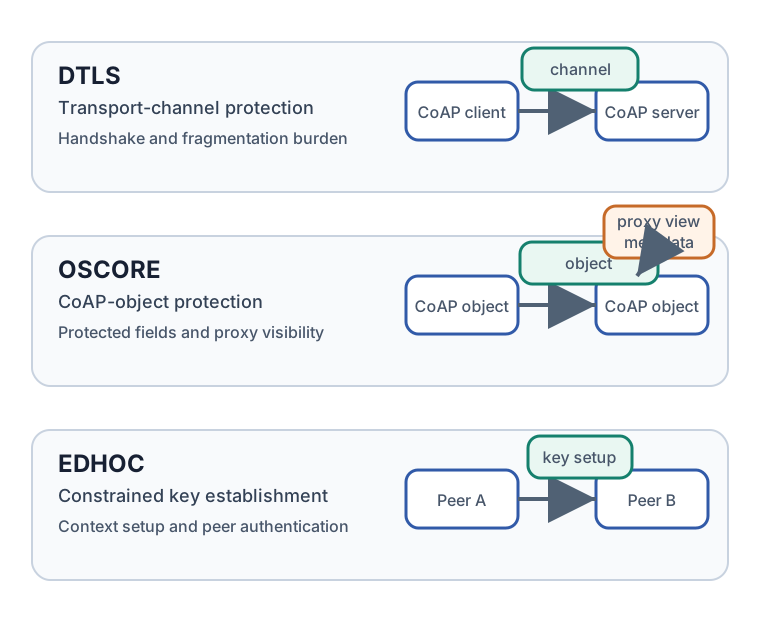
- EDHOC shows one way to set up shared context.
- The paper gives the reason, while the RFC gives the live pact.
Major section
Standards Trail
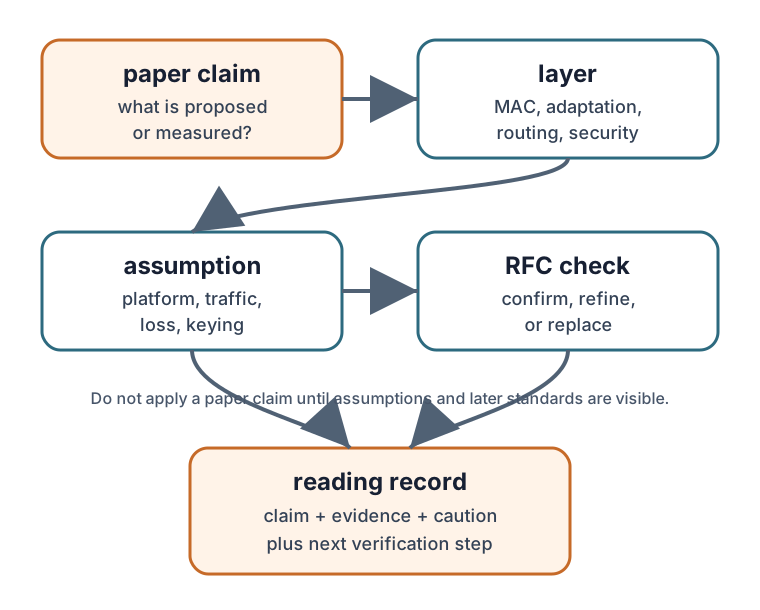
Class it as link, packet fit, route, app, or security work.
- The next field states which terms or steps changed and what still needs a test.
- An old paper can preserve a useful design need.
Major section
Lane 2: Raza et al.
Raza et al. Is useful because it makes constrained security concrete.
- The paper does not simply say "security adds overhead." It shows where overhead appears in the stack, why fragmentation amplifies it, and why header compression alone cannot remove every handshake burden.
- DTLS protects a transport channel, bringing handshake, record-header, retransmission, and fragmentation costs.
- OSCORE protects CoAP objects end to end across permitted intermediaries, changing what a proxy may read, cache, translate, or forward.
- Jump to the evaluation section and identify what was actually measured.
Major section
Common Pitfalls
A protocol stack is not ready just because the data path is described.
- The papers are historically important, but they are not the final protocol specifications.
- Frame sizes, handshake sizes, memory use, and energy measurements depend on implementation details.
- Preserve the paper's reasoning pattern, but do not turn one setup into a universal rule.
Major section
Deep Dive: Layer The Paper Claim Before Using It
The stack is shaped by a physical constraint: an IEEE 802.15.4 frame has a 127-byte maximum physical-layer packet size before MAC headers, security fields, addressing, and checksums consume space.
- A full IPv6 header is 40 bytes before UDP, CoAP, routing headers, and payload.
- UDP is connectionless.
- The choice of UDP and CoAP over TCP and HTTP is deliberate.

Major section
Deep Dive: Layer The Paper Claim Before Using It (continued)
The trade is explicit: CoAP over UDP gives low overhead and sleep-friendliness but weaker built-in guarantees than TCP.
- RFC 4944 and RFC 6282 define fragmentation and header compression so IPv6 can survive where one careless header can dominate the packet.
- RPL, standardized in RFC 6550, then adds a routing model for lossy and low-power networks rather than assuming stable Ethernet-like paths.
- MQTT makes a different architectural bet.
Major section
Deep Dive: Layer The Paper Claim Before Using It (continued)
CoAP, standardized in RFC 7252, then adds compact REST-like methods, binary headers, message identifiers, token matching, and optional confirmable messages with acknowledgments.
- When a paper says scheduling improves reliability, ask whether it means TSCH slot timing, 6TiSCH schedule negotiation, RPL parent stability, CoAP retransmission behavior, or the application sampling policy.
- When it says security overhead is acceptable, ask whether the overhead appears as a larger link-layer frame, extra 6LoWPAN fragments, a longer handshake, persistent state in RAM, or more radio-on time.
- Applications choose confirmable messages where they need them and non-confirmable messages where loss is acceptable.
Major section
Deep Dive: Layer The Paper Claim Before Using It (continued)
DTLS protects a channel below the application, but handshake size, record overhead, and state can matter on small nodes.
- TCP keeps connection state and performs handshakes, retransmission timers, congestion control, in-order byte streams, and recovery behavior that can be costly for a device that sleeps for minutes and wakes to send a few bytes.
- It runs over TCP, uses a broker, and can be excellent for devices or gateways that can maintain a session and benefit from publish-subscribe fan-out.
- DTLS 1.3 in RFC 9147 changes details relative to older DTLS papers.
Major section
Deep Dive: Layer The Paper Claim Before Using It (continued)
MQTT-SN adapts that model for sensor networks, but the same reading discipline applies: check who keeps state, who retransmits, where the broker or gateway sits, and what happens during sleep, loss, and reconnect.
- OSCORE in RFC 8613 protects CoAP messages at the object layer, which can survive proxies that terminate transport connections.
- EDHOC in RFC 9528 is a compact authenticated key establishment protocol for constrained settings.
- A paper about secure CoAP is incomplete unless you ask whether it assumes pre-shared keys, certificate chains, raw public keys, OSCORE contexts, or a particular join process.
Deck summary
Key takeaways
The title and chart are not enough.
- Routing Protocol for Low-Power and Lossy Networks (RPL) means rules for choosing paths in such a network.
- You will extract stack-design and security-overhead lessons from protocol papers, then identify the standards and implementation checks needed today.
- The paper links TSCH, 6LoWPAN, RPL, and CoAP to link time, packet fit, routes, and app exchange.
- Class it as link, packet fit, route, app, or security work.
Retrieval practice
Recall check 1 of 2

Physics Phoebe says: answer from memory, then check your reasoning.
Q1When a protocol paper describes a proposed mechanism that later appears in an RFC family, what should you do before using the mechanism in a design?
Show answer
Answer: C Use papers for rationale, RFCs for current protocol language, and measurements for platform-specific decisions.
Retrieval practice
Recall check 2 of 2
Physics Phoebe says: answer from memory, then check your reasoning.
Q2What did Raza et al. show about DTLS on constrained devices?
Show answer
Answer: C The paper-to-standard path is best read as a sequence of constrained-security design pressures, not as one protocol simply replacing every previous one.
Print reference
Answers
Answer key.
- C · Use papers for rationale, RFCs for current protocol language, and measurements for platform-specific decisions.
- C · The paper-to-standard path is best read as a sequence of constrained-security design pressures, not as one protocol simply replacing every previous one.