IoT Fundamentals · Study deck
Architecture Papers Guide
A protocol is a set of rules that lets systems exchange data.
Physics Phoebe is your guide for this deck.

After studying this chapter
Learning objectives
You will be able to:
- Identify the main contribution of each architecture paper without relying on citation-count claims.
- Extract architecture vocabulary, layer boundaries, protocol assumptions, and unresolved questions from a paper.
- Compare survey papers with focused design papers.
- Build a reading record that links claims to figures, sections, and follow-up chapters.
Major section
In 60 Seconds
The deeper sections show how the four papers frame architecture and where a fresh source or field test is still needed.
- A paper can guide thought, but it cannot prove that a present-day product will work.
- Local laws, threats, radio conditions, and service terms may have changed.
- The goal is a reusable reading record, not memorization of every section.
Major section
Start With the Story
You will use architecture papers to build a reading record that separates reusable ideas from historical assumptions.
- The evidence records preserve each model’s assumptions and trade-offs.
- Their later convergence informs an architecture decision, while the separate validation check keeps historical insight from being mistaken for current implementation proof.
Major section
Four Reading Lanes
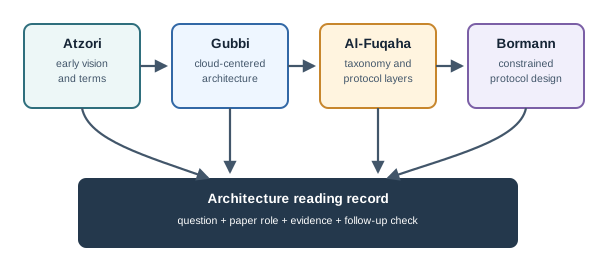
Atzori gives early IoT terms and broad aims.
- Bormann explains small REST systems and compact protocol choices.
- The papers are not a ranked course.
- Old terms must stay apart from reasoning that still holds.
Major section
Reading Workflow
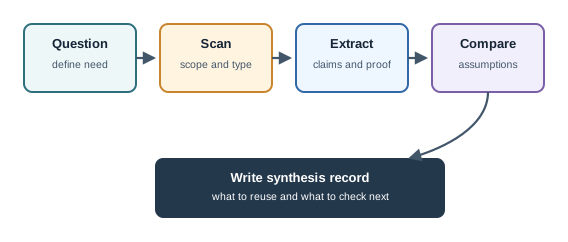
A survey should produce a map.
- A focused protocol paper should produce a design-rationale record.
- It may ask about terms, a layer edge, a map, a cloud role, or a small protocol.
- This stops a survey from being read as a build rule.
- Tie each useful claim to a figure, section, table, or stated limit.
Major section
Synthesis Record
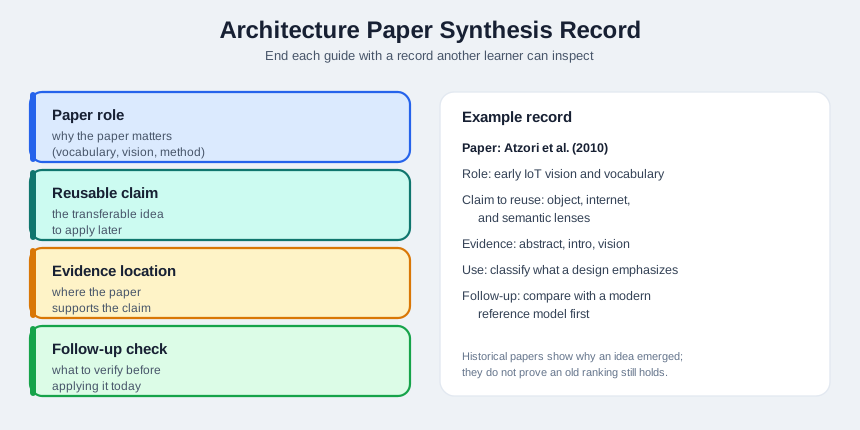
A useful paper guide ends with a synthesis record that another learner can inspect.
- This record preserves a useful idea without treating an older paper as proof of current performance.
- They do not automatically prove that an old comparison, deployment example, or technology ranking still holds.
Major section
Deep Dive: Reading Architecture Papers Through Layered Models
IoT architecture surveys almost always describe systems as a stack of layers, but there is no single canonical model.
- The two most common teaching lenses are the three-layer model and the five-layer model.
- The five-layer model adds explicit processing or middleware concerns and a business layer.
Major section
Deep Dive: Reading Architecture Papers Through Layered Models (continued)
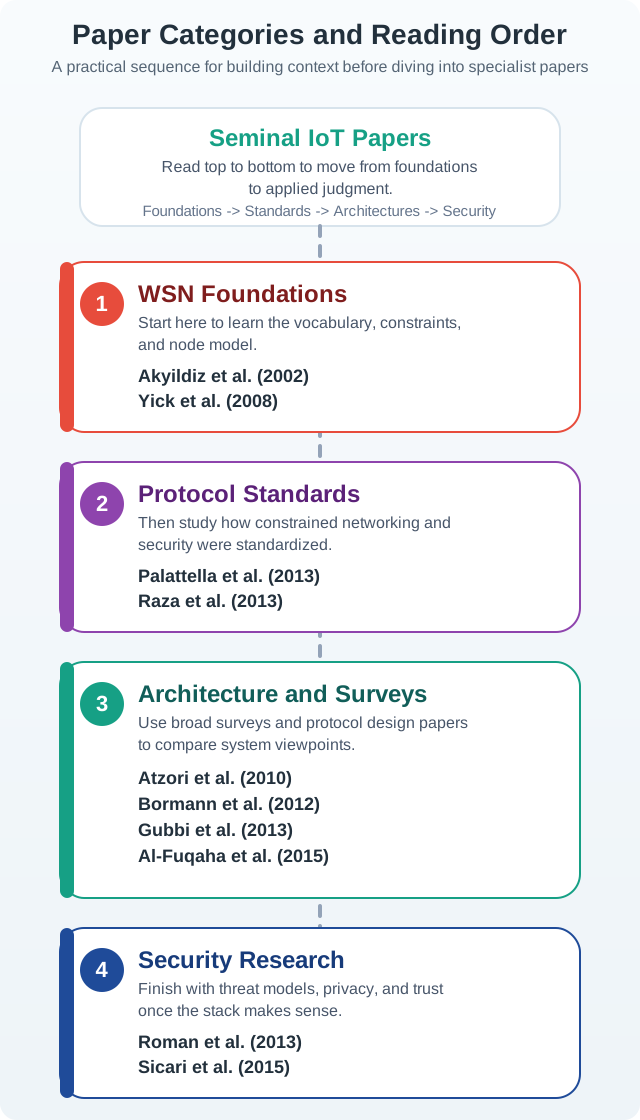
WSN foundations introduce node limits and the vocabulary behind device work.
- Protocol standards then show how constrained networking and security choices are described.
- The architecture and surveys lane brings Atzori, Bormann, Gubbi, and Al-Fuqaha together so a reader can compare viewpoints and boundaries in their papers.
- These models are lenses, not laws.
Major section
Deep Dive: Reading Architecture Papers Through Layered Models (continued)
The four papers in this guide should be read with that distinction in mind.
- Security research follows once the stack and its trust surfaces are clearer.
- This order helps a design review keep a paper's model in context.
- Al-Fuqaha et al. Provides a broad taxonomy across enabling technologies, protocols, and applications.
Major section
Deep Dive: Reading Architecture Papers Through Layered Models (continued)
The model choice should follow the decision, not the other way around.
- A three-layer or five-layer diagram can organize the system, but the paper's assumptions and current deployment needs still decide how far its claim travels.
- Smart parking makes the difference concrete.
- Practitioners should also note what each model hides.
Major section
Deep Dive: Reading Architecture Papers Through Layered Models (continued)
The same smart-building system can be drawn as three layers in an introductory survey or as five layers in a paper focused on platform responsibilities.
- Atzori et al. Gives early vocabulary and the things-oriented, internet-oriented, and semantic-oriented views.
- Bormann et al. Is narrower: it explains why CoAP maps REST-style interaction onto constrained nodes using compact messages and selective reliability.
- Those functions are stable even when the diagrams differ.
Major section
Deep Dive: Reading Architecture Papers Through Layered Models (continued)
If your architecture question is "where do packets flow?", three layers may be enough.
- None of those papers should be treated as a frozen modern reference architecture; each gives a model to test against current constraints.
- The five-layer model refines the middle and top of the stack, which is where much IoT complexity actually lives.
- For Atzori, record whether a claim is about objects, internet connectivity, or semantics.
Major section
Deep Dive: Reading Architecture Papers Through Layered Models (continued)
A three-layer sketch can hide identity lifecycle, time synchronization, schema evolution, and OTA update ownership.
- In a design review, use the three-layer model when you need a fast sketch of who senses, who transports, and who serves the user.
- If your question is "where do stale occupancy values get filtered and who owns pricing decisions?", five layers preserve the responsibility boundary.
- Fog and edge placement make this especially important.
Major section
Deep Dive: Reading Architecture Papers Through Layered Models (continued)
Through the three-layer lens the middle three may collapse into "application", which is why a survey using the five-layer model can describe the same system in more useful detail.
- For Gubbi, ask what work the cloud platform performs and which functions would move to a gateway, edge node, or fog tier in a latency-sensitive deployment.
- For Al-Fuqaha, treat each taxonomy row as a classification aid, then check whether current standards and devices still match the paper's categories.
- That variation is not noise; it shows which responsibilities the paper needs to make visible.
Major section
Deep Dive: Reading Architecture Papers Through Layered Models (continued)
A five-layer sketch can make a system look more separable than it is: a firmware sleep policy can affect cloud freshness, and a business rule can change radio traffic by altering sampling intervals.
- A security paper may prefer the five-layer model to talk about middleware threats; a networking paper may use three layers and zoom into the network layer.
- The practical skill is to read past the layer names to the functions.
- In a cloud-centered model, the gateway may forward data upward and leave analytics, storage, and applications to the cloud.
Major section
Deep Dive: Reading Architecture Papers Through Layered Models (continued)
A paper may call the gateway a transport element, a middleware component, or an edge node; what matters is whether it filters data, translates protocols, buffers during outages, terminates security sessions, or makes local control decisions.
- In a fog-augmented model, a gateway, micro data center, or substation controller may run local rules, aggregate sensor streams, and respond when cloud connectivity is unavailable.
- That difference changes latency, privacy exposure, bandwidth, failure mode, and update responsibility.
- Recognizing that lets you compare their contributions by function rather than being misled by layer counts.
Major section
Deep Dive: Reading Architecture Papers Through Layered Models (continued)
A good reading record therefore captures not only the layer diagram, but the reason compute is placed there and the evidence the authors give for that placement.
- Two papers can describe similar smart-grid systems while using different layer counts: one might use a three-layer diagram, while the other uses a fog-augmented five-layer diagram with a substation compute tier.
- A survey figure can give you vocabulary but not the measured latency of an edge rule.
- A cloud architecture paper can explain service composition but may not capture today's device-management, certificate-rotation, or data-sovereignty constraints.
Major section
Common Pitfalls
An influential paper may be the wrong starting point for a specific question.
- Technology assumptions change.
- A design paper explains why one design was chosen.
- Notes are weak when they do not point back to a section, figure, table, or stated assumption.
- Evidence locations make review possible.
Deck summary
Key takeaways
Four respected papers sit on the table, but each was written for a different question and time.
- You will use architecture papers to build a reading record that separates reusable ideas from historical assumptions.
- Atzori gives early IoT terms and broad aims.
- A survey should produce a map.
- A useful paper guide ends with a synthesis record that another learner can inspect.
Retrieval practice
Recall check 1 of 2

Physics Phoebe says: answer from memory, then check your reasoning.
Q1You need historical vocabulary for the early IoT paradigm before comparing later architecture models. Which paper should you start with?
Show answer
Answer: C Atzori et al.
Q2What makes a paper reading record useful for architecture work?
Show answer
Answer: C Architecture reading records should connect claims to evidence, use, and follow-up checks.
Retrieval practice
Recall check 2 of 2
Physics Phoebe says: answer from memory, then check your reasoning.
Q3What paper details reveal how strongly a method and result support its claim?
Show answer
Answer: D Method, workload, baseline, and result show how strongly the paper supports its claim.
Print reference
Answers
Answer key.
- C · Atzori et al.
- C · Architecture reading records should connect claims to evidence, use, and follow-up checks.
- D · Method, workload, baseline, and result show how strongly the paper supports its claim.