Connected Product and Service Design · Study deck
Device Pairing: Discovery Decisions
The setup must prove the device, the person, the grant, and the way back after a mistake.
UX Uma is your guide for this deck.
After studying this chapter
Learning objectives
You will be able to:
- separate discovery, identification, proof of possession, credential binding, authorization, and recovery
- review discovery results for ambiguity, stale devices, privacy exposure, and setup burden
- explain how pairing methods affect security, accessibility, support, and ownership transfer
- identify what users and support teams need when pairing fails or a device is already owned
Major section
Pair the Right Door Lock
The setup must prove the device, the person, the grant, and the way back after a mistake.
- Pairing the lock is a claim about identity and permission, not just a successful radio exchange.
- A discovered radio identifier alone is not proof that the right household has taken ownership.
- The user may be tired.
Major section
Pair the Right Door Lock (continued)
The room may be loud or dark.
- The resident must select the correct physical lock, prove the setup request, grant only the intended home access, and have a way to recover from a mistaken or interrupted setup.
- A protocol name does not certify the installed pairing experience.
- A device may be low on power.
Major section
Pair the Right Door Lock (continued)
The Practitioner depth tests labels, retries, delegation, and recovery for the chosen product.
- After setup, show which household owns it and which controls are available.
- If the app loses contact halfway through, reveal whether ownership changed before offering retry or reset.
- A sound design still has to work on a bad day.
Major section
Pair the Right Door Lock (continued)
A link may come and go.
- Two records may reach the screen in the wrong order.
- The first view should show what happened, when it happened, and what is known now.
- It should not make the user decode a long list before taking a safe step.
- Each answer should be easy to find.
Major section
Minimum Viable Understanding
A scan result that lists several similar devices can still be a poor experience if the user cannot tell which one is in their hand, room, machine, vehicle, or customer site.
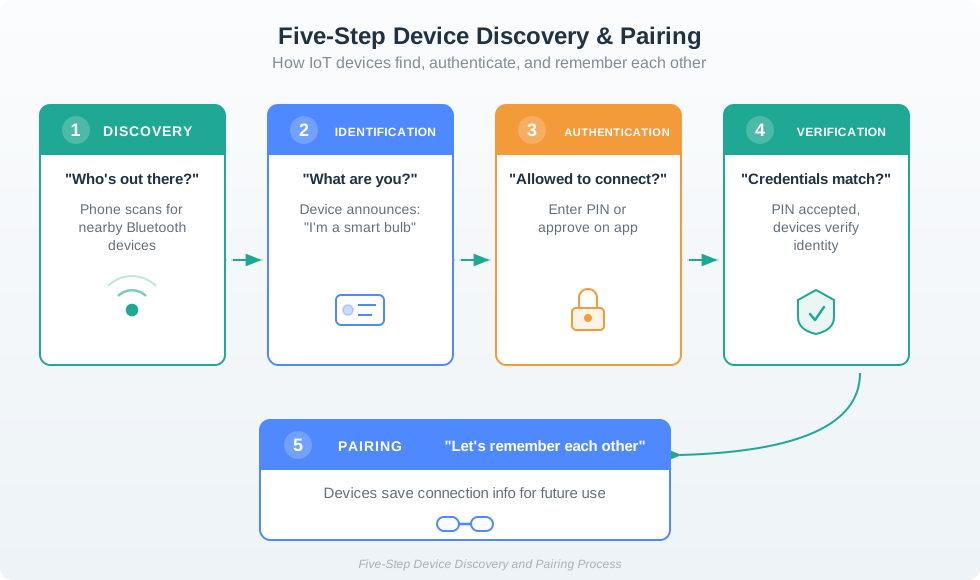
- Discovery lets the phone notice a nearby Bluetooth candidate.
- Identification gives the candidate a claimed type, such as a smart bulb, but that announcement does not grant control.
- Pairing is the last step, not the first.
Major section
Overview: Pairing Is a Chain of Trust
Without that separation, users can end up with duplicate devices, old owners retaining access, cloud records without local joins, or local joins that support cannot diagnose.
- Discovery and pairing are not one step.
- A smooth setup screen is weak if any link in that chain is ambiguous.
- Good pairing UX makes the hidden relationship visible.
Major section
Overview: Pairing Is a Chain of Trust (continued)
A product first discovers candidates, then helps the user identify the correct physical device, proves possession or authority, creates credentials, assigns permissions, and stores enough state to recover later.
- The review should ask what the user can see, touch, scan, hear, or verify at the installed location.
- It explains when the device is only nearby, when possession has been checked, when a credential has been created, when a role has been granted, and when the setup can be safely retried or transferred.
- Binding: the system stores keys, tokens, certificates, network credentials, hub membership, account links, roles, and revocation paths.
Major section
Review Installed Setup Paths
Matter, Thread, Zigbee, BLE, Wi-Fi, LoRaWAN, and cellular products can all have strong or weak setup experiences depending on labels, ownership checks, retries, account rules, and support visibility.
- A resident scanning a smart lock, a maintenance worker replacing a thermostat, a technician commissioning a LoRaWAN sensor, and a lab student adding a gateway all need different proof, delegation, and recovery paths.
- The review should include the physical label, setup window, account role, network credential path, gateway or cloud dependency, and what the UI says when any one of those pieces fails.
- The accepted record should name the owner of each unresolved tradeoff.
Major section
Discovery, Authority, Credentials
Discovery can suggest proximity, but proximity is not ownership.
- Matter uses setup payloads and commissioning windows, then establishes session security and fabric membership.
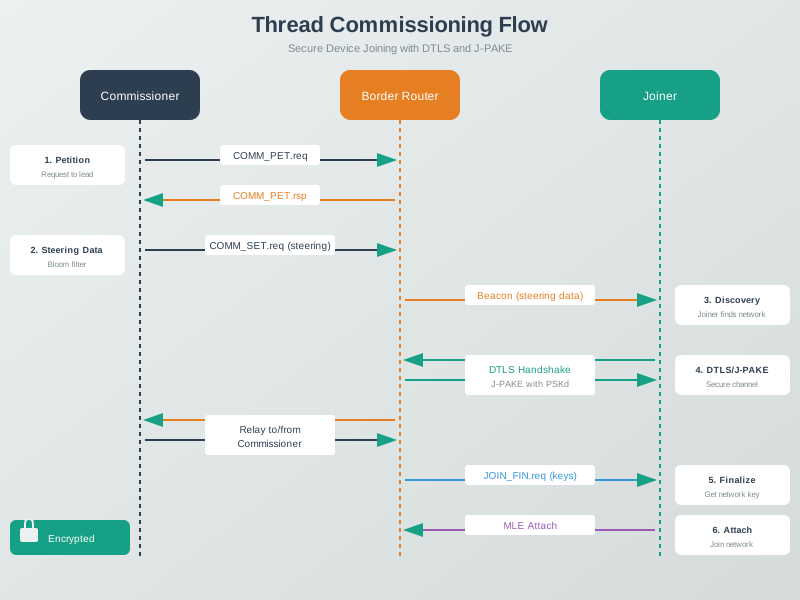
- Thread devices authenticate with a commissioner and receive network credentials during joining; on-mesh commissioning does not require a border router.
- Zigbee products may use install codes or touchlink-style flows.
- The commissioner controls entry.
Major section
Discovery, Authority, Credentials (continued)
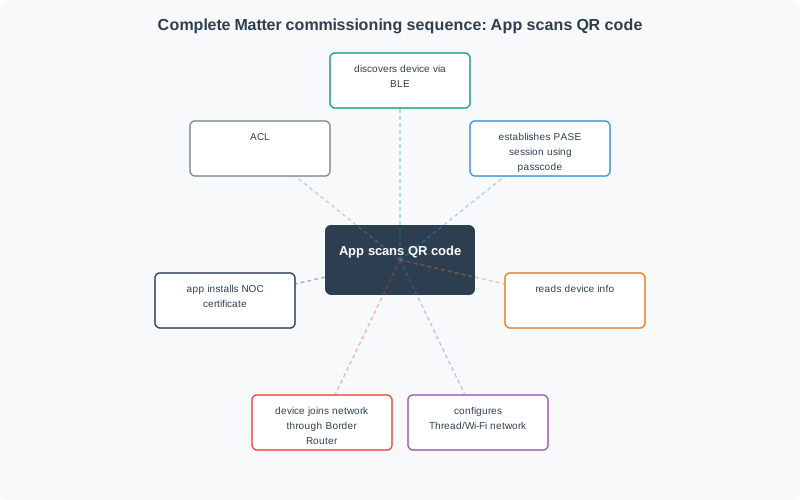
Discovery alone does not establish operational membership or access rights; the pictured topics need a separate ordered commissioning trace to show those transitions.
- LoRaWAN OTAA uses device and join identities with keys managed outside the phone UI.
- These details shape what can be recovered, transferred, revoked, or inspected.
- The secure exchange carries keys and other join data.
Major section
Discovery, Authority, Credentials (continued)
That state does not prove that each cloud account or app role is correct.
- The graphic lists discovery, PASE, device information, network configuration, certificate installation, and access-control topics around a QR scan; use the prose below to check the actual order and missing attestation step.
- A device can therefore be found without being authorized, or joined without the intended role being complete.
- Credential storage and revocation need the same separation.
Major section
Discovery, Authority, Credentials (continued)
The implementation should preserve those intermediate states, just as the Thread path in Figure: Thread commissioning shows why review evidence needs the preserves distinct infrastructure responsibilities.
- A repair can then target the failed layer instead of resetting every part of the product.
- Phones, hubs, gateways, devices, and cloud services may each hold pairing tokens, Wi-Fi credentials, network keys, certificates, refresh tokens, or role grants.
- A clean unpairing flow must know which stores to delete or rotate, which audit records to preserve, and which old owner, installer, tenant, or support credential should stop working.
Deck summary
Key takeaways
The setup must prove the device, the person, the grant, and the way back after a mistake.
- The room may be loud or dark.
- The Practitioner depth tests labels, retries, delegation, and recovery for the chosen product.
- A link may come and go.
- A scan result that lists several similar devices can still be a poor experience if the user cannot tell which one is in their hand, room, machine, vehicle, or customer site.
Retrieval practice
Recall check 1 of 3
UX Uma says: answer from memory, then check your reasoning.
Q1A rental-building team is choosing a pairing flow for smart thermostats installed by maintenance staff and later transferred to residents. Which review record is strong enough to approve the flow?
Show answer
Answer: A A reviewable pairing decision ties scan scope, physical identity, possession proof, credential binding, role assignment, recovery, support evidence, owner, accepted limits, and change condition together before the setup flow is trusted.
Retrieval practice
Recall check 2 of 3
UX Uma says: answer from memory, then check your reasoning.
Q2A setup scan shows several identical nearby thermostats. What should the app require before it binds one to the account?
Show answer
Answer: D Confirm the physical unit with a label, scan, or indicator and check authority to pair it.
Retrieval practice
Recall check 3 of 3
UX Uma says: answer from memory, then check your reasoning.
Q3An installer pairs a thermostat for a new resident, then leaves the site. Which role decision limits later access risk?
Show answer
Answer: D Give the installer a temporary setup role and verify its revocation after resident handoff.
Print reference
Answers
Answer key.
- A · A reviewable pairing decision ties scan scope, physical identity, possession proof, credential binding, role assignment, recovery, support evidence, owner, accepted limits, and change condition together before the setup flow is trusted.
- D · Confirm the physical unit with a label, scan, or indicator and check authority to pair it.
- D · Give the installer a temporary setup role and verify its revocation after resident handoff.