IoT Fundamentals · Study deck
Packet Anatomy
Picture a receiver that accepts a valid packet but assigns the temperature to the wrong device.
Physics Phoebe is your guide for this deck.

After studying this chapter
Learning objectives
A repeatable packet parse separates framing, interpretation, and integrity evidence.
- Mark the packet boundary.A documented delimiter or length prevents guessed offsets.
- Separate header from application payload.Control fields and readings have different meanings.
- Verify the check over its specified bytes.A passing check does not establish the payload meaning.
Major section
Start With the Story
You will separate a captured frame into header, payload, and check fields, then explain how the receiver interprets each part.
- A receiver first sees one continuous message, and the conflicting parses show that arrival alone cannot reveal field boundaries.
- The team separates control information, application data, and the check before decoding.
Major section
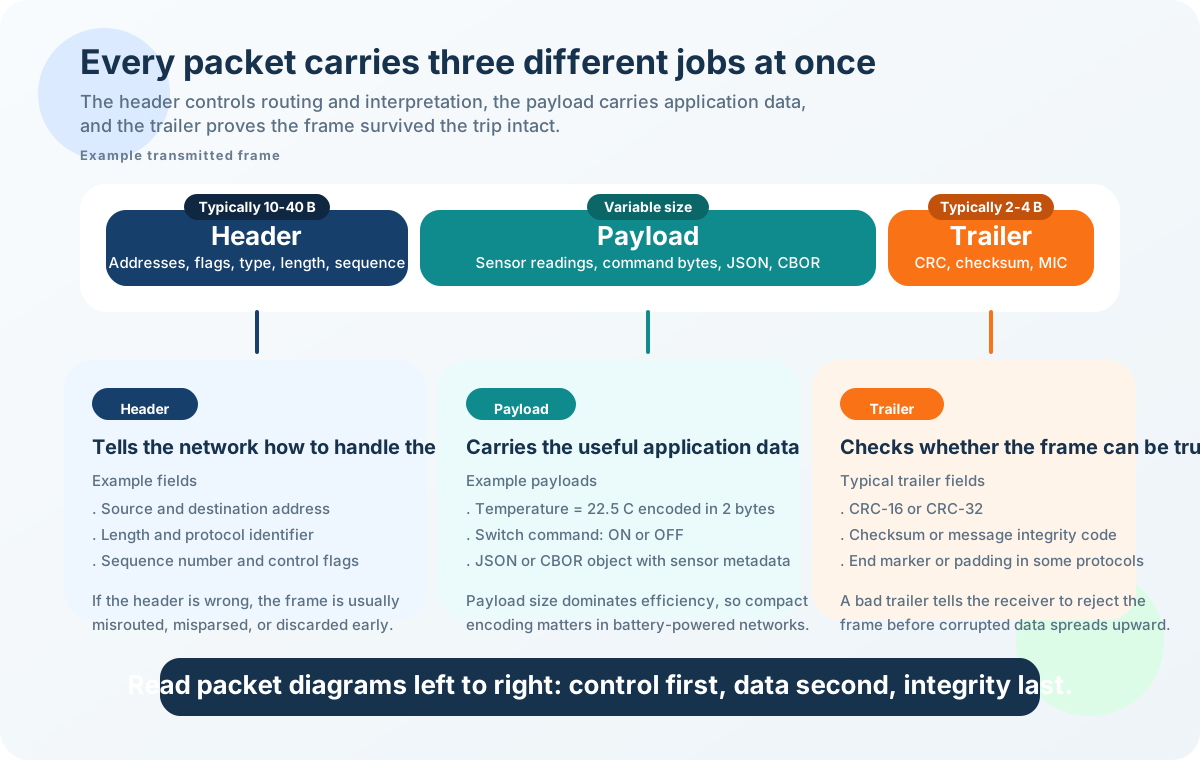
A Packet Is Three Regions
A packet is a structured message, not an undifferentiated string of bytes.
- Packet anatomy is the skill of seeing those regions in raw bytes.
- In real IoT work, those regions appear in different places depending on the layer you are reading.
- An IEEE 802.15.4 or Ethernet frame has link-layer addressing and checks.
Major section
A Packet Is Three Regions (continued)
An IPv6 or UDP packet adds network and transport headers.
- A CoAP, MQTT-SN, BLE advertisement, LoRaWAN MAC frame, or custom serial protocol then adds its own type, length, sequence, flags, or application layout.
- The names change, but the reading habit is the same: identify control fields before trusting the value bytes.
- If you only need the intuition, this layer is enough: think of an addressed parcel.
Major section
A Packet Is Three Regions (continued)
The shipping label (header) says where it goes and how to handle it, the contents (payload) are what you actually wanted, and the tamper seal (check field) tells you whether it arrived intact.
- The payload then gains meaning only through its schema, units, byte order, and encoding contract; a plausible number is not enough.
- This supports the chapter's debugging method: establish control fields and representation before interpreting values, then validate exactly the integrity coverage the protocol defines.
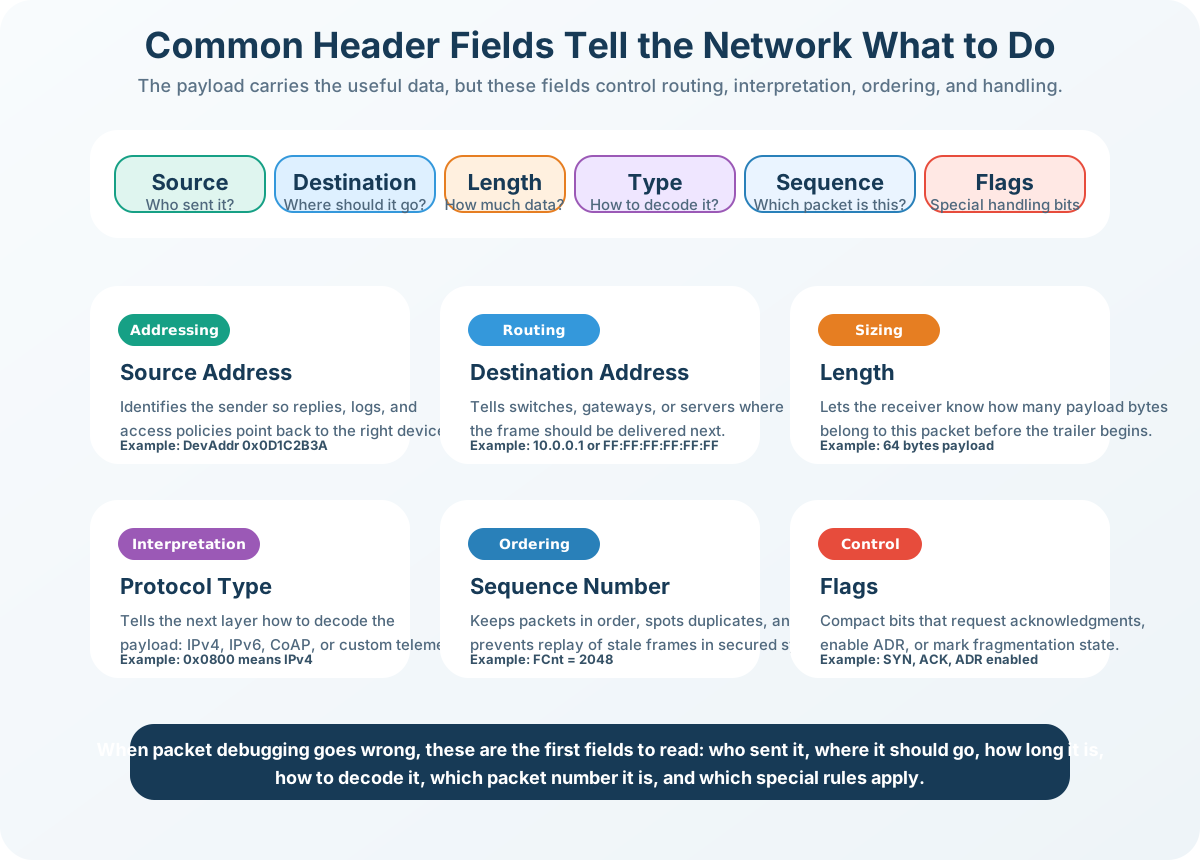
- The receiver reads this first to decide what to do with the rest.
Major section
A Packet Is Three Regions (continued)
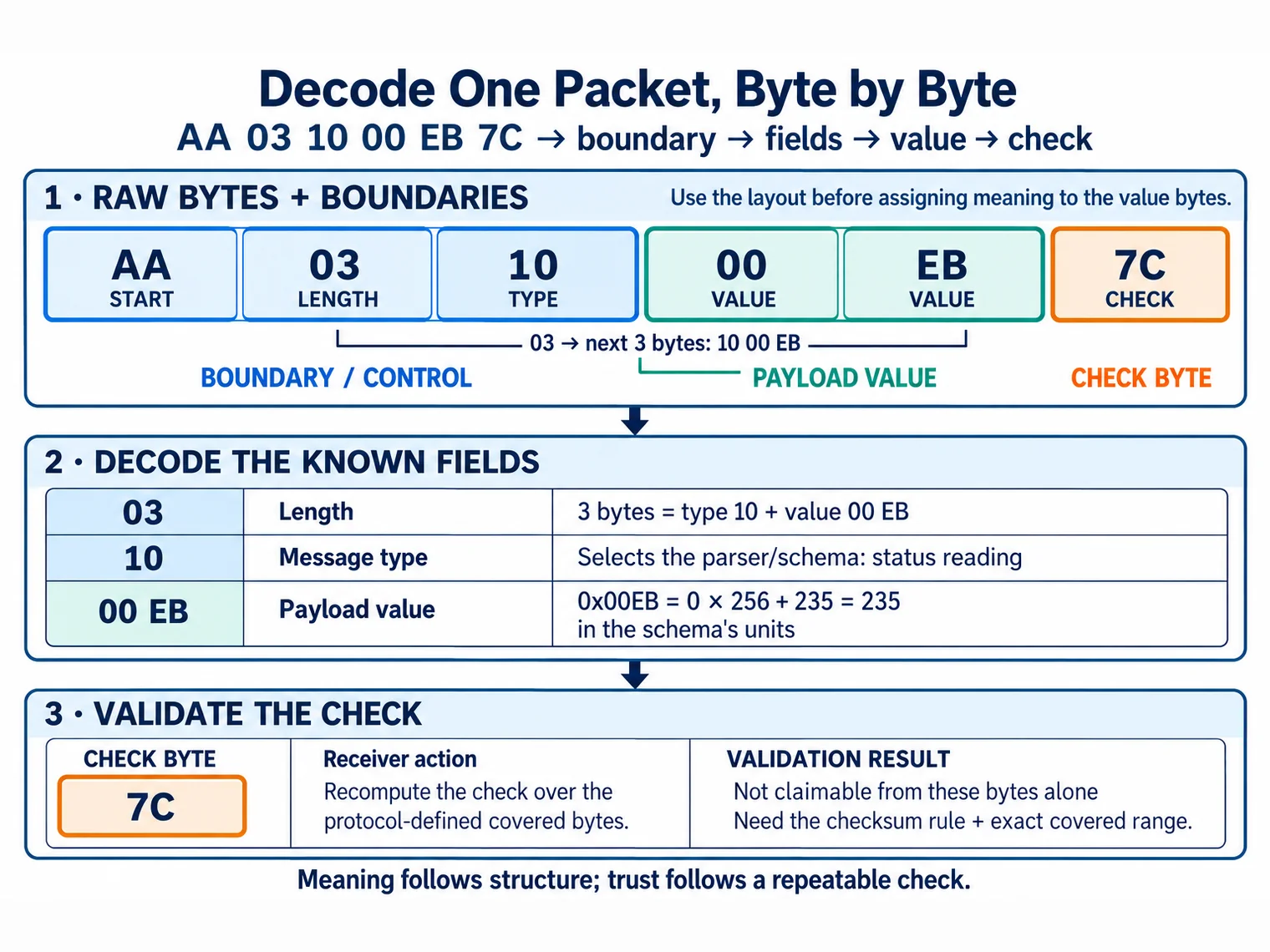
Beginner ExampleA tiny sensor message has a type byte, a two-byte temperature value, and a checksum.
- The type and length belong to the header, the temperature is the payload, and the checksum is the validation field.
- The core review habit is to identify the boundary and control fields before trusting the payload, then validate the check field against the bytes it is supposed to cover.
- The order matters because a length or version error can change where the payload and check are believed to begin.
Major section
Apply It: Read a Packet by Region
Interpret the payload with a contract: Decode the data only after the schema, units, byte order, and nesting rules are known.
- Describes how the receiver should handle the packet.
- Helps detect corruption, truncation, or unauthorized change.
- Its length counts the type together with the value, so field names alone cannot define the parser boundary.
Major section
Under the Hood: Contracts, Overhead, and Workflow
The Payload Needs a Representation ContractA payload is not automatically self-describing.
- The same bytes can be a fixed binary layout, text, a compact structured format, or a nested packet — and each needs its own contract before the values can be trusted.
- Encoding, keys, escaping, length limits, and schema rules.
Major section
Under the Hood: Contracts, Overhead, and Workflow (continued)
A wrong bound can make every later field look sound but false.
- Round-trip tests and parser behavior.
- Outer and inner decode records.
- Overhead Without HypeOverhead is the non-payload part of a packet.
- Common PitfallsGuessing field boundaries: Do not split bytes by eye; use the documented delimiter, length, or frame layout.
Major section
Under the Hood: Contracts, Overhead, and Workflow (continued)
packet bytes = header bytes + payload bytes + check bytes payload share = payload bytes / packet bytes overhead share = non-payload bytes / packet bytes.
- A small payload share can be perfectly acceptable when the extra fields provide needed addressing, integrity, ordering, security, or compatibility.
- A 6-byte frame that is 50% header may still be the right design for a noisy, security-sensitive link.
- Treating the payload as self-describing: Compact bytes, text, and nested formats each need their contract before interpretation.
- Checking the wrong bytes: Integrity fields cover a specific range; confirm exactly which bytes are included.
Deck summary
Key takeaways
You will separate a captured frame into header, payload, and check fields, then explain how the receiver interprets each part.
- A packet is a structured message, not an undifferentiated string of bytes.
- An IPv6 or UDP packet adds network and transport headers.
- The shipping label (header) says where it goes and how to handle it, the contents (payload) are what you actually wanted, and the tamper seal (check field) tells you whether it arrived intact.
- Beginner ExampleA tiny sensor message has a type byte, a two-byte temperature value, and a checksum.
Retrieval practice
Recall questions 1 and 2

Physics Phoebe says: answer from memory, then check your reasoning.
Q1Which packet region usually carries the application data, such as a sensor reading or command?
Show answer
Answer: B Header, payload, and trailer/check fields serve different roles; the payload is the application data.
Q2Why is a packet length field useful?
Show answer
Answer: B Length fields are boundary evidence; they do not replace payload decoding or integrity checks.
Retrieval practice
Recall question 3
Physics Phoebe says: answer from memory, then check your reasoning.
Q3What packet fields tell the receiver how to interpret the bytes that follow?
Show answer
Answer: A Type, version, flags, sequence, and length fields tell the receiver how to process the following bytes.
Print reference
Answers
Answer key.
- B · Header, payload, and trailer/check fields serve different roles; the payload is the application data.
- B · Length fields are boundary evidence; they do not replace payload decoding or integrity checks.
- A · Type, version, flags, sequence, and length fields tell the receiver how to process the following bytes.