Applications & Use Cases · Study deck
IoT Systems Evolution: Computing and Placement
Computing improved, but a sensor system still cannot send every byte to an unlimited cloud without cost, delay, or energy consequences.
Blueprint Bina is your guide for this deck.

After studying this chapter
Learning objectives
You will be able to:
- Explain: Pitfall 3: Ignoring the "last mile" of the 10x cycle: The 10x pattern shows device counts growing from billions to trillions, but the last trillion devices are the hardest.
- Explain: These interacting limits weakened the ideal constant-field relationship and reduced the practicality of relying on frequency growth alone; there was no single universal 65 nm switch.
- Explain: Pitfall 4: Confusing clock speed with real-world performance: A 240 MHz ESP32 is not "60x slower" than a 14 GHz desktop CPU in practical IoT tasks.
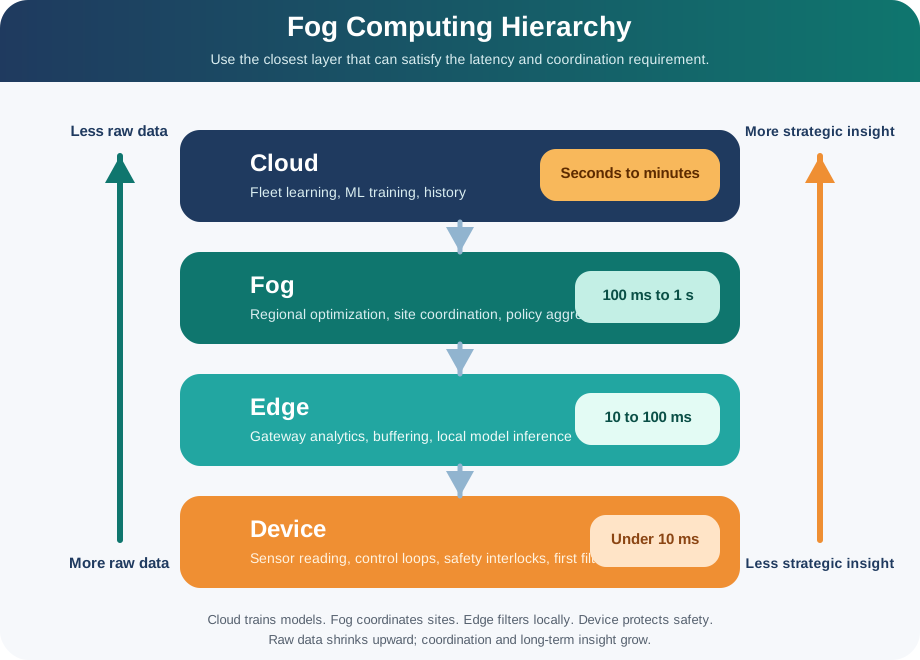
- choose edge, fog, and cloud placement from requirements
Major section
Distributed Computing Economics
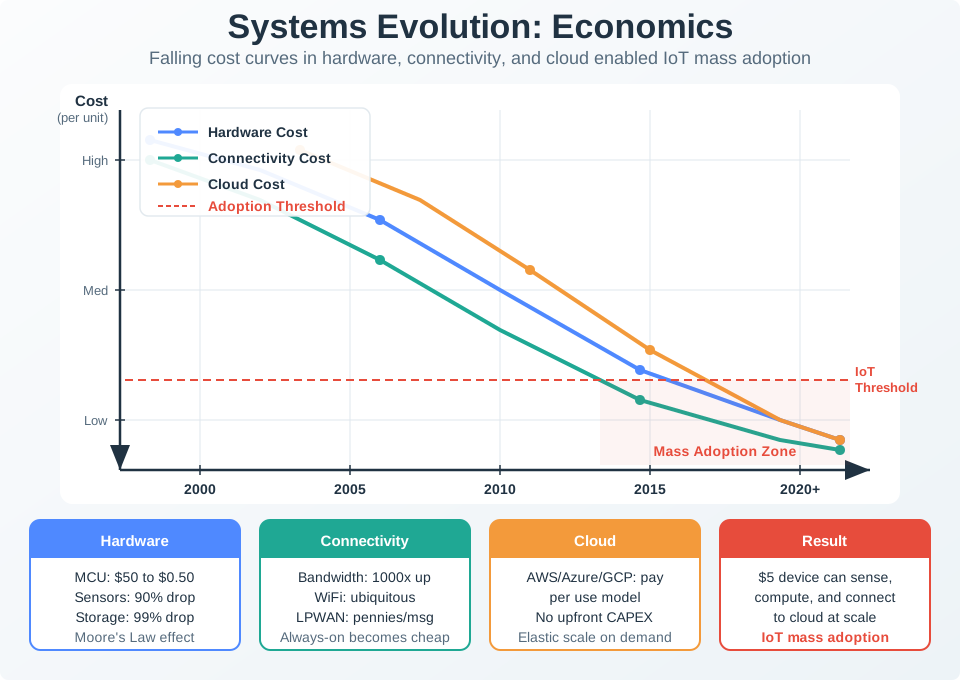
Today's $0.50 microcontroller has more computing power than a $10,000 desktop computer from 1995.
- Real Impact: A security camera can now run face detection locally at 30 fps instead of streaming video to the cloud (99.9% bandwidth reduction).
- The decision in distributed computing economics must preserve that labelled boundary.
Major section
IoT Systems Evolution Myths
Misconception 1: "IoT is just about connecting things to the internet.": Simple connected sensors are valid IoT endpoints.
- Local intelligence is an architecture choice used when latency, resilience, privacy, bandwidth or safety justifies processing near the physical process.
- Misconception 2: "Moore's Law ended, so computing improvement stopped.": Long-run transistor-density gains continued after real technologies departed from ideal Dennard scaling.
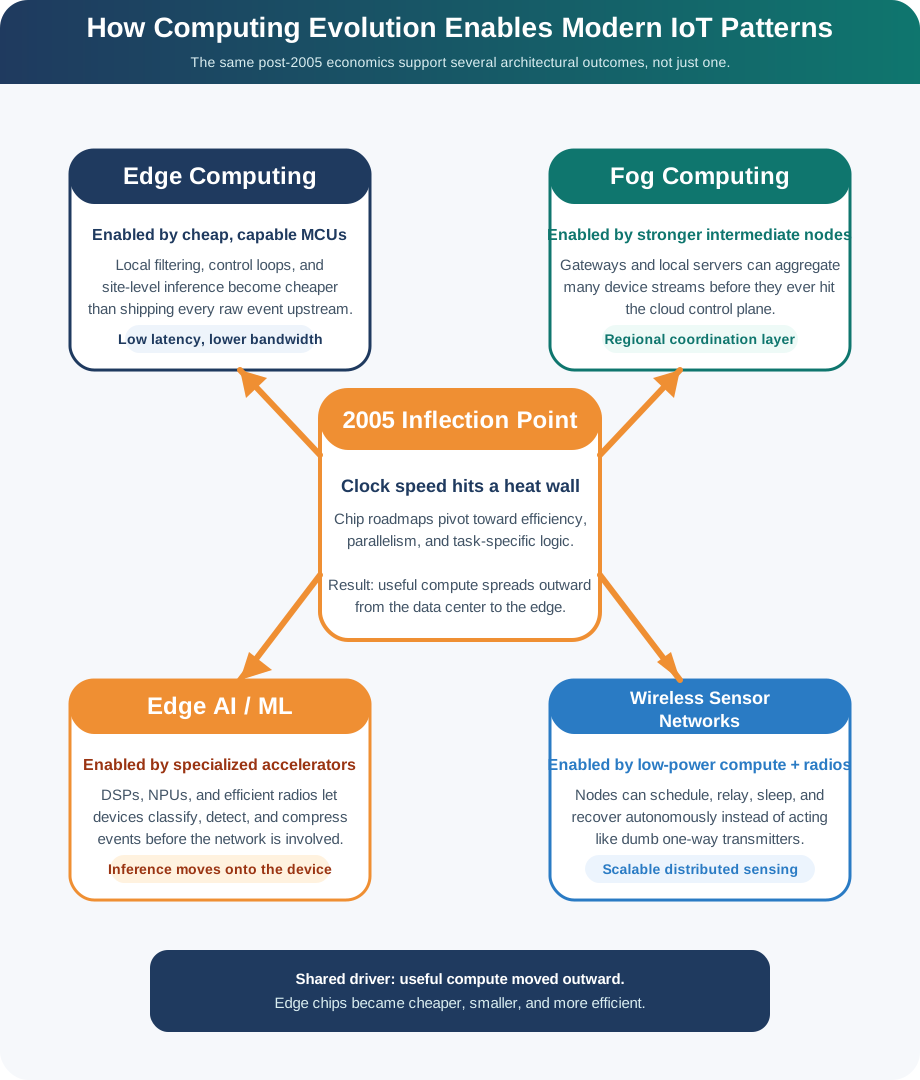
- Misconception 3: "Cloud computing and IoT are competing approaches.": Cloud and edge are complementary, not competing.
- Misconception 4: "IoT just needed cheaper hardware to happen.": Lower component cost was one contributor, not a prerequisite acting alone.
Major section
Systems Evolution Pitfalls
Companies that rip out centralized servers in favor of edge-only architectures discover they still need cloud for ML training, fleet management, and long-term analytics.
- The correct approach is a complementary multi-tier architecture, not wholesale replacement.
- Pitfall 2: Extrapolating Moore's Law linearly into device cost: A $0.50 microcontroller does not mean a $0.50 IoT device.
- Total device cost is typically 10-50x the MCU cost alone.
Major section
Systems Evolution Pitfalls (continued)
Pitfall 3: Ignoring the "last mile" of the 10x cycle: The 10x pattern shows device counts growing from billions to trillions, but the last trillion devices are the hardest.
- They require sub-$1 hardware, 10+ year battery life, and operation in harsh environments (underwater, underground, extreme temperatures).
- Pitfall 4: Confusing clock speed with real-world performance: A 240 MHz ESP32 is not "60x slower" than a 14 GHz desktop CPU in practical IoT tasks.
- Modern microcontrollers have hardware peripherals (DMA, hardware crypto, radio baseband) that offload work from the CPU.
Major section
Computing Evolution Check
These interacting limits weakened the ideal constant-field relationship and reduced the practicality of relying on frequency growth alone; there was no single universal 65 nm switch.
- The centralized approach uses a $100K server with 100-500ms latency.
- The distributed approach uses 1,000 smart sensors with $2 microcontrollers and 1-10 ms latency.
- The upfront saving is $100K - $2K = $98K.
Major section
Cost Curves: When Edge Becomes Cheaper
For cost curves: when edge becomes cheaper, the useful result is the reasoning chain: observed condition, governing constraint, calculation or classification, and operational consequence.
- Where the panel supplies several choices, reject each distractor against the chapter's named mechanism instead of relying on wording cues.
- This turns cost curves: when edge becomes cheaper into evidence that can be reviewed, recalculated, and connected to the running design narrative.
- Key insight: Technology convergence widened edge-processing options, but the appropriate architecture depends on latency, data volume, connectivity, power, privacy, safety and fleet-learning constraints.
Deck summary
Key takeaways
Today's $0.50 microcontroller has more computing power than a $10,000 desktop computer from 1995.
- Misconception 1: "IoT is just about connecting things to the internet.": Simple connected sensors are valid IoT endpoints.
- Companies that rip out centralized servers in favor of edge-only architectures discover they still need cloud for ML training, fleet management, and long-term analytics.
- Pitfall 3: Ignoring the "last mile" of the 10x cycle: The 10x pattern shows device counts growing from billions to trillions, but the last trillion devices are the hardest.
Retrieval practice
Recall check 1 of 5

Blueprint Bina says: answer from memory, then check your reasoning.
Q1A company wants to deploy 10,000 soil sensors across farmland. An engineer argues that since MCUs now cost $0.50 each, the total hardware budget should be $5,000. Using the systems evolution pitfalls discussed above, why is this estimate dangerously low?
Show answer
Answer: B
Retrieval practice
Recall check 2 of 5

Blueprint Bina says: answer from memory, then check your reasoning.
Q2Complete the healthcare IoT vital signs aggregator:
Show answer
Answer: A Negative slicing [-window_size:] takes the last N elements for a moving average.
Q3A farm is evaluating a large soil-sensor deployment. Which economic change most directly improves feasibility as the node count grows?
Show answer
Answer: A Falling total node cost improves the economics of dense sensing, but cost is not the only factor.
Retrieval practice
Recall check 3 of 5

Blueprint Bina says: answer from memory, then check your reasoning.
Q4Before accepting the chapter's illustrative claim that distributed factory placement saves $98K upfront, which evidence is most important?
Show answer
Answer: C Treat the $98K result as an illustrative scenario, not a universal historical fact.
Retrieval practice
Recall check 4 of 5

Blueprint Bina says: answer from memory, then check your reasoning.
Q5A factory compares centralized vs distributed IoT architectures. The centralized approach uses a $100K server with 100-500ms latency. The distributed approach uses 1,000 smart sensors with $2 microcontrollers and 1-10 ms latency. What is the approximate upfront cost savings of the distributed approach?
Show answer
Answer: C
Retrieval practice
Recall check 5 of 5

Blueprint Bina says: answer from memory, then check your reasoning.
Q6Which statement best relates the mid-2000s power-efficiency pivot to cheaper computing, energy efficiency and specialised accelerators?
Show answer
Answer: B
Print reference
Answers
Answer key.
- B
- A · Negative slicing [-window_size:] takes the last N elements for a moving average.
- A · Falling total node cost improves the economics of dense sensing, but cost is not the only factor.
- C · Treat the $98K result as an illustrative scenario, not a universal historical fact.
- C
- B