Applications & Use Cases · Study deck
IoT Requirements: Five-Layer and Seven-Layer Models
A five-layer model is a useful first map.
Blueprint Bina is your guide for this deck.

After studying this chapter
Learning objectives
You will be able to:
- Explain: In 60 Seconds:: This chapter covers IoT requirements and characteristics, explaining the core concepts, practical design decisions, and common pitfalls that IoT practitioners need to build effective, reliable connected systems.
- Explain: Fast, 15%:: Device A scores 5/10 because 15-minute intervals are too slow; Device B scores 9/10 at five minutes; Device C scores 10/10 at one minute.
- Explain: TCO ≠ purchase price: Device A's $89 price looks attractive, but 5-year TCO is 31% higher than Device B due to battery replacement visits and firmware update logistics.
- Explain: Domain determines priorities.
Major section
Visual Bridge: From 5 Layers to 7
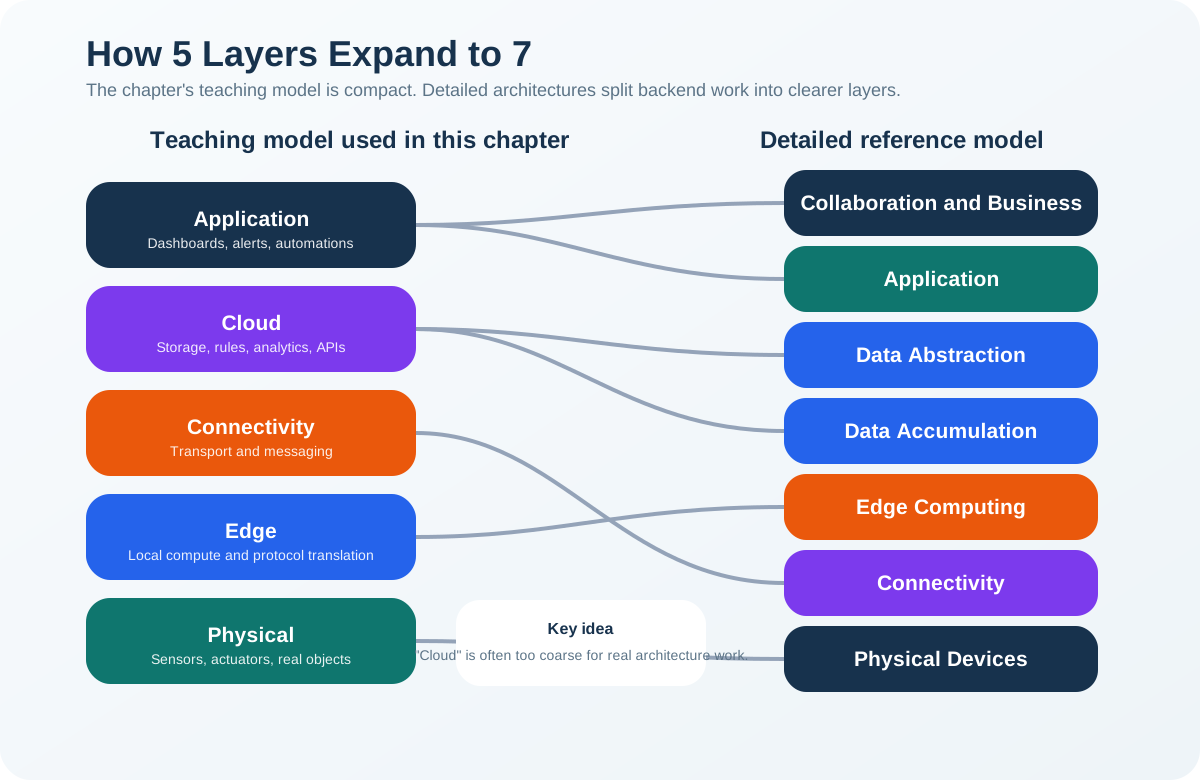
The five-layer model used earlier in the chapter is a teaching shortcut.
- Detailed reference architectures split the backend into more specific data and business layers when you need sharper design boundaries.
- Switch to the seven-layer reference view when you need to separate storage, abstraction, applications, and business processes explicitly.
Major section
Eleven Characteristics Selection
Scenario:: A hospital system must choose between three remote patient monitoring (RPM) wearable devices for 5,000 chronic heart failure patients.
- Secure, critical 9/10:: HIPAA compliance and patient health data protection are mandatory.
- Fast, high 7/10:: Heart failure alerts need less than five-minute latency.
- Agile, low 4/10:: Clinical protocols change slowly.
- Domain determines priorities.
Major section
Eleven Characteristics Selection (continued)
Adaptable, medium 5/10:: Epic EHR integration matters, but the scope is defined.
- Low Maintenance, high 8/10: 5,000 devices with frequent battery visits would be unsustainable.
- Upgradable, high 8/10:: FDA-required firmware patches and clinical protocol changes must reach the fleet.
- Ubiquitous, low 3/10:: The device works at home and clinic, not everywhere.
Major section
Eleven Characteristics Selection (continued)
Growing, medium 6/10:: The system may expand to 10,000 patients, but not 100,000.
- Smart, medium 6/10:: Local anomaly detection helps, but is not the primary decision driver.
- On Demand, low 4/10:: Medical monitoring is periodic, not an instant-response consumer interaction.
- Characteristics predict TCO: Low Maintenance and Upgradable directly correlate with operational costs.
Major section
Eleven Characteristics Selection (continued)
Secure, 20%:: Device A scores 7/10 because the proprietary design is hard to audit; Devices B and C score 9/10 with standard protocols.
- Fast, 15%:: Device A scores 5/10 because 15-minute intervals are too slow; Device B scores 9/10 at five minutes; Device C scores 10/10 at one minute.
- Upgradable, 20%:: Device A scores 2/10 because updates require return; Device B scores 10/10 with automatic OTA; Device C scores 7/10 with manual OTA.
- Hardware for 5,000 devices:: Device A costs $445,000; Device B costs $995,000; Device C costs $725,000.
Major section
Eleven Characteristics Selection (continued)
In 60 Seconds:: This chapter covers IoT requirements and characteristics, explaining the core concepts, practical design decisions, and common pitfalls that IoT practitioners need to build effective, reliable connected systems.
- Firmware updates:: Device A costs $225,000 for return shipping across three updates; Device B costs $0 with OTA; Device C costs $75,000 for two manual updates.
- Prevented hospitalizations per 5,000 patients per year:: Device A prevents 360, Device B prevents 470, and Device C prevents 480.
- Cost per hospitalization:: All three use the same $12,500 avoided-cost assumption.
Major section
Eleven Characteristics Selection (continued)
Decision:: Device B costs $110 more per unit than Device A, but saves $331K in 5-year TCO and delivers $6.9M more in clinical value.
- Device C has slightly better clinical outcomes ($600K over 5 years) but costs $226K more than Device B and scores lower on critical characteristics (Low Maintenance, Upgradable).
- TCO ≠ purchase price: Device A's $89 price looks attractive, but 5-year TCO is 31% higher than Device B due to battery replacement visits and firmware update logistics.
- This framework prevents "gut feel" decisions and ensures the right trade-offs for your use case.
Deck summary
Key takeaways
The five-layer model used earlier in the chapter is a teaching shortcut.
- Scenario:: A hospital system must choose between three remote patient monitoring (RPM) wearable devices for 5,000 chronic heart failure patients.
- Adaptable, medium 5/10:: Epic EHR integration matters, but the scope is defined.
- Growing, medium 6/10:: The system may expand to 10,000 patients, but not 100,000.
- Secure, 20%:: Device A scores 7/10 because the proprietary design is hard to audit; Devices B and C score 9/10 with standard protocols.
Retrieval practice
Recall check 1 of 3

Blueprint Bina says: answer from memory, then check your reasoning.
Q1Place each architecture layer where it lives so you can trace a requirement from real-world sensing through transport and processing to a user-visible outcome.
Show answer
Answer: E Trace a requirement across physical capability, local computation, transport, shared processing, and user outcome so you can assign latency, reliability, security, and ownership to the layer that can actually satisfy them.
Q2Complete the device classifier based on this chapter's minimum requirements:
Show answer
Answer: A The logic mirrors the chapter's classification model.
Retrieval practice
Recall check 2 of 3

Blueprint Bina says: answer from memory, then check your reasoning.
Q3A farmer is choosing IoT technology for soil moisture monitoring across 500 acres. The sensors need to operate for 5+ years on batteries, transmit small data packets twice daily, and work in areas with no cellular coverage. Which three IoT characteristics should be prioritized, and which connectivity technology best matches?
Show answer
Answer: C Agricultural IoT prioritizes Low Maintenance (5+ year battery life, minimal field visits), Growing (scalable from 10 to 500+ sensors), and Adaptable (different crop types and soil conditions).
Retrieval practice
Recall check 3 of 3

Blueprint Bina says: answer from memory, then check your reasoning.
Q4A fitness band measures activity, sends its data by Bluetooth to a phone, and the phone app relays that data to a cloud service. Using the Three Ingredients Test (Thing + Computation + Internet), is the band part of an IoT wearable system?
Show answer
Answer: C The Three Ingredients Test applies to the end-to-end product architecture.
Print reference
Answers
Answer key.
- E · Trace a requirement across physical capability, local computation, transport, shared processing, and user outcome so you can assign latency, reliability, security, and ownership to the layer that can actually satisfy them.
- A · The logic mirrors the chapter's classification model.
- C · Agricultural IoT prioritizes Low Maintenance (5+ year battery life, minimal field visits), Growing (scalable from 10 to 500+ sensors), and Adaptable (different crop types and soil conditions).
- C · The Three Ingredients Test applies to the end-to-end product architecture.