IoT Value and Product Strategy · Study deck
IoT Requirements: Connectivity Costs and Trade-Offs
Two radio choices may meet the same need but hide very different costs.
Ada is your guide for this deck.

After studying this chapter
Learning objectives
You will be able to:
- Explain: The mathematical gist: A 2400 mAh cell retaining 99% per year and keeping a 15% reserve leaves about 1850 mAh after ten years: only 21.1 microamps on average.
- Explain: Three characteristics describe what a user feels, three describe how well the system reasons, two cover trust and speed, and three are about living with the fleet after launch.
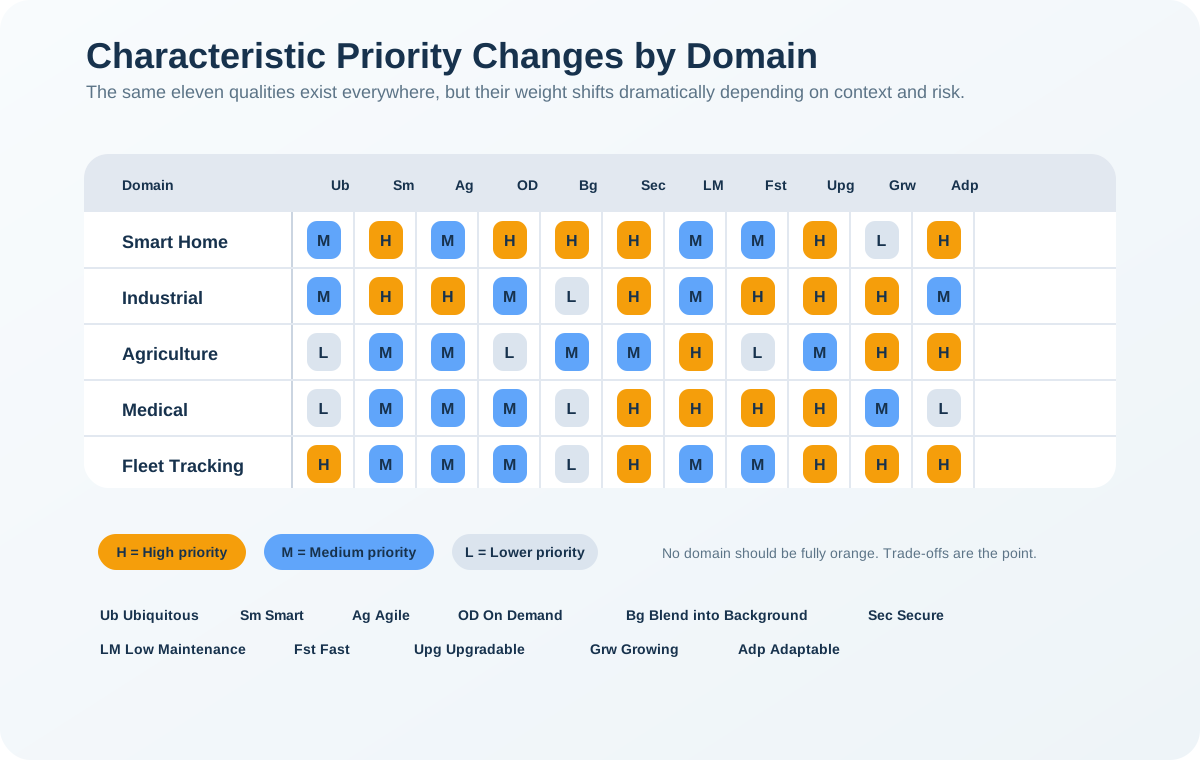
- Explain: The matrix turns broad virtues into explicit priorities, which lets a team explain why it spends power, cost, or complexity on one goal instead of another.
- Explain: 10-minute intervals provide ample warning (regulations require hourly checks).
Major section
Connectivity Technology TCO
Cost savings: ($55K - $34K) / $55K = 38%: Lower operational costs (10-year batteries, no SIM management) drive LoRaWAN ROI despite higher initial gateway investment.
- Pharmaceutical storage temperature changes gradually (hours, not seconds).
- Refrigeration systems have thermal mass - temperature drifts slowly.
- 10-minute intervals provide ample warning (regulations require hourly checks).
Major section
Bex's Math Bridge: Turn Years into a Current Budget
The mathematical gist: A 2400 mAh cell retaining 99% per year and keeping a 15% reserve leaves about 1850 mAh after ten years: only 21.1 microamps on average.
- The ten-year line is a measurement contract, not a nameplate promise.
Major section
The Eleven Characteristics of Ideal IoT
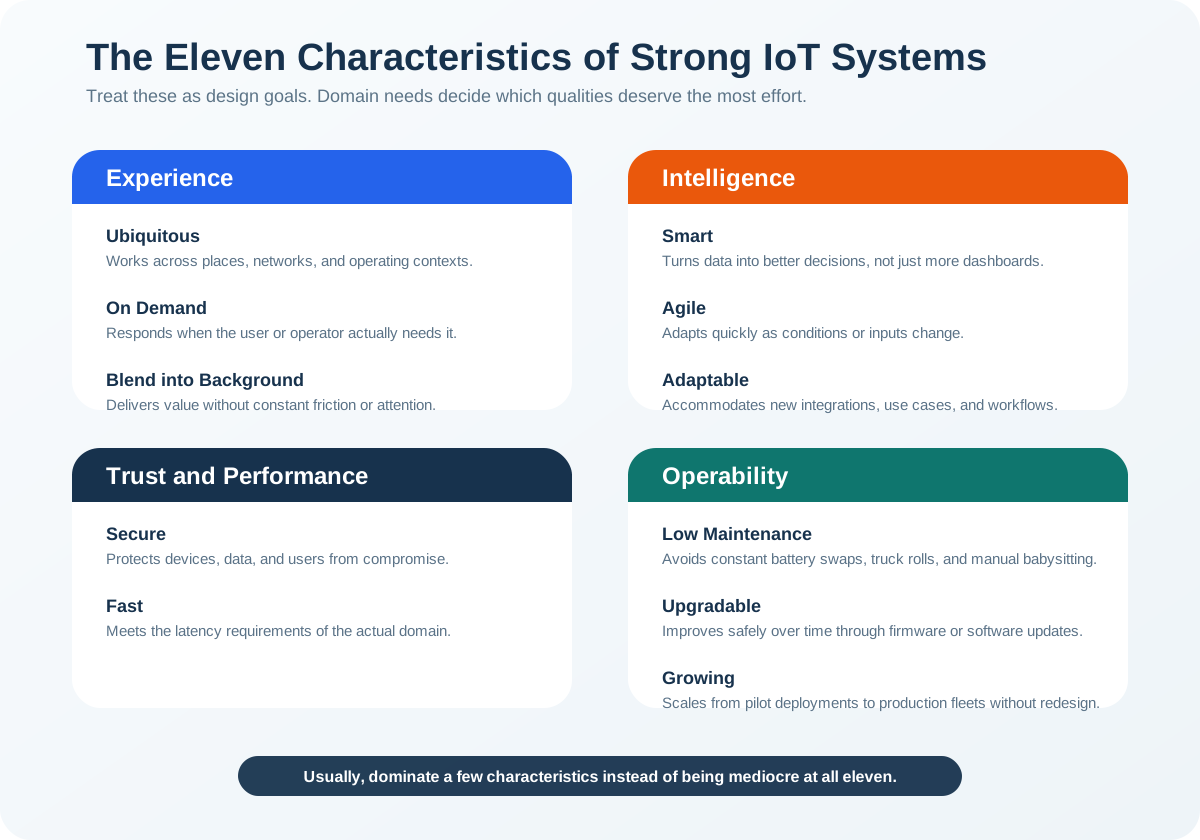
The grouping does the teaching here.
- Three characteristics describe what a user feels, three describe how well the system reasons, two cover trust and speed, and three are about living with the fleet after launch.
Major section
Characteristics as Tradeoffs
Agriculture rates Fast at 3/10 but Growing at 10/10 because a farm may accept hours of delay while scaling across many sensors.
- The matrix turns broad virtues into explicit priorities, which lets a team explain why it spends power, cost, or complexity on one goal instead of another.
Major section
Characteristics as Tradeoffs (continued)
Ubiquitous: Available everywhere and integrated across environments, like smart lighting that works consistently at home, office, and hotel.
- Agile: Adapts quickly to changing conditions, like factory sensors that detect anomalies and adjust process parameters.
- Low Maintenance: Self-monitors and reduces human intervention through health reports and automatic updates.
- Fast: Delivers low-latency response, like industrial control loops responding in less than 10 ms.
Major section
Characteristic Dependencies
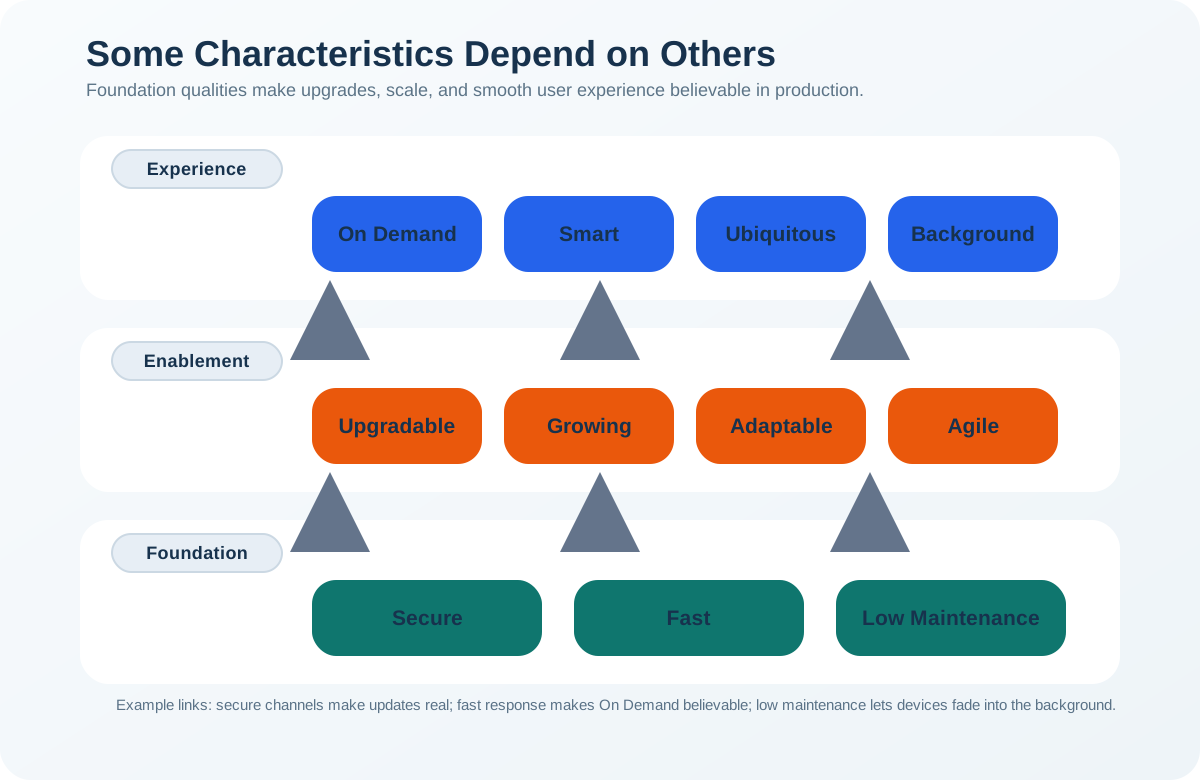
Understanding these relationships helps you identify which foundational characteristics to invest in first.
- Product B can then send security patches to the 500-device fleet, while Product A still needs manual USB updates.
- Prioritize the foundational qualities your product's service promise actually needs.
Major section
Evaluate IoT Products
Product A: Fast response (2-second latency), excellent mobile app, requires manual firmware updates via USB, single-building deployment limit, proprietary protocol.
- Product B: Slower response (8-second latency), basic web interface, automatic OTA updates, unlimited scalability, supports multiple protocols (Wi-Fi, Zigbee, BACnet).
- Speed Trade-off is Acceptable: HVAC systems have thermal mass: 8-second response is adequate for temperature control (rooms don't heat/cool in seconds).
- 2-second advantage provides no practical benefit.
Major section
Common Pitfalls
Confusing "Connected" with "IoT": A device with Bluetooth-only connectivity is a connected device, not an IoT device.
- True IoT requires internet reachability -- either directly (Wi-Fi, cellular) or indirectly through a gateway.
- Treating All Eleven Characteristics as Equally Important: No single IoT system can excel at all eleven characteristics simultaneously.
- A farm sensor optimized for "Fast" (millisecond response) wastes engineering effort -- soil moisture changes over hours.
Major section
Common Pitfalls (continued)
Ignoring the Gateway Distinction: A fitness tracker that syncs only to a phone via Bluetooth is not IoT on its own.
- The system becomes IoT when the phone uploads data to the cloud.
- This distinction matters for reliability: if the phone is absent, the cloud connection breaks.
- Design decisions should account for whether a device depends on a gateway and what happens when that gateway is unavailable.
Deck summary
Key takeaways
Cost savings: ($55K - $34K) / $55K = 38%: Lower operational costs (10-year batteries, no SIM management) drive LoRaWAN ROI despite higher initial gateway investment.
- The mathematical gist: A 2400 mAh cell retaining 99% per year and keeping a 15% reserve leaves about 1850 mAh after ten years: only 21.1 microamps on average.
- The grouping does the teaching here.
- Agriculture rates Fast at 3/10 but Growing at 10/10 because a farm may accept hours of delay while scaling across many sensors.
- Ubiquitous: Available everywhere and integrated across environments, like smart lighting that works consistently at home, office, and hotel.
Retrieval practice
Recall check 1 of 4

Ada says: answer from memory, then check your reasoning.
Q1A warehouse compares cellular and LoRaWAN over the same deployment life. Which costs belong in the comparison?
Show answer
Answer: A The worked example adds all three categories over the same horizon.
Retrieval practice
Recall check 2 of 4

Ada says: answer from memory, then check your reasoning.
Q2Which of the following is the MOST accurate way to describe the "Internet" requirement in IoT?
Show answer
Answer: C In this chapter, internet reach means communication with remote IP-based services, directly or through a gateway; it does not specify one radio or interface.
Retrieval practice
Recall check 3 of 4

Ada says: answer from memory, then check your reasoning.
Q3A team applies a factory’s speed priorities to a farm sensor. What should the priority review reconsider?
Show answer
Answer: B The matrix shows that factory and agriculture use cases prioritize characteristics differently.
Q4An IoT pacemaker must prioritize which characteristics above all others?
Show answer
Answer: B The medical context sets priorities: protect commands and patient data, then meet the timing needed for potentially rapid cardiac changes.
Retrieval practice
Recall check 4 of 4

Ada says: answer from memory, then check your reasoning.
Q5A startup is designing a smart home hub. They can only excel at 3 characteristics. Which combination makes the most business sense?
Show answer
Answer: C This question asks for three differentiators: immediate interaction, software evolution and interoperability with emerging devices.
Q6A device has 876 mAh of usable battery capacity and must last one year. What is its average-current ceiling before other losses?
Show answer
Answer: B One year is 8,760 hours; 876 mAh divided by that is 0.1 mA, or 100 µA.
Print reference
Answers 1 of 2
Answer key.
- A · The worked example adds all three categories over the same horizon.
- C · In this chapter, internet reach means communication with remote IP-based services, directly or through a gateway; it does not specify one radio or interface.
- B · The matrix shows that factory and agriculture use cases prioritize characteristics differently.
- B · The medical context sets priorities: protect commands and patient data, then meet the timing needed for potentially rapid cardiac changes.
Print reference
Answers 2 of 2
Answer key.
- C · This question asks for three differentiators: immediate interaction, software evolution and interoperability with emerging devices.
- B · One year is 8,760 hours; 876 mAh divided by that is 0.1 mA, or 100 µA.