Applications & Use Cases · Study deck
Why IoT Projects Fail: Security and Redesign
A connected product has cleared its budget review and can survive a lost cloud link.
Blueprint Bina is your guide for this deck.

After studying this chapter
Learning objectives
You will be able to:
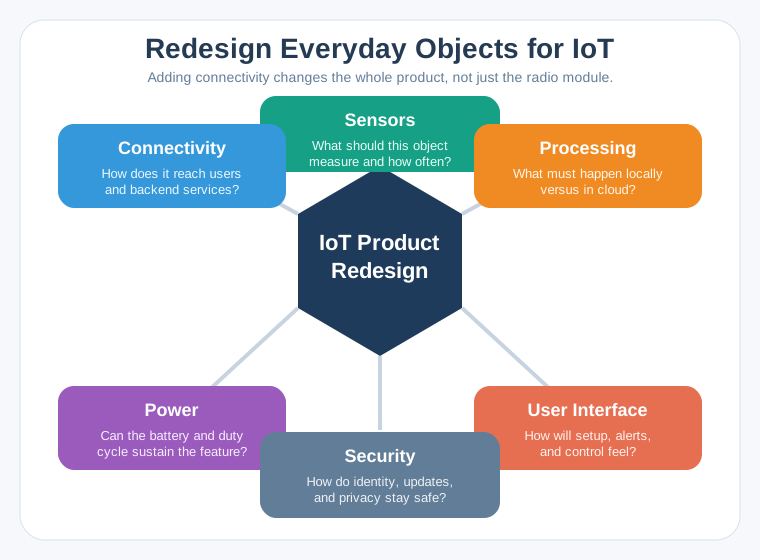
- Explain: When transforming ordinary objects into IoT devices, the most common pitfall is focusing exclusively on "what cool things can this do?" rather than systematically evaluating the six dimensions of IoT product design.
- Explain: Common mistakes for this product: Using Wi-Fi (battery dies in days), requiring daily charging (users abandon it), collecting GPS data (unnecessary PII), no offline mode (bottle is useless without phone).
- Explain: For a production run of 100,000 units, that is $750,000 saved on hardware alone, plus $1.2M/year in avoided cellular subscriptions.
- Explain: Your robot is useless!
Major section
Defense-in-Depth Security
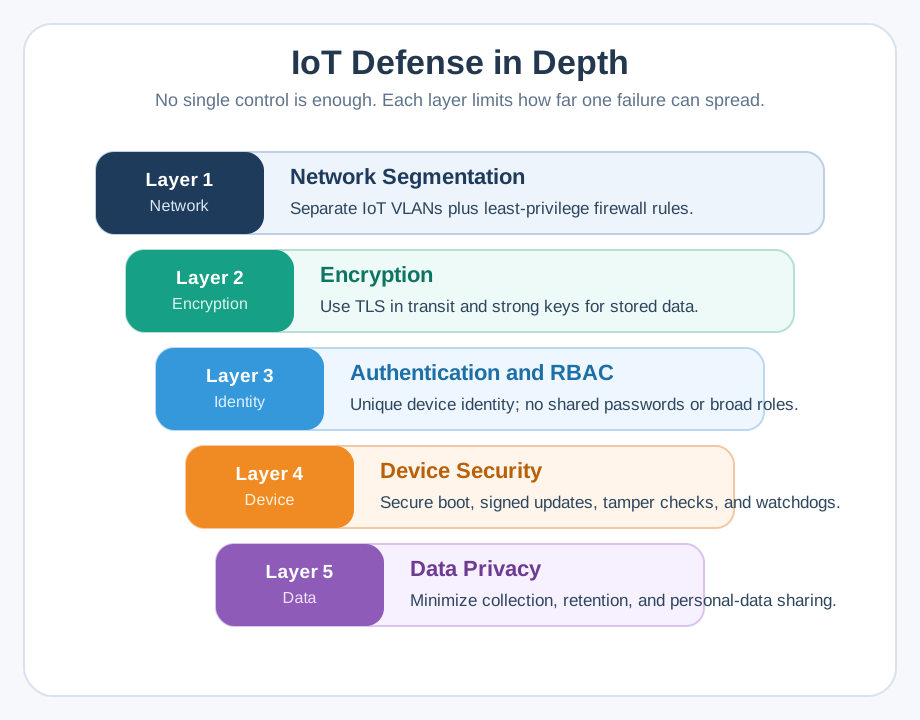
Together those labels make five-layer defense-in-depth model for iot deployments testable.
- Encryption: TLS 1.3 plus AES-256: protects against eavesdropping and data theft through device certificates and encrypted storage.
Major section
Redesigning Everyday Objects for IoT
When transforming ordinary objects into IoT devices, the most common pitfall is focusing exclusively on "what cool things can this do?" rather than systematically evaluating the six dimensions of IoT product design.
- That sequence keeps redesigning everyday objects for iot tied to what is visibly labelled.
Major section
Redesigning Everyday Objects for IoT (continued)
Common mistakes for this product: Using Wi-Fi (battery dies in days), requiring daily charging (users abandon it), collecting GPS data (unnecessary PII), no offline mode (bottle is useless without phone).
- The BLE option costs $7.50 less per unit than NB-IoT at the BOM level.
- For a production run of 100,000 units, that is $750,000 saved on hardware alone, plus $1.2M/year in avoided cellular subscriptions.
- This analysis illustrates why connectivity selection is one of the highest-leverage decisions in IoT product design.
Major section
Interactive Security Checklist Scorer
Each "No" answer represents a risk that should be addressed before proceeding.
- Lock-in:: Devices support Matter, Thread, or open APIs; the system works without vendor cloud; data is exportable in standard formats.
- Cost: 5-year TCO calculated beyond hardware; connectivity costs included per device per year; maintenance budgeted at 15-20% annually.
- The checklist is the handoff point from reading to action.
Try it: Interactive Security Checklist Scorer in the chapter
Major section
IoT Risks: Lock-In, Security, Cost, and Connectivity
Temperature Terry says: "Imagine you buy a toy robot that only works with one brand of batteries.
- Your robot is useless!
- That's called vendor lock-in -- it's like being stuck with one brand forever.".
- Every smart camera and doorbell should get a new, strong password right away!".
Major section
IoT Risks: Lock-In, Security, Cost, and Connectivity (continued)
Buying a smart device is like getting a pet.
- The pet food (electricity, internet, cloud service) costs WAY more over time than the pet itself!
- A $50 sensor might cost $200 over five years when you add everything up.".
- Bella the Barometer adds: "And always have a backup plan!
Deck summary
Key takeaways
Together those labels make five-layer defense-in-depth model for iot deployments testable.
- When transforming ordinary objects into IoT devices, the most common pitfall is focusing exclusively on "what cool things can this do?" rather than systematically evaluating the six dimensions of IoT product design.
- Common mistakes for this product: Using Wi-Fi (battery dies in days), requiring daily charging (users abandon it), collecting GPS data (unnecessary PII), no offline mode (bottle is useless without phone).
- Each "No" answer represents a risk that should be addressed before proceeding.
- Buying a smart device is like getting a pet.
Retrieval practice
Recall check 1 of 5

Blueprint Bina says: answer from memory, then check your reasoning.
Q1Place each pitfall defence where it belongs so you can test ownership and security, survive outages and scale, and price the full service with an exit path.
Show answer
Answer: A Common IoT failures become visible when teams test trust and ownership, failure and scale, and lifecycle economics as separate release conditions.
Q2Complete the industrial sensor monitoring pipeline:
Show answer
Answer: A Industrial monitoring uses threshold-based alerts.
Retrieval practice
Recall check 2 of 5

Blueprint Bina says: answer from memory, then check your reasoning.
Q3An enterprise deploys 500 IoT sensors with a projected 3-year cost of $150,000 (hardware only). After year one, the actual cost has already reached $180,000 including connectivity fees, cloud storage, and field maintenance. What pitfall does this illustrate?
Show answer
Answer: B TCO underestimation is the most common enterprise IoT pitfall.
Retrieval practice
Recall check 3 of 5

Blueprint Bina says: answer from memory, then check your reasoning.
Q4A smart home user buys devices from three different manufacturers: smart lights (Brand A, Zigbee), a thermostat (Brand B, WiFi + proprietary cloud), and door locks (Brand C, Z-Wave). After Brand B discontinues their cloud service, the thermostat becomes a $200 paperweight. Which IoT pitfall is this, and how could it have been prevented?
Show answer
Answer: D Vendor lock-in is the most common consumer IoT pitfall.
Retrieval practice
Recall check 4 of 5

Blueprint Bina says: answer from memory, then check your reasoning.
Q5You are designing a smart plant pot that monitors soil moisture and reminds users to water their plants. Which connectivity choice is MOST appropriate?
Show answer
Answer: Review the source
Retrieval practice
Recall check 5 of 5

Blueprint Bina says: answer from memory, then check your reasoning.
Q6A team is adding IoT capability to a commercial dishwasher for restaurants. They plan to use a smartphone app as the only user interface. What is the PRIMARY concern with this approach?
Show answer
Answer: Review the source
Print reference
Answers
Answer key.
- A · Common IoT failures become visible when teams test trust and ownership, failure and scale, and lifecycle economics as separate release conditions.
- A · Industrial monitoring uses threshold-based alerts.
- B · TCO underestimation is the most common enterprise IoT pitfall.
- D · Vendor lock-in is the most common consumer IoT pitfall.
- Review the source
- Review the source