Applications & Use Cases · Study deck

IoT Perspectives: Shared Definitions and Decisions

A thermostat review has five confident answers: security wants stronger protection, hardware wants longer battery life, data wants more samples, UX wants fewer prompts, and operations wants simple recovery.

Blueprint Bina is your guide for this deck.

perspectives
Blueprint Bina, the module guide, in a scene from this chapter.
iotclass.org

After studying this chapter

Learning objectives

You will be able to:

  • Explain: Keeping the two questions separate prevents a connected object from being called intelligent by default while preserving the source's reminder that useful IoT systems usually do more than move raw readings.
  • Explain: The connecting lines illustrate that IoT value emerges not from individual smart devices, but from the network effects when thousands of diverse devices share data and coordinate actions.
  • Explain: Another describes interrelated devices, machines, objects, animals, or people that carry unique identifiers and transfer data across a network without requiring a person to move every message.
  • resolve cross-functional trade-offs with testable evidence
iotclass.org

Major section

Academic Definitions

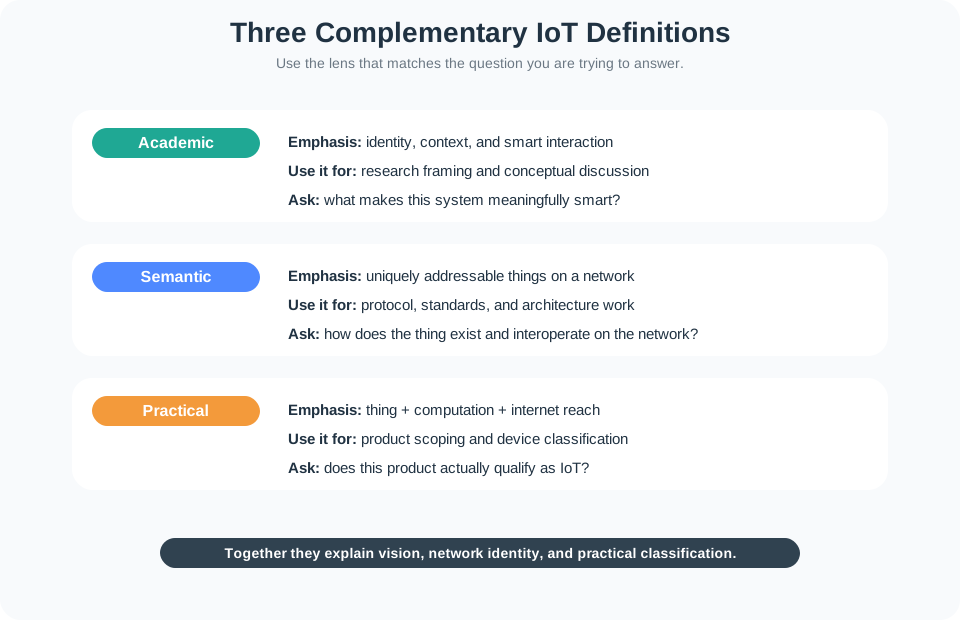
Together those labels make three complementary iot definitions: academic, semantic, and practical testable.

  • Therefore, semantically, Internet of Things means a world-wide network of interconnected objects uniquely addressable, based on standard communication protocols.".
Three complementary IoT definitions: academic, semantic, and practical
iotclass.org

Major section

Connected Things Diversity

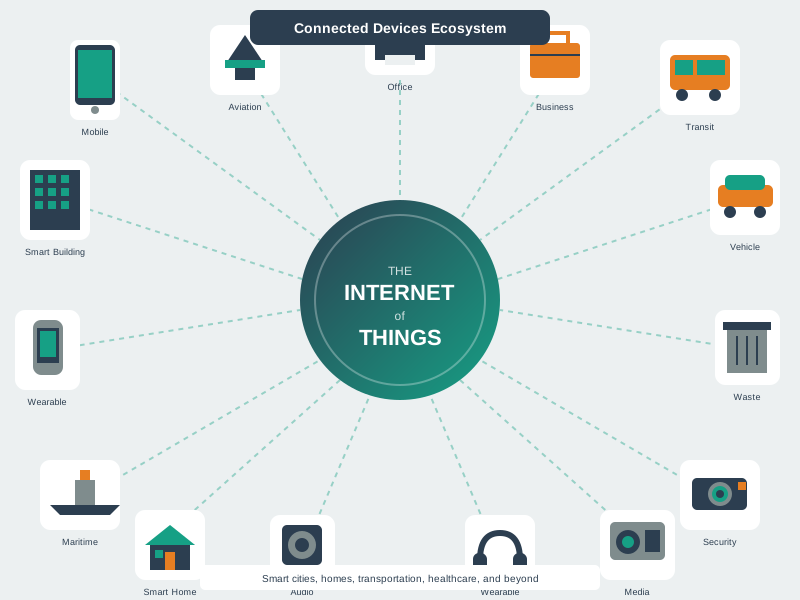
Together those labels make the internet of things concept showing connected devices across all domains testable.

  • The connecting lines illustrate that IoT value emerges not from individual smart devices, but from the network effects when thousands of diverse devices share data and coordinate actions.
The Internet of Things concept showing connected devices across all domains
iotclass.org

Major section

Definitions Are Lenses, Not One Checklist

One frames IoT as people and things being connected anytime, anyplace, with anything and anyone, over any suitable path or service.

  • Another describes interrelated devices, machines, objects, animals, or people that carry unique identifiers and transfer data across a network without requiring a person to move every message.
  • These definitions describe reach, identity, and machine-to-machine exchange; they do not replace the engineering boundary below.
  • Keeping the two questions separate prevents a connected object from being called intelligent by default while preserving the source's reminder that useful IoT systems usually do more than move raw readings.
iotclass.org

Major section

IoT Classification Test

Yes -- under the gateway model used in this course, the phone provides the device's internet path, so the three criteria are satisfied.

  • The trade-off is that remote reach disappears when the gateway phone is absent.
  • Academic, identity, and context definitions capture intelligence and context well, but can be operationally vague.
  • They fit research papers and vision documents.
iotclass.org

Major section

The Multidisciplinary Imperative

Definitions classify the system; multidisciplinary review decides whether the system is worth shipping.

  • The same device can satisfy the IoT definition and still fail if one perspective quietly dominates.
  • UX designer vs: System architect: Users want seamless experience; architecture requires complexity.
  • Acknowledge that each perspective is valid and necessary.

Key terms

Acknowledge that each perspective
Acknowledge that each perspective is valid and necessary 2.
iotclass.org

Major section

Build an IoT Project Team

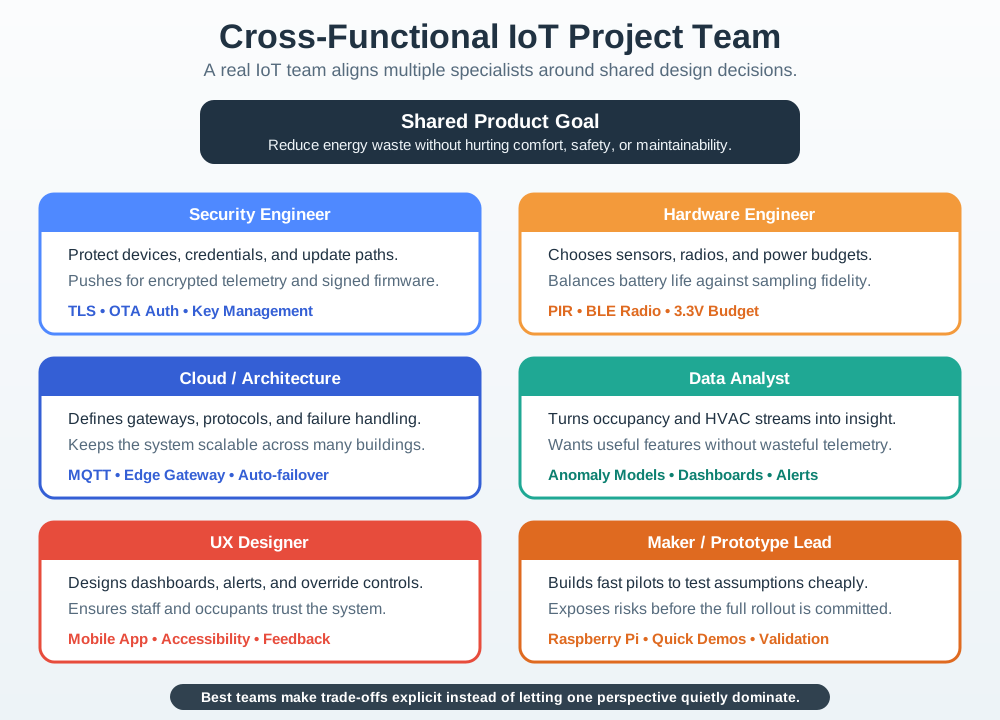
That sequence keeps build an iot project team tied to what is visibly labelled.

  • A balanced resolution is a 15-second average with event-driven bursts.
  • A balanced resolution is biometric confirmation for critical controls and a PIN for dashboards.
  • Edge versus cloud processing:: Hardware has limited edge compute while data teams want complex models.
A cross-functional IoT project team coordinates security, hardware, architecture, data, UX, and operations around a shared product goal and explicit design trade-offs.
iotclass.org

Major section

Resolve IoT Perspective Conflicts

Security versus usability:: Security engineers ask for stronger authentication while UX designers protect low-friction access.

  • Performance versus battery:: Hardware engineers protect service life while data scientists ask for real-time inference.
  • Cost versus features:: Product teams push bill-of-materials limits while engineers price radios, sensors, memory, and certification realistically.
  • Most IoT conflicts are false dichotomies.

Numbers to remember

95%Result: 95% of unlocks are one-tap (home use)
5%5% require biometric (away/suspicious).
<1mWEdge classifier detects "activity vs. rest" (runs on MCU, <1mW).

Why it matters

Documentation prevents relitigating resolved decisions.

iotclass.org

Major section

Resolve IoT Perspective Conflicts (continued)

Documentation prevents relitigating resolved decisions.

  • Privacy versus monetization:: Legal and privacy teams constrain data use while business teams may see value in location, behavior, or occupancy data.
  • Speed versus reliability:: Software teams want fast rollout while architecture teams protect device variants, rollback paths, and field reliability.
  • Regulatory Risk ≥ 4: Security/Privacy perspective MUST win (non-negotiable).
iotclass.org

Major section

Resolve IoT Perspective Conflicts (continued)

User Impact ≥ 4: UX/Product perspective should win (unless Regulatory ≥ 4).

  • UX demand: One-tap unlock for daily use.
  • Result: 95% of unlocks are one-tap (home use), 5% require biometric (away/suspicious).
  • Hardware demand: Model runs drain battery in 8 hours; need 48+ hour life.
iotclass.org

Deck summary

Key takeaways

Together those labels make three complementary iot definitions: academic, semantic, and practical testable.

  • Together those labels make the internet of things concept showing connected devices across all domains testable.
  • One frames IoT as people and things being connected anytime, anyplace, with anything and anyone, over any suitable path or service.
  • Yes -- under the gateway model used in this course, the phone provides the device's internet path, so the three criteria are satisfied.
  • Definitions classify the system; multidisciplinary review decides whether the system is worth shipping.
iotclass.org

Retrieval practice

Recall check 1 of 6

Blueprint Bina says: answer from memory, then check your reasoning.

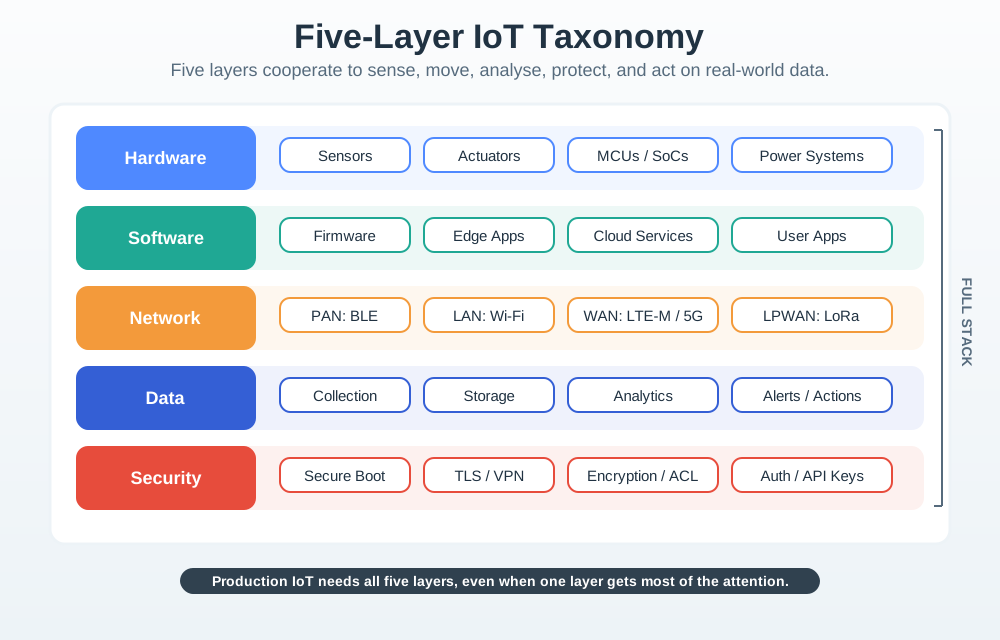
Q1A startup building a smart door lock has a security engineer who insists on AES-256 encryption, but the hardware engineer says the chosen microcontroller cannot handle it without significant battery drain. Which concept does this conflict best illustrate?

AA taxonomy-layer mismatch only, with no stakeholder trade-off
BA practical-definition question about whether the lock counts as IoT
CA cross-functional perspective trade-off between security strength and battery life
DA semantic-addressing problem about assigning unique device identifiers
Show answer

Answer: C Answer: C.

iotclass.org

Retrieval practice

Recall check 2 of 6

Blueprint Bina says: answer from memory, then check your reasoning.

Q2A smart factory deploys vibration sensors on motors, sends data via Wi-Fi to a local gateway that runs anomaly detection, stores results in InfluxDB, and alerts maintenance staff via a mobile app. Which taxonomy layers are involved?

AHardware, network, and data layers only, because alerts are data outputs
BHardware, software, network, and data, but not security controls
CAll five layers: hardware, software, network, data, and security
DSoftware and data only, because the gateway and app do most of the work
Show answer

Answer: C Answer: C.

iotclass.org

Retrieval practice

Recall check 3 of 6

Blueprint Bina says: answer from memory, then check your reasoning.

Q3A smart irrigation controller has soil moisture sensors, runs a local algorithm to decide when to water, and uploads daily logs to a farmer&#x27;s cloud dashboard. Using the practical definition framework, is this an IoT device?

ANo, because local control makes it an embedded controller rather than IoT
BNo, because passive soil sensors do not count unless they actuate water
CYes, because it combines a physical thing, local computation, and internet connectivity
DYes, but only during upload windows when the dashboard receives new data
Show answer

Answer: C Answer: C.

iotclass.org

Retrieval practice

Recall check 4 of 6

Blueprint Bina says: answer from memory, then check your reasoning.

Q4A startup building a pet activity tracker faces this dilemma: the data science team wants GPS location recorded every 30 seconds for accurate activity maps, but the hardware team says this will drain the battery in 4 hours (target is 7 days). What is the BEST resolution approach?

AThe CEO should decide which team wins
BShip with 30-second GPS and include a larger battery
CUse adaptive sampling -- high-frequency GPS during walks
DRemove GPS entirely and use only the accelerometer
Show answer

Answer: C Answer: C.

iotclass.org

Retrieval practice

Recall check 5 of 6

Blueprint Bina says: answer from memory, then check your reasoning.

Q5Complete the industrial sensor monitoring pipeline:

Aif value > self.threshold_high or value < self.threshold_low:
Bif value > self.threshold_high and value < self.threshold_low:
Cif value != self.threshold_high:
Dif value > self.threshold_low:
Show answer

Answer: A Industrial monitoring uses threshold-based alerts.

iotclass.org

Retrieval practice

Recall check 6 of 6

Blueprint Bina says: answer from memory, then check your reasoning.

Q6A pet tracking collar connects via Bluetooth to a smartphone app that uploads location data to the cloud. A marketing team wants to label it as an "IoT pet tracker." Using the practical definition and the gateway model introduced earlier in the course, which classification is most accurate?

AIt qualifies as an IoT device
BIt is not IoT because only direct Wi-Fi or cellular links count as internet connectivity
CIt becomes IoT only after the cloud processes the location data
DIt is not IoT because pet collars are not valid "things" in IoT terminology
Show answer

Answer: A The practical definition requires Thing + Compute + Internet, and the course allows internet reach through a gateway such as a smartphone.

iotclass.org

Print reference

Answers

Answer key.

  1. C · Answer: C.
  2. C · Answer: C.
  3. C · Answer: C.
  4. C · Answer: C.
  5. A · Industrial monitoring uses threshold-based alerts.
  6. A · The practical definition requires Thing + Compute + Internet, and the course allows internet reach through a gateway such as a smartphone.
iotclass.org