IoT Value and Product Strategy · Study deck
What IoT Delivers: Closed-Loop Value
This first route explains the closed IoT loop and the responsibility, classification, and value questions that distinguish a useful connected system.
Ada is your guide for this deck.

After studying this chapter
Learning objectives
Useful IoT combines a physical system, a decision, and responsibility for the result.
- IoT classification needs a physical thing, computation, and connectivity.A basic microwave has an object and local computation, but its missing Internet path makes the example an embedded device.
- A useful observation can lead to a decision and action.The thermostat uses measured room temperature to decide how its HVAC actuator should change the physical environment.
- The Five Verbs connect IoT proposals to human needs.SUSTAIN, MOVE, MAKE, HEAL, and FEED can group opportunities across energy, transport, manufacturing, healthcare, and agriculture.
- A planning model is different from deployment evidence.The chapter’s Five Verbs market projections are illustrative, with a scope that can differ from other published estimates.
Major section
IoT for Business Leaders
A business case starts with the decision that better observations can improve.
- Connected assets can reduce the need for costly manual inspection.The business case is stronger when observations change a decision, such as responding to equipment failure or reducing energy waste.
- The Five Verbs are categories for useful business outcomes.Energy and environment belong to SUSTAIN, while transport, manufacturing, healthcare, and agriculture give the other verbs concrete purposes.
- Market projections are illustrative planning assumptions.The chapter’s $1.78 trillion 2024 model uses 14.5% annual growth to estimate about $2.04 trillion in 2025.
- The investment decision needs security, integration, and training costs.Platform dependence and legacy integration are risks alongside the skills needed to operate and maintain the connected service.
Major section
IoT Delivers a Closed Loop
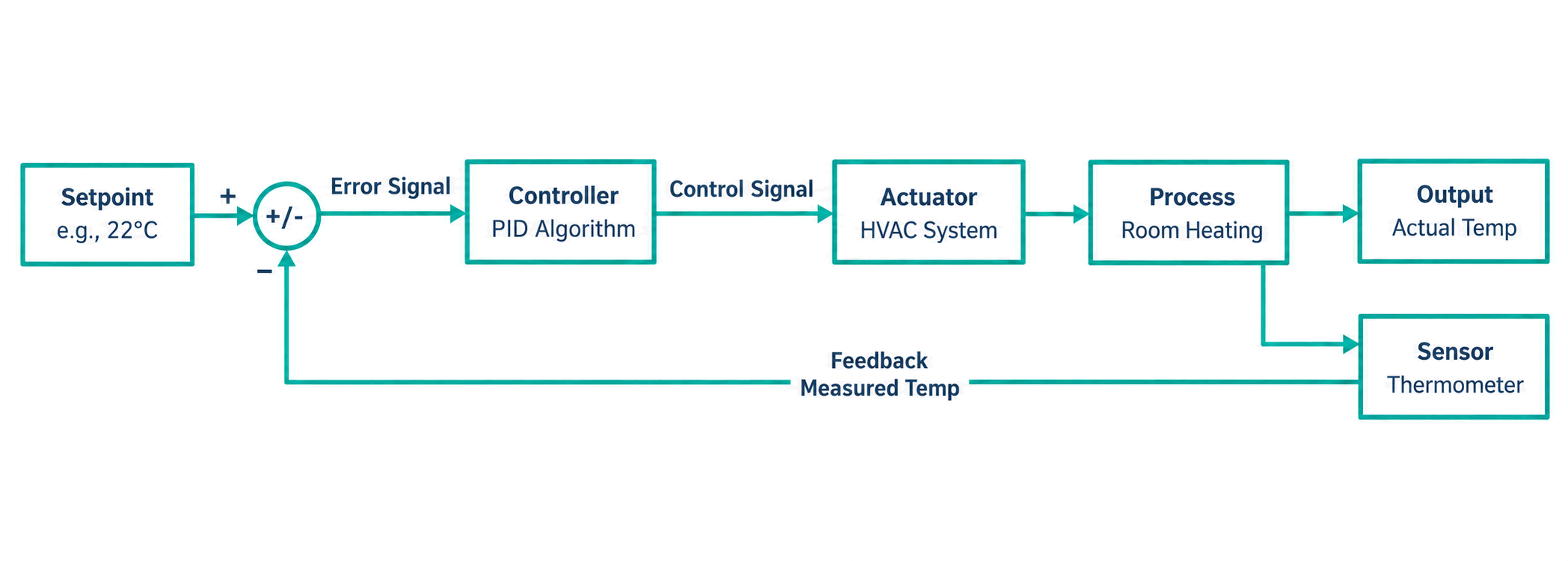
This thermostat diagram shows feedback control; follow the setpoint through heating and back to the thermometer.
- The setpoint is the room temperature requested by the control policy.The diagram compares that target with measured temperature, so the controller has an error signal for its next decision.
- The controller uses temperature error to drive the HVAC actuator.The requested heating response is connected to the room’s measured condition rather than an unchecked remote command.
- The heating process changes the room’s temperature.The thermometer measures the resulting physical state, which is the observation returned along the feedback path.
- Feedback lets the controller respond to the room’s actual condition.The returning temperature measurement can change the next control decision, closing the path from sensing through heating.

Major section
Remote control and the local loop
Connectivity extends the thermostat loop with remote visibility and schedule changes.
- Local computation can interpret the sensor reading before the HVAC controller acts.The thermostat’s microcontroller runs control logic, so the physical response is based on the room’s measured temperature.
- Wi-Fi carries thermostat state and remote commands.The cloud or app interface can change schedules while the local sensor and HVAC controller remain parts of the physical loop.
- A thermostat can control temperature without networking.A programmable thermostat without an Internet path is embedded control under the chapter’s classification, even when its local behaviour remains useful.
- A tracker or water monitor needs an operational response to create value.A delayed shipment can change logistics work, while a water-level observation can change pump behaviour or maintenance visits.
Activity 1 · Draw it
✎ Close the thermostat loop

I want you to show how the room changes the next control decision.
Sketch the thermostat loop on paper. Label the temperature sensor, controller, HVAC actuator, room, and feedback path. Add the Wi-Fi path to the app and mark which part changes the schedule.
3 minutes · Pen and paper · Answer: Activity 1
Major section
Classify Before Business Case
The connection path shapes costs, power needs, and what survives a network outage.
- A fitness tracker can use a phone as its gateway.The phone provides the Internet path, so indirect connectivity can still satisfy the chapter’s Three Ingredients Test.
- A soil probe may need range and battery life above other features.LoRaWAN or NB-IoT can be candidates when the installation’s connection path must meet those particular constraints.
- A manual-entry dashboard is different from an instrumented physical asset.An attractive display cannot establish the same observation evidence when the underlying measurements are entered by hand.
- An alarm needs a person responsible for the response.Sensor data alone cannot deliver an operational outcome when nobody owns the decision or action after the alert.
Major section
The cold-room requirements record
A requirements record makes the system boundary concrete before estimating its value.
- The physical-asset record needs installation and ownership details.Environment, power source, mounting constraints, expected life, and the responsible operator are part of the boundary for the connected asset.
- The compute record identifies where decisions run.Logic can live on the microcontroller, phone, gateway, PLC, edge computer, or cloud service, with different responsibilities at each location.
- The connectivity record needs both the normal path and fallback behaviour.Protocol, payload, coverage, and network ownership are necessary to explain what the system can do when the wide-area connection fails.
- A cold-room compliance system needs more than a temperature sensor.Calibration, timestamps, alert acknowledgement, local alarm behaviour, and audit evidence are required to support its food or medicines-storage process.
Major section
Connectivity Changes Responsibility
Adding connectivity changes who owns state, security, updates, and recovery.
- A controller may fail locally; an IoT product can also fail through expired credentials, weak coverage, a broker outage, app permissions, or stale cached state.
- The device, gateway, broker, application, and update service share this responsibility.
- A dashboard number alone cannot establish that an action is safe.
Major section
Connectivity Changes Responsibility (continued)
MQTT, CoAP, HTTP, OPC UA, and industrial gateways carry different reliability and support obligations, but all need a clear device identity, message freshness, command authorization, and recovery plan.
- Recovery: Preserve useful local behavior while the app, gateway, broker, or cloud is unavailable.
- IoT is a system boundary across firmware, connectivity, services, security, and maintenance.
- Later chapters separate those layers; here the first decision is who owns each handoff in the value loop.
Major section
Sammy Finds IoT
Familiar home examples connect sensing with an automatic response.
- A light sensor can detect daylight and trigger the blinds.In the morning story, the bright outdoor condition is the observation that leads to the blinds opening slowly.
- A temperature sensor helps the heating system respond to the room.The morning check asks whether the room is warm enough, connecting a measured condition with the heating decision.
- A backpack tracker can report arrival through a phone connection.The school example is useful because a physical journey becomes arrival information on the parents’ phone.
- A spoken bedtime request can coordinate several home actions.The Goodnight example uses lighting, music, and a temperature setting as connected responses to one household request.
Major section
Internet of Things Basics
DOE/PNNL modeled about 29% potential energy savings from properly tuned controls across commercial building types; actual results vary by building.
- Simple Definition: IoT = Everyday Objects Connected to the Internet: The Internet of Things (IoT) is like giving everyday objects a "digital brain" and connecting them to the internet.
- It's the transformation of ordinary "dumb" devices into "smart" ones that can sense their environment, process information, and take action automatically.
- DOE/PNNL modeled about 29% potential energy savings from properly tuned commercial building controls; actual results vary by building.
Major section
IoT Market Scale and Impact
A dated IoT Analytics estimate is 21.1 billion active IoT connections in 2025, with a forecast of 39 billion for 2030.
- Annual device growth: 40B minus 20B over 9 years is about 2.22B additional devices per year.
- Market value growth: The model's $1.78T 2024 baseline compounded at 14.5% for 10 years is about $6.9T by 2034.
- Efficiency translation: A percentage improvement is meaningful only after the affected cost base is defined.
Major section
Checkpoint: Device Classification
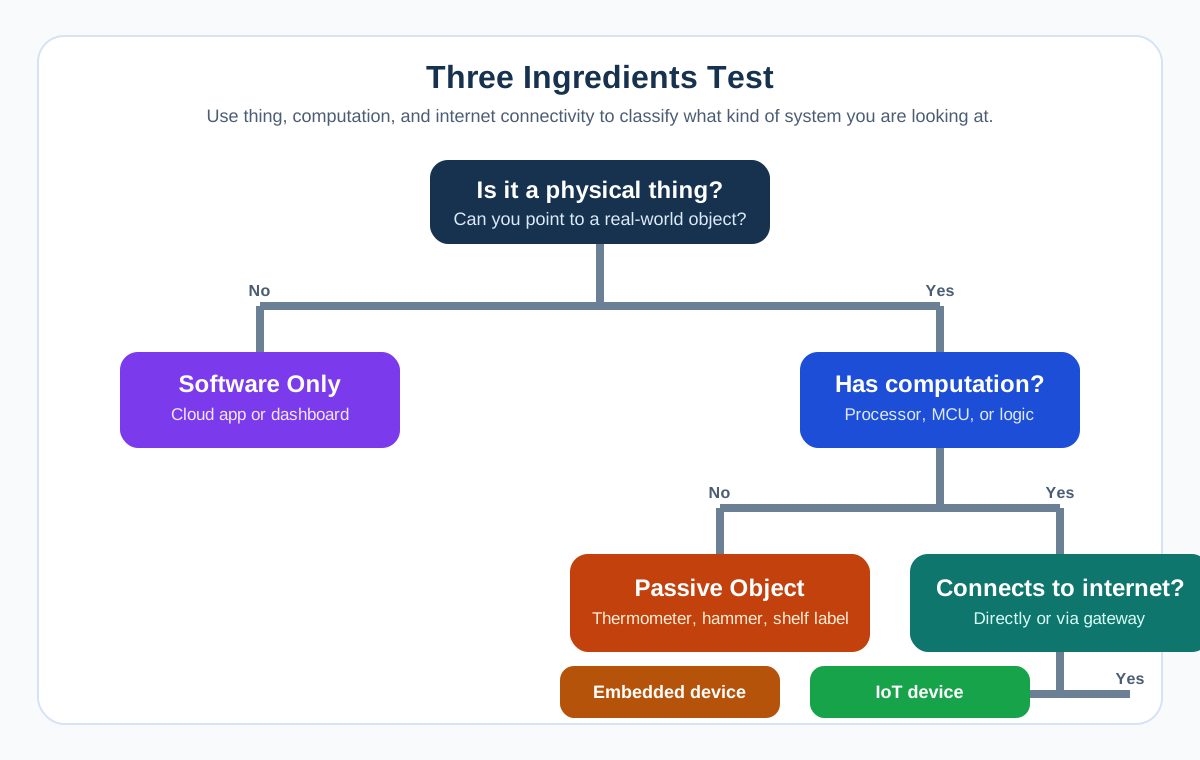
You now know how everyday devices become IoT only when the object, processor, and internet path are all present.
- You can classify the chapter's examples: a basic microwave is embedded, a fitness tracker can use a phone gateway, and a cloud dashboard alone is software.
- The chapter’s global scale can be illustrated by IoT Analytics’ 21.1-billion 2025 connection estimate.
- The next section compresses that classification into the minimum working model you should carry into examples and exercises.
Major section
Key Concepts
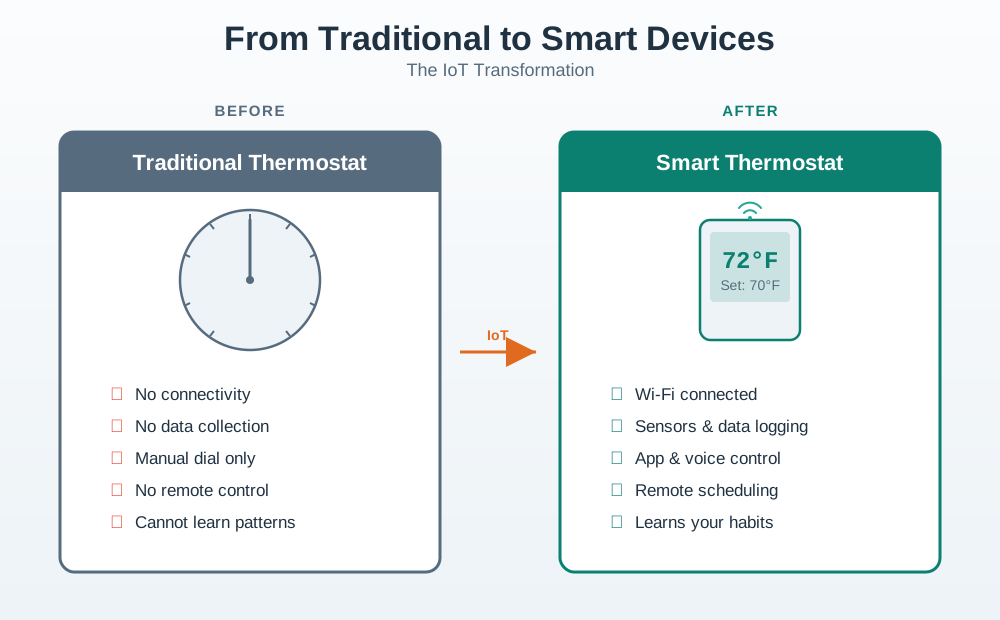
This transformation diagram compares the traditional thermostat with sensing, logging, app control, and learned schedules.
- The traditional thermostat is the starting point for temperature control.Its dial needs a person beside the device, giving the comparison a concrete boundary for direct local adjustment.
- The smart-device side adds sensing and data logging.Recorded observations can make the room’s condition visible beyond the immediate local control action.
- App control lets the user change the thermostat remotely.The chapter’s user can adjust the temperature from work before arriving home rather than standing beside the wall control.
- Learned schedules connect past observations with future heating decisions.Stored information can support later temperature choices, extending the transformation beyond a single remotely requested adjustment.
Major section
The thing, computation, and connection
The ingredient test separates physical objects, embedded controllers, and complete IoT systems.
- A physical object supplies the thing whose condition matters.The thermostat box on the wall is the chapter’s tangible example of the first ingredient.
- Computation supports decisions within the connected system.The thermostat’s processor can interpret temperature readings before the HVAC response changes the room.
- Connectivity can use a direct link or a gateway.Wi-Fi links the thermostat to its router, while a fitness tracker can reach Internet services through a phone.
- Edge processing keeps some decisions near the sensor.Nearby processing can reduce latency, bandwidth costs, and dependence on distant servers when the system handles observations locally.
Activity 2 · Match
✎ Connect the term to the job
I want you to connect each component to the part of the system it supports.
Match sensor, actuator, gateway, cloud, and edge computing to these jobs: remote storage and applications; physical action; nearby processing; physical measurement; bridging a device to the Internet. Write each pair on paper.
3 minutes · Pen and paper · Answer: Activity 2
Major section
Connectivity, Freshness, and Recovery
A connected product needs named recovery paths and evidence that each displayed value is current.
- Keep useful local control when remote services fail.Expired credentials, weak coverage, a broker outage, or an unavailable app must not erase a cold-room alarm or safe local action.
- Name an owner for each failed boundary.Firmware, radio, gateway, backend service, identity, update, and application teams each need a recovery responsibility.
- Keep measurement and receipt times distinct.A device timestamp, where supported, records the physical observation; a gateway or broker timestamp records later arrival.
- A cached reading can be stale.An app can remain available while its displayed room reading is old, so operators need freshness evidence alongside the value.
Major section
The remote-command contract
Every remote command needs an authority boundary and a way to report its outcome.
- A remote command must identify its target and allowed actor.The device needs an authority boundary so a request cannot gain permission merely by arriving over the network.
- The desired state is the outcome requested by the command.A thermostat schedule change needs a clear requested result that the receiving control system can interpret.
- An expiry time limits how long a delayed command remains useful.The receiver needs to know whether a queued request is still valid when the network eventually delivers the message.
- An acknowledgement path can report the request’s outcome.The application needs evidence after transmission to distinguish a requested change from the result returned by the connected system.
Major section
Minimum Viable Understanding
A human need gives the Three Ingredients Test a useful purpose.
- The Three Ingredients Test needs all three elements.A physical thing, computation, and an Internet path are each necessary for the chapter’s classification of a complete IoT device.
- A basic microwave is an embedded device in this classification.Its local computation can control the appliance, but the example lacks the connectivity needed for the IoT category.
- The Five Verbs connect technical choices to human needs.Energy waste, transport, healthcare, food production, and manufacturing are purposes that can guide which observations and responses matter.
- A deployment should start from the human problem.Reducing energy waste or detecting equipment failure gives the design a useful decision before sensor and network requirements are chosen.
Major section
Key Concepts (continued)
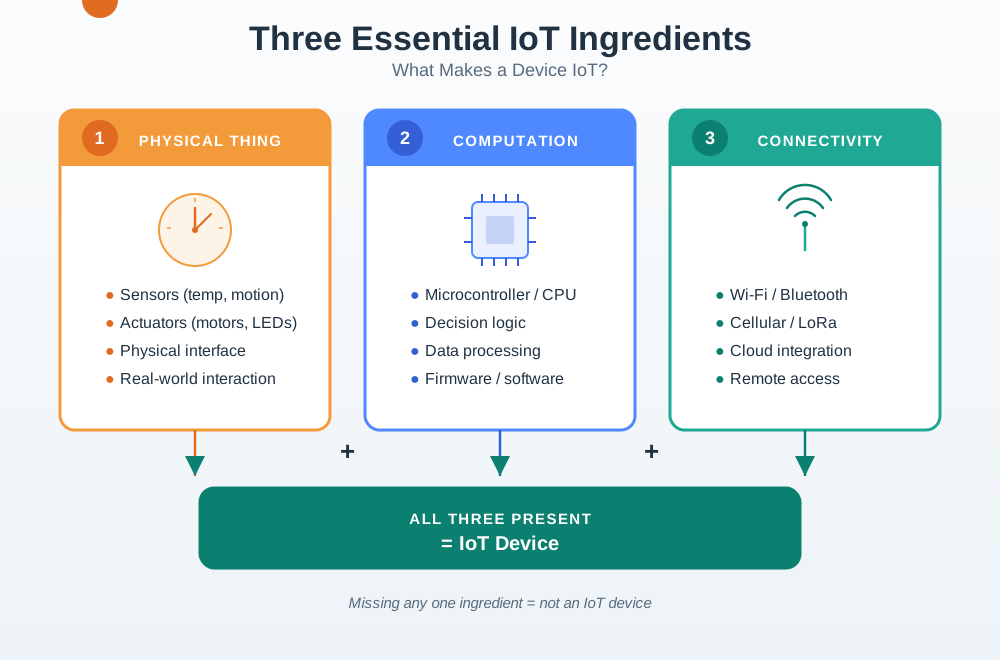
The parts are added together, so none of them ranks above the others.
- The line beneath the row does the real work.
- Miss any one ingredient and the sum fails. Figure: The three essential IoT ingredients is what lets you reject a clever gadget with no link, or a cloud app with nothing physical to touch.
- A physical object without a processor remains passive, while computation without Internet connectivity describes an embedded device.
Deck summary
Key takeaways
IoT value depends on a complete decision loop and clear operational ownership.
- IoT classification requires physical, compute, and connectivity elements.The microwave example is useful because the missing Internet path separates an embedded appliance from a complete IoT device.
- A feedback loop connects observations with decisions and physical action.The thermostat’s measured room temperature can change the next HVAC response through the returning feedback path.
- Gateway choices affect power, coverage, cost, and recovery.A fitness tracker can depend on a phone gateway, while a soil probe may need a different path for range and battery life.
- A useful connected service needs clear operational ownership.Identity, fresh state, authorized commands, and local recovery are necessary when the device, network, and application share responsibility for the result.
Retrieval practice
Recall check 1 of 4
Ada says: answer from memory, then check your reasoning.
Q1A review uses the chapter’s Five Verbs market total. How should that figure be presented?
Show answer
Answer: B The chapter says published totals differ in scope and labels this a planning model.
Retrieval practice
Recall check 2 of 4
Ada says: answer from memory, then check your reasoning.
Q2A connected cold-chain service prevents spoiled food and reduces delivery waste. Why can it fit more than one value category?
Show answer
Answer: A Correct: the same evidence and action can support both food and movement outcomes.
Retrieval practice
Recall check 3 of 4
Ada says: answer from memory, then check your reasoning.
Q3A greenhouse valve has a physical body and local controller but no data path beyond itself. How should it be classified?
Show answer
Answer: C Correct: the physical thing and computation are present, but the required data exchange path is absent.
Retrieval practice
Recall check 4 of 4
Ada says: answer from memory, then check your reasoning.
Q4A thermostat senses temperature and sends readings, but no control action follows. Which value link is missing?
Show answer
Answer: B The chapter’s thermostat loop links measurement, control, actuation, and feedback.
Print reference
Answers
Answer key.
- B · The chapter says published totals differ in scope and labels this a planning model.
- A · Correct: the same evidence and action can support both food and movement outcomes.
- C · Correct: the physical thing and computation are present, but the required data exchange path is absent.
- B · The chapter’s thermostat loop links measurement, control, actuation, and feedback.
Print reference
Activity 1 answer
Model answer.
Draw it: The sensor measures the room and returns temperature to the controller. The controller drives the HVAC actuator, which changes room temperature. Wi-Fi exchanges status and commands with the cloud or app interface, where schedules can change.
Print reference
Activity 2 answer
Model answer.
Match: Sensor: physical measurement. Actuator: physical action. Gateway: bridging a device to the Internet. Cloud: remote storage and applications. Edge computing: nearby processing.