IoT Value and Product Strategy · Study deck
IoT History: Adoption and Cost
A useful device can stay niche until cost, trust, and supporting networks cross a threshold.
Ada is your guide for this deck.

After studying this chapter
Learning objectives
You will be able to:
- Explain: Incumbents correctly calculate that the new technology is inferior -- for existing use cases Use a hypothetical $50 sensor, $500 pump and $50,000 outage only after labeling all three values as assumed.
- Explain: Phase 2: Apple Watch Launch and Skepticism (2015): Even after Apple entered the market, critics focused on what smart watches did worse than existing products rather than what they uniquely enabled.
- Explain: The axes are simple, with time across the bottom and adoption up the side, and the phase names run along the curve from experimentation to mass adoption.
- Explain: Expertise Becomes a Liability.
Major section
The Anatomy of Paradigm Blindness
Anchoring to Existing Behavior: Forecasters assume people will continue behaving as they currently do.
- The often-retold AT&T/McKinsey cellular forecast illustrates forecast risk, but remove the invented quotation and reconstruct it only from a traceable primary record.
- Linear Extrapolation of Exponential Change: Technology costs drop exponentially (Moore's Law), but human minds think linearly.
- The revenue shift is a useful warning for IoT forecasts.
Major section
Historical Lesson Pitfalls
Learning from history is essential, but misapplying these lessons can be just as dangerous as ignoring them.
- Pitfall 1: "Everything is the next telephone" fallacy: Not every new technology is a paradigm shift.
- Some IoT products genuinely are solutions looking for a problem.
- Acknowledging these real challenges is not paradigm blindness; it is prudent engineering.
Major section
Innovator's Dilemma in IoT
Clayton Christensen's "Innovator's Dilemma" (1997) explains why successful companies fail to adopt disruptive technologies.
- Expertise Becomes a Liability.
- IoT parallel: Manufacturing companies optimized for product reliability may dismiss sensor data as "unnecessary complexity".
- In 1983, no AT&T customer was asking for a mobile phone.
- New Use Cases Emerge Unexpectedly.
Major section
Innovator's Dilemma in IoT (continued)
Incumbents correctly calculate that the new technology is inferior -- for existing use cases Use a hypothetical $50 sensor, $500 pump and $50,000 outage only after labeling all three values as assumed.
- IoT is enabling predictive maintenance, precision agriculture, remote healthcare.
- IoT parallel: Smart meters were deployed for billing accuracy, then became grid optimization tools, then enabled demand-response programs worth billions.
- Emergency lighting that guides evacuation routes dynamically.
Major section
The IoT Adoption S-Curve
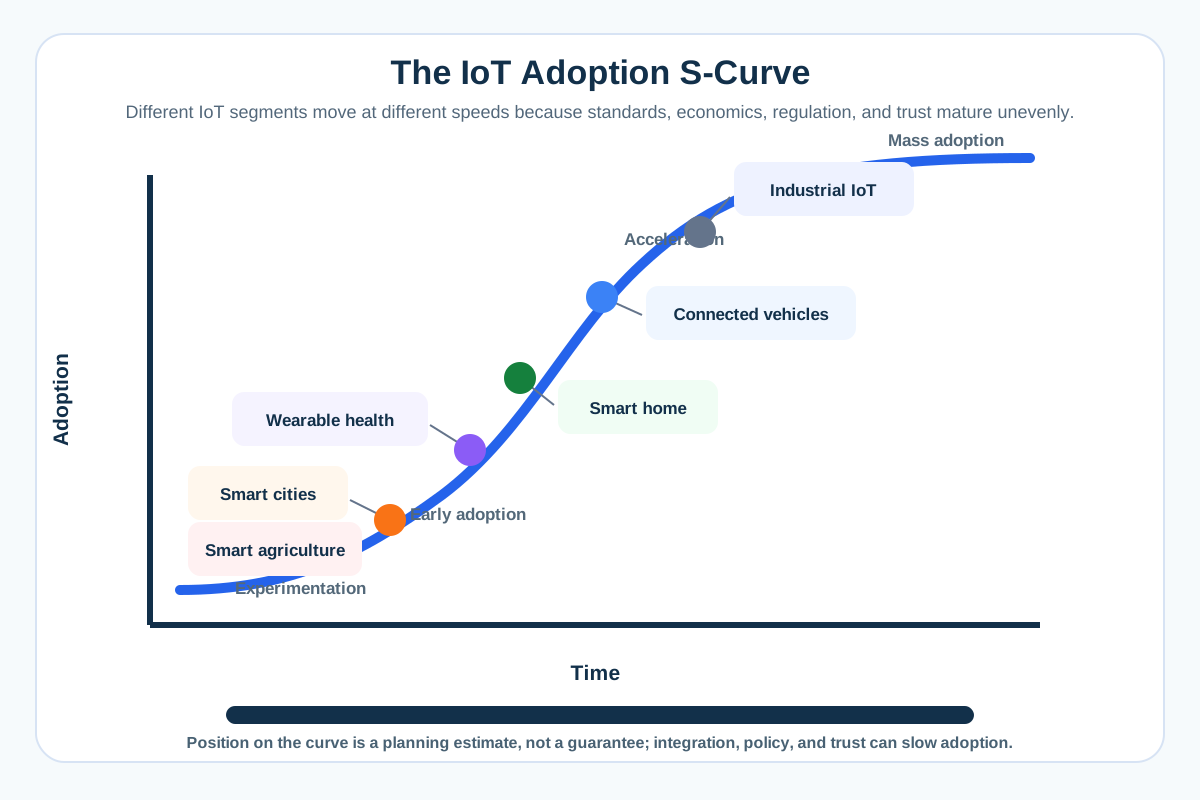
Technology adoption follows a predictable S-curve pattern, but the timing and steepness of the curve are consistently underestimated.
- The axes are simple, with time across the bottom and adoption up the side, and the phase names run along the curve from experimentation to mass adoption.
- What matters is that the segment labels are scattered along it rather than clustered.
- Industrial IoT adoption and maintenance outcomes vary by sector; cite a dated market-scope report and measured downtime study before showing percentages or dollar size.
Major section
Today's IoT Questions
Connected lighting can enable schedules, presence simulation and accessibility; give study-specific ranges for energy or health outcomes.
- A connected refrigerator could assist inventory reminders and food planning; quantify food-waste reductions for a tested household intervention.
- Sensors in bridge structures can aid condition monitoring; estimate savings from an asset-specific maintenance and risk model.
- Livestock tracking can support grazing, health alerts and theft response; cite a herd study before attaching yield or lead-time figures.
Major section
Smart Watch Journey
Phase 3: The Unexpected Killer App (2018-2020): None of these use cases were in the original product pitch.
- The smart watch story perfectly illustrates how paradigm blindness works -- and how it eventually gets overcome.
- Swiss watch executives declared Apple Watch would not affect their market.
- Hospitals integrate smart watch data into patient records.
Major section
Smart Watch Journey (continued)
Phase 2: Apple Watch Launch and Skepticism (2015): Even after Apple entered the market, critics focused on what smart watches did worse than existing products rather than what they uniquely enabled.
- They emerged from the combination of sensors + connectivity + processing that only a smart watch on a wrist could provide.
- Phase 4: Essential Health Infrastructure (2022-2026): By 2026, smart watches have become medical devices.
- It comes from enabling entirely new capabilities that were impossible before connectivity.
Deck summary
Key takeaways
Anchoring to Existing Behavior: Forecasters assume people will continue behaving as they currently do.
- Learning from history is essential, but misapplying these lessons can be just as dangerous as ignoring them.
- Clayton Christensen's "Innovator's Dilemma" (1997) explains why successful companies fail to adopt disruptive technologies.
- Incumbents correctly calculate that the new technology is inferior -- for existing use cases Use a hypothetical $50 sensor, $500 pump and $50,000 outage only after labeling all three values as assumed.
- Technology adoption follows a predictable S-curve pattern, but the timing and steepness of the curve are consistently underestimated.
Retrieval practice
Recall check 1 of 3

Ada says: answer from memory, then check your reasoning.
Q1An often-cited early mobile forecast put the year-2000 market at 900,000 units, while an ITU count recorded 738 million subscriptions. The chapter uses this contrast to examine forecasts based on existing landline behavior. What kind of missed behavior can help explain the roughly 820-to-1 comparison?
Show answer
Answer: D 738 million divided by 900,000 is 820.
Retrieval practice
Recall check 2 of 3
Ada says: answer from memory, then check your reasoning.
Q2A startup proposes putting IoT sensors in all concrete structures to monitor curing and structural health. A construction industry veteran dismisses it: 'Concrete has been fine for 2,000 years without sensors. This is a solution looking for a problem.' Which historical parallel BEST describes this response?
Show answer
Answer: D s existing track record (structural longevity), just as Sir William Preece measured telephones against messenger boys.
Retrieval practice
Recall check 3 of 3
Ada says: answer from memory, then check your reasoning.
Q3Which observation best marks the rapid-growth part of an adoption S-curve?
Show answer
Answer: C Improved conditions can move adoption from a niche into faster growth.
Print reference
Answers
Answer key.
- D · 738 million divided by 900,000 is 820.
- D · s existing track record (structural longevity), just as Sir William Preece measured telephones against messenger boys.
- C · Improved conditions can move adoption from a niche into faster growth.