Applications & Use Cases · Study deck
Device Evolution: IoT Products and Enablers
A smart washer senses its load, checks energy prices, and changes the cycle.
Blueprint Bina is your guide for this deck.

After studying this chapter
Learning objectives
You will be able to:
- Trace how sensing, edge compute, BLE, and cloud services enable an IoT product.
- Test a product benefit against battery, privacy, and operating-cost limits.
- trace how sensing, edge compute, BLE, and cloud services enable an IoT product
- test a product benefit against battery, privacy, and operating-cost limits
Major section
IoT Products (2010s-Present)
Machine learning: Learns patterns and improves over time.
- Example: A smart washing machine that automatically selects optimal washing cycles based on water usage, energy efficiency, and load type.
- It detects fabric types via sensors, learns your usage patterns (you always wash jeans on Wednesdays), adjusts water temperature based on energy prices from the smart grid, and orders detergent automatically when running low.
- Integrates with smart home ecosystem (starts cycle when solar panels generate excess power).
Major section
Common Pitfalls and Misconceptions
A light bulb controlled from a phone can meet the baseline IoT test, but it should not be sold as adaptive.
- A more mature lighting system may learn a routine, use ambient-light sensors, and coordinate with other devices.
- Confusing Connectivity with Intelligence:: Connectivity can establish an IoT data path, but it does not prove intelligence.
- Ignoring the Embedded Foundation:: IoT devices do not replace embedded systems -- they build on top of them.
Major section
Common Pitfalls and Misconceptions (continued)
A thermostat with an app is connected IoT; a thermostat that learns your schedule and adjusts from occupancy, weather, and energy prices is adaptive IoT.
- Every IoT device still contains an embedded core that must balance the cost-power-performance triangle.
- Assuming Linear Evolution:: Not every product should become connected or adaptive.
- A simple kitchen timer can remain embedded; it does not need ML or cloud analytics.
Major section
Common Pitfalls and Misconceptions (continued)
The distinction matters because products lose trust when basic connectivity is sold as autonomous optimisation.
- Forcing connectivity or intelligence into products where users do not need it adds cost, complexity, and attack surface without proportional value.
- Overlooking the Ecosystem Opportunity:: Ecosystem integration is not required for baseline IoT, but it can extend value.
- A thermostat may gain useful capabilities by coordinating with a home platform, blinds, and occupancy sensors.
Major section
Defining Principle
"An embedded system is a computerized system that is purpose-built for its application.": Elicia White, Making Embedded Systems (O'Reilly).
- Unlike desktop software where you can always throw more RAM or CPU at a problem, embedded systems force engineers to make hard trade-offs.
Major section
Defining Principle (continued)
Purpose-Built Functionality:: Embedded systems are designed to perform a single, specialized task, making them highly efficient in operation.
- Low Power Consumption:: Due to their focused functionality, embedded systems operate with minimal power requirements, allowing them to fit in small spaces and extend device longevity.
- Cost-Effective:: Embedded systems are typically inexpensive, making them an economical solution for controlling devices in various applications.
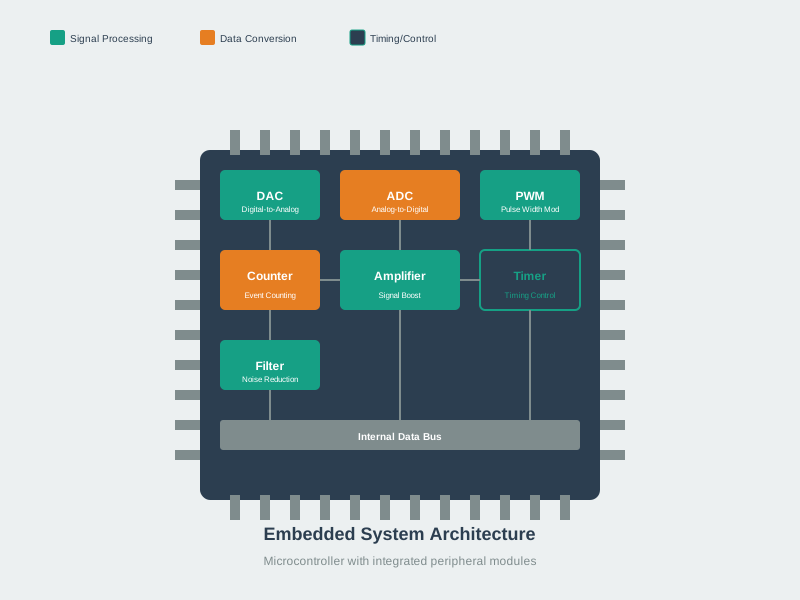
- That labelled check bounds diagram of an embedded system showing components like processors, converters, and amplifiers.
Major section
Defining Principle (continued)
Optimization Requirements:: Designers must optimize code and use minimal microcontroller resources to keep costs low and efficiency high.
- Embedded systems are fundamental to modern electronics, providing tailored solutions to a wide range of technological challenges.
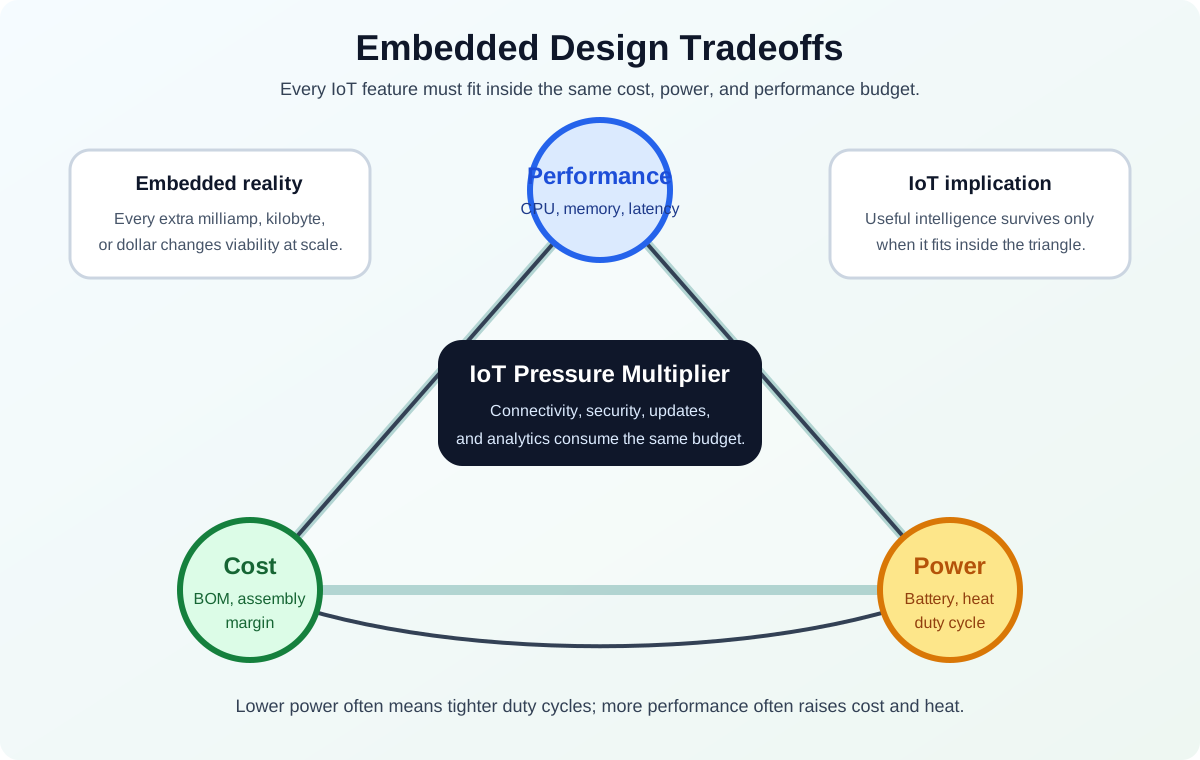
- Figure: Embedded systems design triangle balancing cost makes defining principle inspectable through Embedded Design Tradeoffs and: Performance.
- This "design triangle" of cost, power, and performance defines the fundamental constraints that embedded system engineers must balance.
Major section
Phoebe's Field Notes: What The "Coin Cell For A Year" Claim Actually Budgets
The mathematical gist.: A 225 mAh CR2032 at 3.0 V stores 0.675 Wh by nameplate.
- One year of 1% self-discharge leaves 222.75 mAh, so charge, energy, pulse sag, and retention must be checked together.
Deck summary
Key takeaways
Machine learning: Learns patterns and improves over time.
- A light bulb controlled from a phone can meet the baseline IoT test, but it should not be sold as adaptive.
- A thermostat with an app is connected IoT; a thermostat that learns your schedule and adjusts from occupancy, weather, and energy prices is adaptive IoT.
- The distinction matters because products lose trust when basic connectivity is sold as autonomous optimisation.
- "An embedded system is a computerized system that is purpose-built for its application.": Elicia White, Making Embedded Systems (O'Reilly).
Retrieval practice
Recall check 1 of 3

Blueprint Bina says: answer from memory, then check your reasoning.
Q1A washing machine adjusts its cycle using load and energy context. Which capability distinguishes the example from remote control?
Show answer
Answer: A The example combines sensing and logic to select and improve operating behavior.
Q2A phone-controlled bulb is marketed as adaptive lighting. What should the review require for that stronger claim?
Show answer
Answer: D The maturity test distinguishes basic connectivity from adaptive behavior.
Retrieval practice
Recall check 2 of 3

Blueprint Bina says: answer from memory, then check your reasoning.
Q3A startup is designing a pet feeder. Version 1 dispenses food on a fixed schedule. Version 2 adds Wi-Fi so owners can trigger feeding from their phone. Version 3 uses weight sensors, pet activity tracking, and ML to automatically adjust portion sizes based on the pet's health data. Which version can most justifiably charge a monthly subscription fee, and why?
Show answer
Answer: C
Retrieval practice
Recall check 3 of 3

Blueprint Bina says: answer from memory, then check your reasoning.
Q4Why was the ARM Cortex-M processor considered a "game-changer" for IoT development?
Show answer
Answer: B
Q5What event was critical in driving widespread BLE adoption for IoT consumer devices?
Show answer
Answer: C
Print reference
Answers
Answer key.
- A · The example combines sensing and logic to select and improve operating behavior.
- D · The maturity test distinguishes basic connectivity from adaptive behavior.
- C
- B
- C