IoT Value and Product Strategy · Study deck
Applied: Device Evolution Operating Limits
A gateway is a device or service that passes data between unlike parts of a system.
Ada is your guide for this deck.

After studying this chapter
Learning objectives
You will be able to:
- Explain why device evolution shifts operating responsibility instead of merely adding features.
- Classify a product as embedded, connected, or IoT using its operating claims and evidence.
- Identify the engineering and support work implied by each product category.
- Describe how IoT systems split state across firmware, gateways, brokers, cloud services, apps, and business workflows.
Major section
Start With the Story
A gateway is a device or service that passes data between unlike parts of a system.
- It may also filter, store, or translate data.
- Its job and owner must be named.
- Later it gains phone access, remote updates, shared data, and an outside support service.
- For example, keep local heat control when the phone service is down.
Major section
Start With the Story (continued)
A category such as "connected" or "IoT" does not prove that the added service is safe or supported.
- More remote ability can create more value, but it also creates new duties and new ways to fail.
- A product life is not complete if the team can add remote control but cannot remove it safely.
- This contract chapter turns device evolution into operating boundaries so a connected feature has clear limits, fallback behavior, and release evidence.
Major section
Evolution Adds Responsibility
Device evolution is not a ladder where every product must climb toward cloud intelligence.
- A connected device adds remote visibility or remote control through Wi-Fi, BLE, cellular, Ethernet, LoRaWAN, Zigbee, Thread, or a gateway.
- The technical category should match the value the product can actually deliver.
- The evolution also changes who must be involved.
Major section
Evolution Adds Responsibility (continued)
If a device only moves a button from the wall to a phone app, the value is convenience.
- An IoT device adds a wider operating model: sensing, data flow, decisions, integration, security updates, fleet management, and evidence that the product keeps improving after installation.
- If it detects occupancy, learns a schedule, reacts to tariff changes, coordinates with other devices, and documents what it did, the value becomes outcome improvement.
- Embedded systems keep responsibility mostly inside the product.
Major section
Evolution Adds Responsibility (continued)
They pay for a thermostat that reduces waste without confusion, a machine sensor that prevents downtime, a medication dispenser that records adherence safely, or a logistics tag that makes exceptions visible before cargo is spoiled.
- Embedded products can often be shipped as stable hardware plus firmware.
- Connected products need mobile app, cloud API, identity, and support teams.
- IoT products need operations, analytics, privacy, security, incident response, customer success, and lifecycle planning.
Major section
Classify Products by Claims
A practical classification starts with the claim the product makes and the evidence behind that claim.
- If it adjusts behavior from occupancy, weather, energy price, equipment state, route condition, patient adherence, or learned usage patterns, then inspect whether the decision path is real and maintainable.
- A rule hidden in a cloud dashboard is not the same as a validated control policy with fallback behavior, audit logs, and a support process.
- Connected work adds commissioning, local network behavior, MQTT or HTTP message design, TLS credentials, cloud outage handling, and mobile-app state.
Major section
Each Era Moves the Boundary
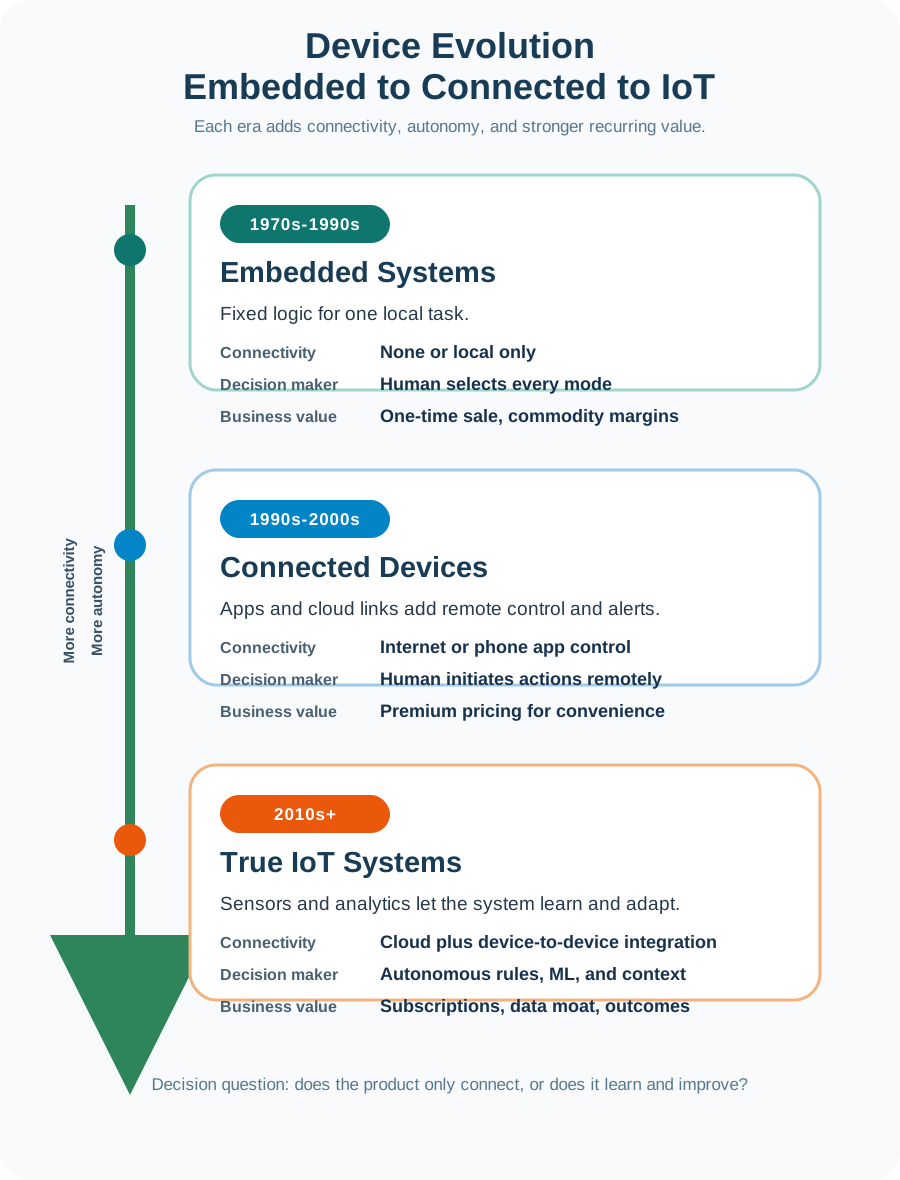
A Cortex-M, ESP32, nRF52, RP2040, or similar microcontroller may read sensors, run a control loop, sleep aggressively, and drive actuators without the internet.
- The important engineering questions are local: boot time, clock source, ADC resolution, interrupt latency, EEPROM or flash wear, watchdog recovery, radio sleep current, and whether the device fails safe.
Major section
Each Era Moves the Boundary (continued)
Connected products move some state into a phone, hub, broker, or cloud API, so stale status, retry behavior, authentication, pairing, and rate limits become part of the design.
- Device twins, MQTT retained messages, CoAP resources, LwM2M objects, time-series stores, rules engines, edge inference, and cloud dashboards can all hold partial truths about the same physical object.
- Without those semantics, users see "on" in one interface and "off" at the device, and support teams cannot tell whether the problem is firmware, network, cloud, or expectation.
- In the third, several places hold partial truth at once.
Major section
Boundary Semantics and Observability
The boundary shift affects failure modes.
- Embedded failures are often reproducible on a bench with a debugger, logic analyzer, or power profiler.
- Connected failures may depend on router behavior, captive portals, TLS certificate expiry, app permissions, or a cloud outage.
- Business boundary: Subscription pricing is credible only when the system keeps producing outcome value after installation.
Major section
Boundary Semantics and Observability (continued)
IoT failures may depend on delayed telemetry, duplicate messages, inconsistent units, model drift, missing consent, or an integration endpoint changing shape.
- Production observability therefore needs device logs, event ids, firmware version, radio signal, battery voltage, broker acknowledgments, cloud trace ids, and user-visible command history.
- It changes the trust model, operating cost, test matrix, and product promise.
- A well-designed IoT system treats firmware, cloud, data, security, and support as one product surface.
Deck summary
Key takeaways
A gateway is a device or service that passes data between unlike parts of a system.
- A category such as "connected" or "IoT" does not prove that the added service is safe or supported.
- Device evolution is not a ladder where every product must climb toward cloud intelligence.
- If a device only moves a button from the wall to a phone app, the value is convenience.
- They pay for a thermostat that reduces waste without confusion, a machine sensor that prevents downtime, a medication dispenser that records adherence safely, or a logistics tag that makes exceptions visible before cargo is spoiled.
Retrieval practice
Recall check 1 of 5

Ada says: answer from memory, then check your reasoning.
Q1A connected fleet launches with remote control but no retirement plan. Which contract is missing?
Show answer
Answer: B Fleet support needs an owner for identity, credentials, and end-of-life actions.
Retrieval practice
Recall check 2 of 5
Ada says: answer from memory, then check your reasoning.
Q2Per this chapter, what actually changes as a product moves from embedded to connected to IoT?
Show answer
Answer: D IoT systems distribute responsibility across device firmware, edge gateway, network, data platform, rule engine, user workflow, and business process.
Retrieval practice
Recall check 3 of 5
Ada says: answer from memory, then check your reasoning.
Q3A freezer monitor reports temperature readings to a mobile app. Per this chapter's scenario test, what would need to be added to justify classifying it as an IoT system rather than merely connected?
Show answer
Answer: D see answers page
Retrieval practice
Recall check 4 of 5
Ada says: answer from memory, then check your reasoning.
Q4A fleet release shows only a command button and an online badge. Which added contract would make it supportable?
Show answer
Answer: A Correct: those records let staff trace action, trust software, diagnose faults, and close the lifecycle.
Retrieval practice
Recall check 5 of 5
Ada says: answer from memory, then check your reasoning.
Q5Why do IoT products need explicit command states such as requested, queued, applied, rejected, overridden, and expired?
Show answer
Answer: C Once responsibility for a command is split across app, cloud, gateway, and device, no single component holds the full truth about what happened to it.
Print reference
Answers 1 of 3
Answer key.
- B · Fleet support needs an owner for identity, credentials, and end-of-life actions.
- D · IoT systems distribute responsibility across device firmware, edge gateway, network, data platform, rule engine, user workflow, and business process.
Print reference
Answers 2 of 3
Answer key.
- D · The chapter's worked scenario: a freezer monitor that only reports temperature to an app is connected; it becomes IoT-like only when it identifies compressor short-cycling from historical current-draw baselines, suppresses duplicate defrost-cycle alarms, and opens a CMMS maintenance ticket with a recommended action -- 'The extra value comes from coordination between sensing, interpretation, workflow, and accountability, not from the radio alone.'.
- A · Correct: those records let staff trace action, trust software, diagnose faults, and close the lifecycle.
Print reference
Answers 3 of 3
Answer key.
- C · Once responsibility for a command is split across app, cloud, gateway, and device, no single component holds the full truth about what happened to it.