Energy & Power · Study deck

Software Optimization Techniques

Picture a battery sensor that wakes every second to ask whether anything happened.

Battery Bruno is your guide for this deck.

optimizationsoftware
Battery Bruno, the module guide, in a scene from this chapter.
iotclass.org

After studying this chapter

Learning objectives

You will be able to:

  • Choose compiler and linker settings from evidence instead of habit.
  • Identify when code size, memory traffic, active time, or wakeups dominate firmware cost.
  • Apply data-layout and buffering changes that reduce copies and memory stalls.
  • Decide when code-level changes such as inlining, lookup tables, or loop restructuring are worth the risk.
iotclass.org

Major section

Start With Firmware That Wakes Too Often · In 60 Seconds

Most wake-ups do no useful work, yet each one starts clocks and code.

  • Firmware means the software stored on the device.
  • Duty cycle means the share of time a device spends active instead of asleep.
  • This runway does not prove that every software change saves energy.

Key terms

Software optimization
Software optimization is the measured process of changing firmware so it does less work, moves less data, sleeps sooner, or fits smaller memory.

Why it matters

A useful change should reduce work without losing required events.

iotclass.org

Major section

Firmware Optimization Loop
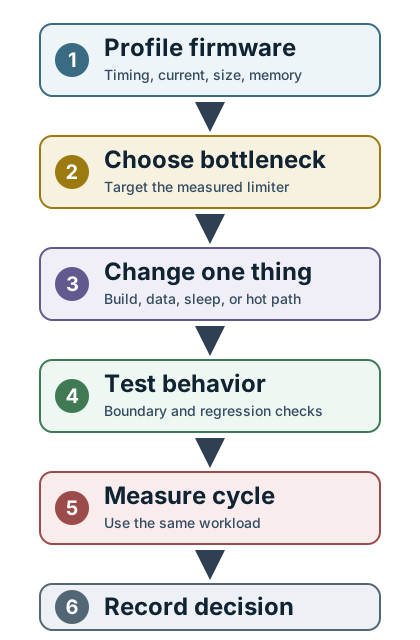
That sequence gives the visual its meaning: No-panel firmware optimization loop: profile, choose bottleneck, change one thing, test correctness, measure whole cycle, and record result.

  • Unit tests, reference vectors, boundary cases, and integration run.
Firmware optimization loop showing profile, choose bottleneck, change one thing, test correctness, measure whole cycle, and record result.
iotclass.org

Major section

Code-Level Changes · Compiler And Build Choices
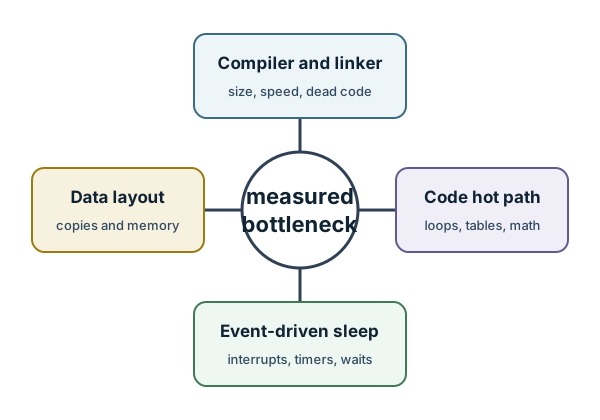
Compiler flags are a starting point, not an optimization strategy by themselves.

  • You need readable stepping, assertions, and source-level diagnosis.
  • The product needs stable speed without aggressive code growth.
  • Flash, update size, or instruction fetch is the limit.
  • A measured hot path blocks a deadline or keeps the device awake.
iotclass.org

Major section

Data, Memory, And Copies · Event-Driven Sleep
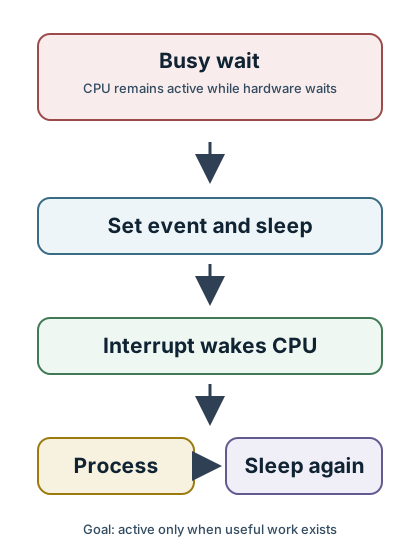
Data movement can dominate firmware cost.

  • A clean algorithm can still waste energy if it copies buffers, parses verbose payloads, or wakes the CPU for every small transfer.
  • Busy waiting is one of the easiest ways to waste energy.
  • Replacing a polling loop is only useful if firmware has a complete route back to sleep.

Key terms

Verbose logging
Verbose logging is moved outside the critical active window.

Why it matters

Batch when latency allows: Batching can reduce wakeups and protocol overhead, but it must not hide important events or overload buffers.

Sleep-aware firmware timeline showing busy wait replaced by event setup, sleep, interrupt wake, short processing, and return to sleep.
iotclass.org

Major section

Polling Keeps The Core Awake; Events Let It Sleep
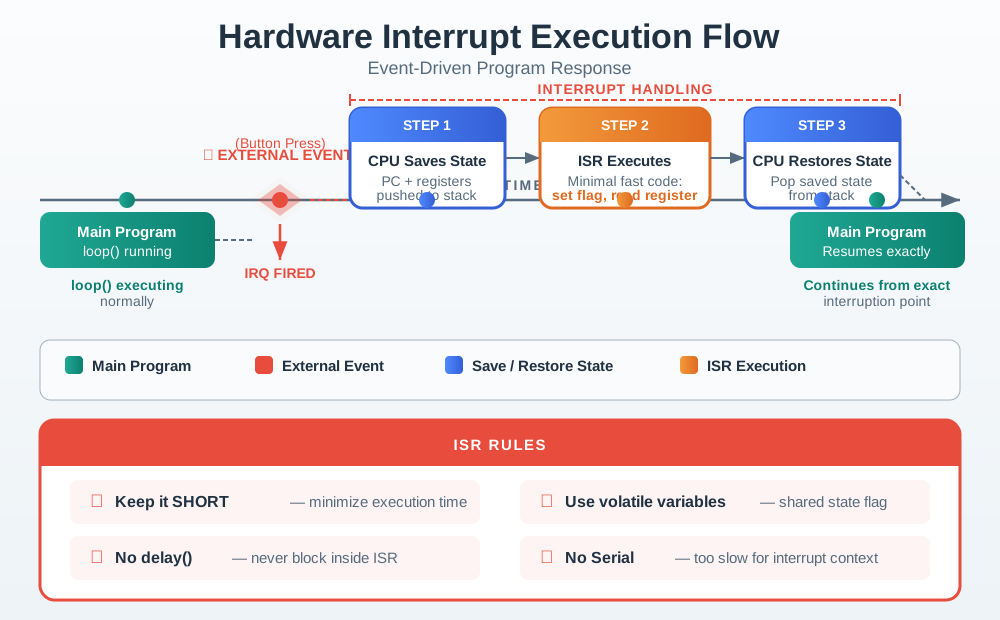
In particular, Runs normally must be reconciled with: Sleeps until an event before the result can guide implementation.

  • With those jobs separated, the chapter's polling keeps the core awake; events let it sleep claim remains testable.
An interrupt saves CPU state, runs a short ISR, and restores state so the main program resumes exactly where it paused, keeping the core asleep until an event fires.
iotclass.org

Major section

Phoebe's Field Notes: Why "More Than 8000 Days" Is A Ceiling, Not A Forecast · delay() Does Not Sleep, And You Must Offload The Watching

The mathematical gist.: A 2,000 mAh, 3.7 V pack stores 7.40 Wh at nameplate conditions.

  • At 2% monthly self-discharge, 29.8% remains after five years and 8.85% after ten, so an ideal 8,000-day current-draw ceiling is not a field-life promise.

Numbers to remember

3.7 V3.7 V pack stores 7.40 Wh at nameplate conditions.
7.40 Wh3.7 V pack stores 7.40 Wh at nameplate conditions.
iotclass.org

Major section

Compiler Optimization Modes

Optimization flags express a preference to a particular toolchain; they do not guarantee a fixed list of transformations.

  • In common GCC- and Clang-style workflows, a speed-focused -O3 build may inline more aggressively, unroll or vectorize loops, reorder instructions, and create separate fast paths for alignment or aliasing cases.
  • A size-focused -Os build usually discourages growth, favors shorter encodings, and may keep branches or calls that a speed build removes.
  • A size build can reduce fetch energy, yet keep the core awake longer.
  • The winning flag is the one that lowers measured charge per useful task while preserving timing, stack, numerical, and update-slot requirements.
iotclass.org

Major section

Code Density and Instruction-Level Parallelism

Code occupies silicon and consumes energy every time it is fetched.

  • A memory large enough to hold software can dwarf a small processor core, so instruction density can affect area, fetch bandwidth, leakage, and update time.
  • Compressed instruction sets commonly provide short 16-bit encodings alongside wider 32-bit encodings.

Key terms

None
None is a reliable proxy for the other two.
Three instruction-set branches compare compressed 16-bit encodings, CISC complexity, and VLIW parallel bundles under an update-size limit.
iotclass.org

Major section

Code Density and Instruction-Level Parallelism (continued)

VLIW therefore exchanges dynamic scheduling hardware for compiler scheduling and can waste code space when parallelism is sparse.

  • Short forms save bytes but have fewer encoding bits, so they may expose only a subset of registers, smaller immediate ranges, fewer addressing modes, or an explicit mode/history constraint on older designs.
  • The assembler expands to a wider form when operands do not fit.
  • None is a reliable proxy for the other two.
iotclass.org

Major section

Vectorization and Tail Handling

The: TAIL [8 9] then branches to masked lanes or scalar cleanup, so the speedup boundary includes setup and remainder work and never reads beyond x[9] merely to fill a vector.

  • The vector loop executes $q$ times over $qW$ elements; a tail path handles the remaining $r$ elements.

Key terms

Vectorization
Vectorization is complete only when the remainder path is as deliberate as the fast path.

Why it matters

That removes a scalar loop but does not remove the boundary obligation: the mask must prevent out-of-range memory access and preserve inactive lanes.

Ten scalar array elements become two four-lane vector operations plus a two-element cleanup tail.
iotclass.org

Major section

Vectorization and Tail Handling (continued)

For $N=18$ and $W=4$, there are four vector iterations covering 16 elements and two scalar tail iterations.

  • Omitting the tail silently leaves c[16] and c[17] wrong.
  • Some instruction sets provide masked loads and stores, allowing one final vector operation with only the first $r$ lanes enabled.
  • so short arrays, tails, alignment repair, alias checks, and memory bandwidth reduce the gain.
iotclass.org

Major section

Predication and Function Inlining · Summary

Below,: CALL / RETURN keeps one 12 B body, while: INLINE AT THREE SITES removes call overhead at the explicit cost of +24 B image growth.

  • If its direction is hard to predict, a misprediction flushes useful pipeline work.
  • For a branch with misprediction probability $p_m$ and recovery cost $L$ cycles, the expected branch penalty is approximately $p_mL$.

Key terms

Predication
Predication is attractive when executing or issuing the guarded instructions costs less than that penalty and has no unsafe side effects.
If a three-instruction helper
If a three-instruction helper is called in a hot inner loop, this can be valuable.
Branch and predicated instruction timelines are compared beside shared-call and three-site inline code layouts.
iotclass.org

Deck summary

Key takeaways

Most wake-ups do no useful work, yet each one starts clocks and code.

  • That sequence gives the visual its meaning: No-panel firmware optimization loop: profile, choose bottleneck, change one thing, test correctness, measure whole cycle, and record result.
  • Compiler flags are a starting point, not an optimization strategy by themselves.
  • Data movement can dominate firmware cost.
  • In particular, Runs normally must be reconciled with: Sleeps until an event before the result can guide implementation.
iotclass.org

Retrieval practice

Recall check 1 of 6

Battery Bruno says: answer from memory, then check your reasoning.

Q1A profile shows firmware spends much of its active window waiting for a peripheral transfer to complete. Which software optimization should be evaluated first?

ARewrite every loop by hand because loops are usually the main problem
BUse an event-driven transfer path so the CPU can sleep until completion
CIncrease log verbosity inside the active window
DKeep polling because it is easier to read
Show answer

Answer: B Optimization follows the measured bottleneck.

iotclass.org

Retrieval practice

Recall check 2 of 6

Battery Bruno says: answer from memory, then check your reasoning.

Q2A speed-focused build reduces one hot function's runtime but grows the firmware enough to threaten over-the-air update limits. What is the best next step?

AKeep it because shorter active time should save battery charge
BCompare size, timing, full-cycle current, and OTA limits first.
CCheck hot-function timing first and defer the larger regression suite
DReturn to the size-focused build because it leaves more OTA space
Show answer

Answer: B Software optimization is multidimensional.

iotclass.org

Retrieval practice

Recall check 3 of 6

Battery Bruno says: answer from memory, then check your reasoning.

Q3Place each software optimization artifact where it lives so you can change the measured hot path without trading away timing, memory, or energy safety.

AProfile
BBuild choice
CFirmware change
DValidation
Show answer

Answer: A Link measured hot-path evidence to explicit build and firmware changes, then replay the same workload and guardrails so you can prove the optimization rather than infer it.

iotclass.org

Retrieval practice

Recall check 4 of 6

Battery Bruno says: answer from memory, then check your reasoning.

Q4Why does an event-driven firmware structure usually beat a polling loop on battery life by a large margin?

AEvent-driven code executes fewer total instructions per event.
BPolling holds the processor active to keep checking.
CPolling uses a slower clock, which wastes energy.
DEvent-driven designs never need to process anything.
Show answer

Answer: B Polling keeps the core active at milliamps while event-driven firmware sleeps at microamps and wakes only on real events.

iotclass.org

Retrieval practice

Recall check 5 of 6

Battery Bruno says: answer from memory, then check your reasoning.

Q5A node handles about 10 events per hour, each 5 ms at 8 mA, and can sleep at 10 uA. What is the approximate average current if it is event-driven rather than polling at 8 mA?

AAbout 10.1 uA, near the sleep floor.
BAbout 8 mA, the same as polling, because the processing is the same.
CAbout 4 mA, half of polling.
DAbout 0 uA, counting just the brief processing bursts.
Show answer

Answer: A The bursts contribute 0.4 mA-s per hour, or about 0.11 uA averaged. Add the 10 uA sleep floor for roughly 10.1 uA total, about 800x below 8 mA polling.

iotclass.org

Retrieval practice

Recall check 6 of 6

Battery Bruno says: answer from memory, then check your reasoning.

Q6A firmware author changes fixed-interval reporting to use delay(1000) between reports expecting big energy savings, but the average current barely drops. Why?

AThe reporting interval is too short for a timer wake to help.
Bdelay() already enters deep sleep, so the battery estimate is wrong.
Cdelay() is busy-waiting; a real sleep call needs a timer wake.
DBattery self-discharge is dominating the one-second interval.
Show answer

Answer: C A spinning delay produces the timing but not the energy saving, because the core stays active the whole second.

iotclass.org

Print reference

Answers 1 of 2

Answer key.

  1. B · Optimization follows the measured bottleneck.
  2. B · Software optimization is multidimensional.
  3. A · Link measured hot-path evidence to explicit build and firmware changes, then replay the same workload and guardrails so you can prove the optimization rather than infer it.
  4. B · Polling keeps the core active at milliamps while event-driven firmware sleeps at microamps and wakes only on real events.
iotclass.org

Print reference

Answers 2 of 2

Answer key.

  1. A · The bursts contribute 0.4 mA-s per hour, or about 0.11 uA averaged. Add the 10 uA sleep floor for roughly 10.1 uA total, about 800x below 8 mA polling.
  2. C · A spinning delay produces the timing but not the energy saving, because the core stays active the whole second.
iotclass.org