Energy & Power · Study deck
Fixed-Point Arithmetic
Picture a battery sensor that stays awake to calculate a value its small processor could handle with scaled integers.
Battery Bruno is your guide for this deck.

After studying this chapter
Learning objectives
You will be able to:
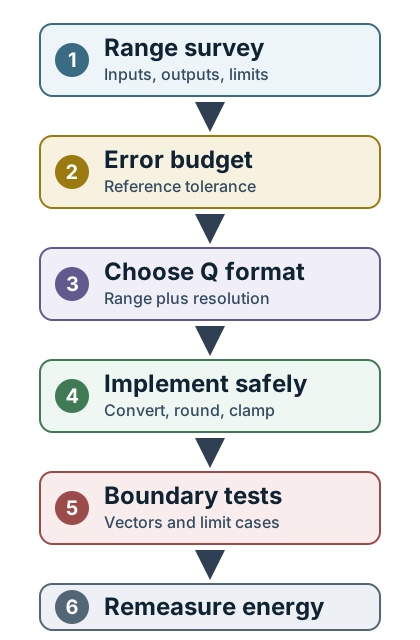
- Explain: That contrast is the visual's teaching load: Fixed-point conversion workflow from range survey and error budget through Q-format choice, safe implementation, boundary tests, and energy remeasurement.
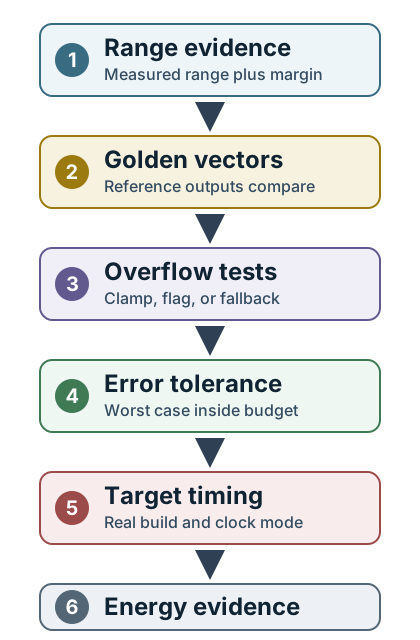
- Explain: In other words, no-panel fixed-point validation gates: range survey, golden vectors, overflow tests, error budget, target timing, and full-cycle energy evidence.
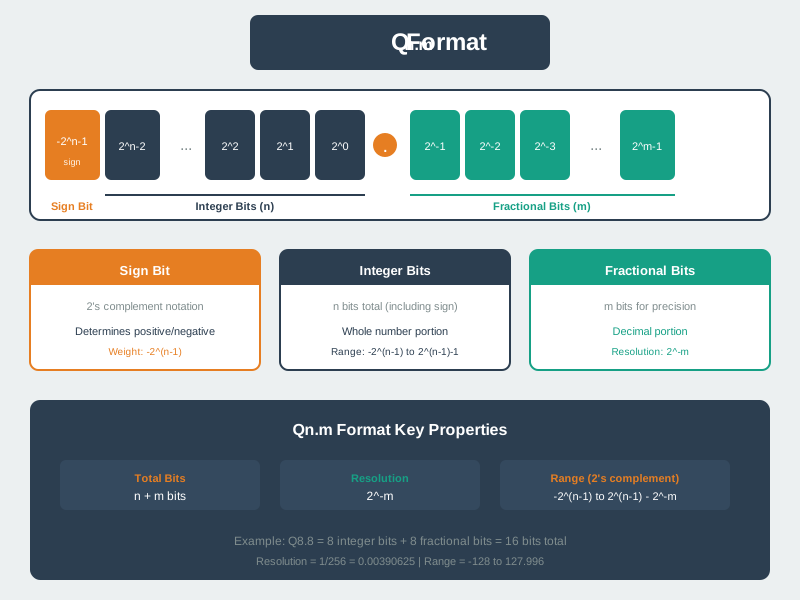
- Explain: The separate 2^n-2 label adds a distinct review condition, preventing the first two stages from being accepted on their own.
- Explain: Duty cycle means the share of time a device spends active instead of asleep.
Major section
Start With a Floating-Point Cost You Can Avoid
A faster result is useful only if its error remains safe.
- Firmware means the software stored on the device.
- Duty cycle means the share of time a device spends active instead of asleep.
- This runway does not prove that fixed-point arithmetic is always better.
Major section
Q-Format Model
In a signed Qn.m format, n bits hold the signed integer side and m bits hold the fractional side.
- The separate 2^n-2 label adds a distinct review condition, preventing the first two stages from being accepted on their own.
- This distinction carries forward into q-format model.
Major section
Validation Gates
Fixed-point arithmetic changes numerical behavior.
- In other words, no-panel fixed-point validation gates: range survey, golden vectors, overflow tests, error budget, target timing, and full-cycle energy evidence.
- Any required value cannot be represented with margin.
- Error changes decisions, alarms, control output, or classification.
- Intermediate values cannot wrap silently.
Major section
Cycles Become Active Time Becomes Energy
They expose the two conditions that the surrounding argument must keep together.
- That contrast is the visual's teaching load: Fixed-point conversion workflow from range survey and error budget through Q-format choice, safe implementation, boundary tests, and energy remeasurement.
Deck summary
Key takeaways
A faster result is useful only if its error remains safe.
- In a signed Qn.m format, n bits hold the signed integer side and m bits hold the fractional side.
- Fixed-point arithmetic changes numerical behavior.
- They expose the two conditions that the surrounding argument must keep together.
Retrieval practice
Recall check 1 of 5

Battery Bruno says: answer from memory, then check your reasoning.
Q1What should drive the choice of integer and fractional bits in a fixed-point format?
Show answer
Answer: D Fixed-point design starts with numeric requirements and validation evidence.
Q2Why does fixed-point multiplication usually need a wider temporary value?
Show answer
Answer: A Fixed-point multiplication needs planned intermediate width and rescaling.
Retrieval practice
Recall check 2 of 5

Battery Bruno says: answer from memory, then check your reasoning.
Q3Place each fixed-point design step where it lives so you can prevent overflow and quantify precision before firmware release.
Show answer
Answer: A Connect measured bounds to bit allocation, arithmetic rules, and release evidence so you can show that the optimization saves resources without silently corrupting values.
Retrieval practice
Recall check 3 of 5

Battery Bruno says: answer from memory, then check your reasoning.
Q4Why does a floating-point multiply cost far more energy than a fixed-point multiply on a Cortex-M0+ sensor node?
Show answer
Answer: C Without an FPU, floats are emulated in software and take many cycles; fixed-point uses the integer multiplier in a few cycles.
Retrieval practice
Recall check 4 of 5

Battery Bruno says: answer from memory, then check your reasoning.
Q5On a 16 MHz FPU-less core, a filter needs 50000 cycles per sample in software float and 3000 cycles in fixed-point, running at 100 samples per second. What is the main energy consequence?
Show answer
Answer: B 100 x 3.125 ms = 312.5 ms/s active for float versus 18.75 ms/s for fixed. The float version cannot get back to sleep quickly, so its average current is far higher.
Retrieval practice
Recall check 5 of 5

Battery Bruno says: answer from memory, then check your reasoning.
Q6A Cortex-M4F design with a single-precision FPU still shows high compute energy in a hot loop that uses floats. What is a likely cause?
Show answer
Answer: D The M4F FPU accelerates only single precision.
Print reference
Answers 1 of 2
Answer key.
- D · Fixed-point design starts with numeric requirements and validation evidence.
- A · Fixed-point multiplication needs planned intermediate width and rescaling.
- A · Connect measured bounds to bit allocation, arithmetic rules, and release evidence so you can show that the optimization saves resources without silently corrupting values.
- C · Without an FPU, floats are emulated in software and take many cycles; fixed-point uses the integer multiplier in a few cycles.
Print reference
Answers 2 of 2
Answer key.
- B · 100 x 3.125 ms = 312.5 ms/s active for float versus 18.75 ms/s for fixed. The float version cannot get back to sleep quickly, so its average current is far higher.
- D · The M4F FPU accelerates only single precision.