Electronics & Circuits · Study deck
Sampling and Aliasing: Nyquist and Filters
A sensor can report a slow false wave when it samples a fast real signal.
Voltage Vera is your guide for this deck.

After studying this chapter
Learning objectives
You will be able to:
- Apply Nyquist Theorem: Calculate minimum sampling rates for different signals
- Diagnose Aliasing: Explain why undersampling causes incorrect frequency representation and predict aliased frequencies
- Design Anti-Aliasing Filters: Specify hardware low-pass filter parameters to prevent high-frequency contamination before ADC
- Evaluate Sampling-Power Trade-offs: Select optimal sampling rates that satisfy Nyquist while minimizing energy consumption in battery-powered IoT devices
Major section
Start Simple
Nyquist sampling is the rule that prevents a changing signal from pretending to be something else.
- The stored trace may be neat and still be false.
- Sampling rate means how many measurements are taken each second.
- The deeper sections develop aliasing, limits, filtering, oversampling, and reconstruction.
Major section
Nyquist-Shannon Sampling Theorem
Sampling means taking readings from a changing signal.
- If the readings are too far apart, a fast real wave can look like a slow false one; that error is aliasing.
- Sampling rate is the number of readings each second.
- The first design question is simple: what is the fastest part of the signal you must preserve.
Major section
Phoebe's Field Notes: Why Aliases Fold Back
The mathematical gist: Sampling at fs gives a Nyquist ceiling fs/2.
- The chapter’s 800 Hz harmonic sampled at 1000 Hz appears at 200 Hz, while 2500 Hz leaves a 250 Hz gap above the named 1 kHz precursor.
Major section
Deep dive: Putting Numbers to It
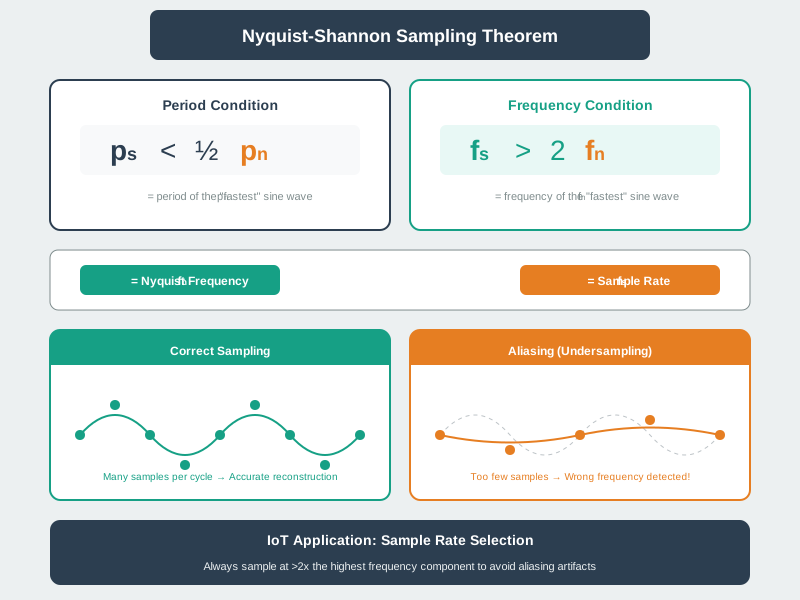
For audio sampling human voice (max frequency fmax=3400 Hz), Nyquist requires fsample≥2×3400=6800 Hz minimum.
- Telephony uses 8 kHz (18% margin).
- That reading provides the evidence needed for the section’s next calculation, comparison, or field check.
- Following those roles reveals how sample rate changes the reconstructed signal.
Major section
Deep dive: Putting Numbers to It (continued)
The theorem has direct implications for how we choose sampling rates in practice.
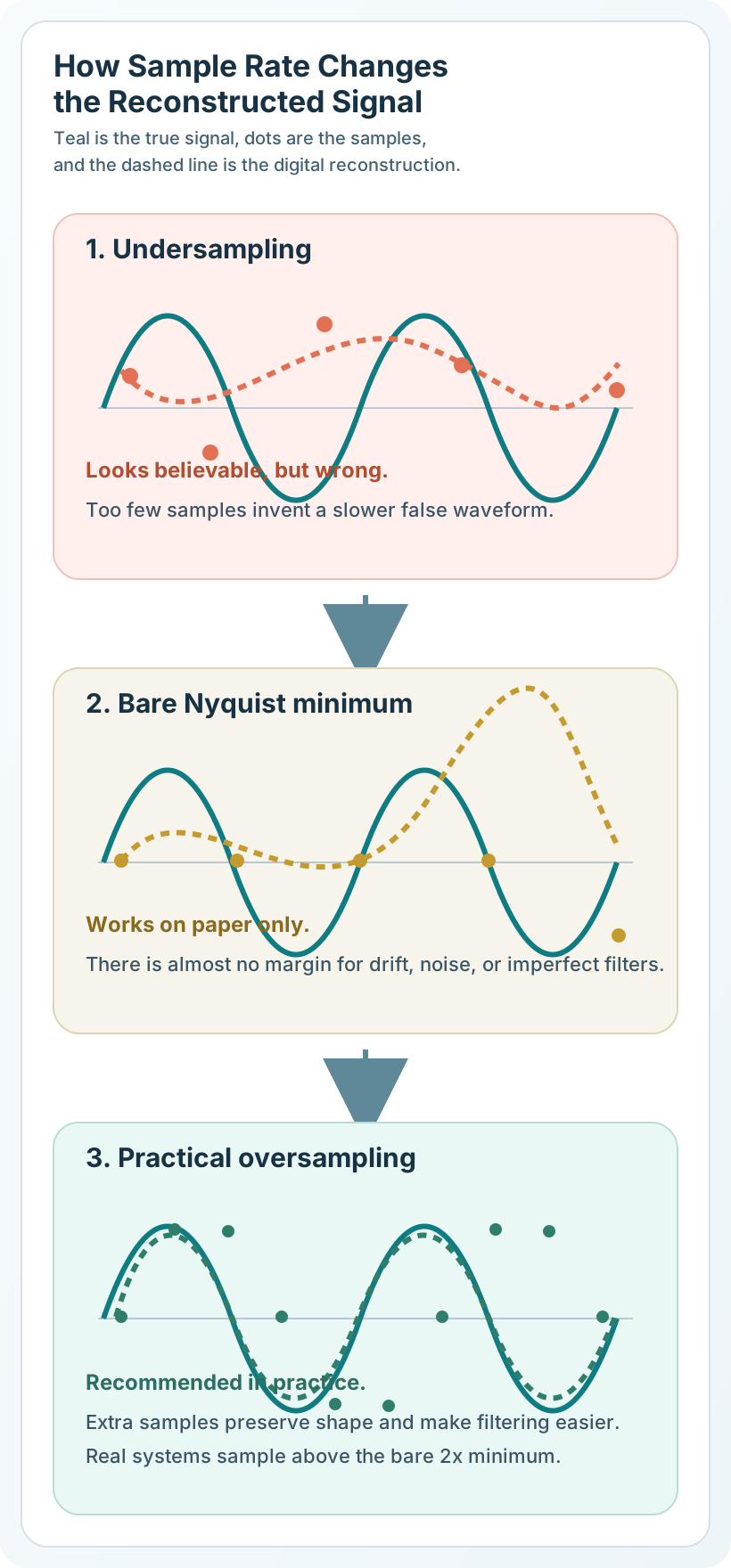
- Bare Nyquist is the mathematical minimum, but real devices usually need extra margin for noise, timing uncertainty, and anti-aliasing filter roll-off.
- It turns how sample rate changes the reconstructed signal from a verbal claim into labelled evidence.
- Undersampling (too slow) causes aliasing - high frequencies appear as low frequencies!
Major section
Sampling Tradeoffs for Vibration
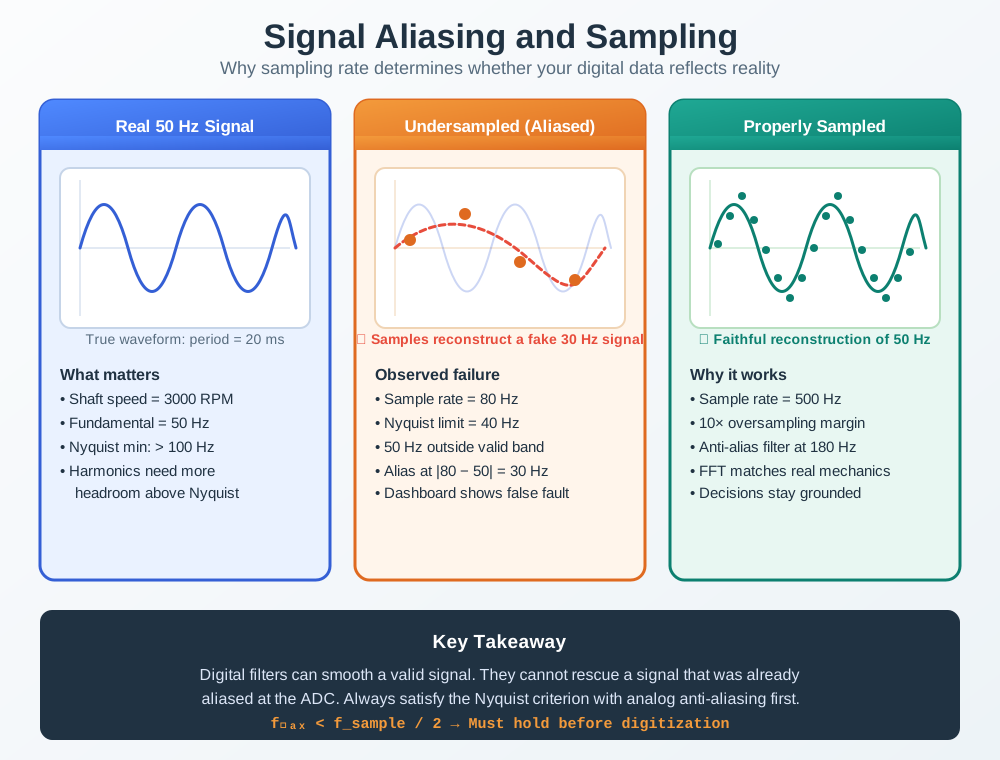
Option A: 500 Hz Sampling (FAILS).
- Sampling at 500 Hz = exactly at signal frequency → aliasing occurs!
- Aliasing: Nyquist frequency is only 250 Hz, so the 500 Hz component folds back to |500: 500| = 0 Hz (DC) or nearby low frequencies depending on phase.
- But: Real motors have frequency components >500 Hz (harmonics, noise).
Major section
Sampling Rate vs Power
At 32 bits per sample, 86.4 million samples/day require about 346 MB/day.
- Option B: Low-frequency sampling (1 Hz): Adequate for slow environmental signals (temperature, humidity), power draw ~0.005mW with sleep between samples, generates 86,400 samples/day, requires 345 kB/day storage.
- Decision Factors: For battery-powered environmental sensors where signals change over minutes or hours, 1 Hz sampling can reduce sampling work while preserving relevant variation; battery-life gain depends on the full power budget.
- For vibration analysis, motor monitoring, or audio capture, 1000+ Hz is mandatory to avoid aliasing.
Major section
Anti-Aliasing Filter Strategies
Problem: Real-world signals have infinite frequency components (noise, harmonics).
- Attenuates 50 Hz by only about 10.4 dB before 100 Hz sampling; stronger rejection is needed if a 50 Hz component must not alias.
- Specify the required stopband attenuation from the out-of-band signal level and allowed error; f_cutoff = f_sample / 4 is only a starting point.
- Setting fcutoff=fsample/4 creates transition bandwidth, but filter order and out-of-band signal levels still determine whether attenuation at and above fsample/2 is adequate.
Deck summary
Key takeaways
Nyquist sampling is the rule that prevents a changing signal from pretending to be something else.
- Sampling means taking readings from a changing signal.
- The mathematical gist: Sampling at fs gives a Nyquist ceiling fs/2.
- For audio sampling human voice (max frequency fmax=3400 Hz), Nyquist requires fsample≥2×3400=6800 Hz minimum.
- The theorem has direct implications for how we choose sampling rates in practice.
Retrieval practice
Recall check 1 of 2
Voltage Vera says: answer from memory, then check your reasoning.
Q1You need to sample a 500 Hz signal. What is the minimum sampling rate according to Nyquist?
Show answer
Answer: B The Nyquist theorem requires f_sample >= 2 x f_max = 2 x 500 Hz = 1000 Hz.
Retrieval practice
Recall check 2 of 2
Voltage Vera says: answer from memory, then check your reasoning.
Q2An ADC samples at eight kilohertz and the wanted signal ends at one kilohertz. Which anti-alias filter plan is reviewable?
Show answer
Answer: C A pre-ADC filter needs transition room and measured stopband proof.
Print reference
Answers
Answer key.
- B · The Nyquist theorem requires f_sample >= 2 x f_max = 2 x 500 Hz = 1000 Hz.
- C · A pre-ADC filter needs transition room and measured stopband proof.