Connected Health and Wearables · Study deck
Nursery Monitoring: Care Workflow
A nursery monitor supports a caregiver; it does not replace one.
Ada is your guide for this deck.
After studying this chapter
Learning objectives
You will be able to:
- Design smart nursery IoT systems with appropriate sensor selection and data flow architecture
- Evaluate baby monitoring system tradeoffs between wearable and non-contact approaches
- Distinguish between wellness and medical-grade devices and their regulatory implications
- Explain UTI early detection algorithms using multi-sensor pattern analysis
Major section
Respond to the Nursery Alert
The carer must decide whether to check the child, change the room, seek help, or dismiss a bad reading.
- Bandwidth means how much data a link can carry in a set time.
- Latency means the wait from an event to an alert or response.
- A home monitor supports care decisions; it does not establish a medical condition.
Major section
Respond to the Nursery Alert (continued)
The next step is a care action within the product's stated role, such as checking the child or room; the device cannot turn one reading into a diagnosis.
- A weak radio or battery state changes how much trust to place in silence from the device.
- The user may be tired.
- A mat may show motion.
Major section
Respond to the Nursery Alert (continued)
The first view should show what happened, when it happened, and what is known now.
- A sound design still has to work on a bad day.
- The room may be loud or dark.
- A device may be low on power.
- A link may come and go.
Major section
Respond to the Nursery Alert (continued)
Two records may reach the screen in the wrong order.
- It should not make the user decode a long list before taking a safe step.
- Each answer should be easy to find.
- Trust grows when the system admits its bounds.
- Retest after a change to the device, site, rule, link, or owner.
Major section
Respond to the Nursery Alert (continued)
The simple story is not a claim that the work is simple.
- End with an owned act and a clear limit.
- Say whether the product aids daily care or makes a medical claim.
- A room sensor may show heat or damp.
- A worn device may show a body sign.
Major section
Key Concepts
Nursery alert: A sensor sign must be checked before it becomes a care claim.
- Caregiver handoff: A missed acknowledgement needs a timed second contact.
- Privacy boundary: Monitoring should retain only evidence needed for the care response.
- Smart baby monitoring has evolved from simple audio intercoms to sophisticated closed-loop IoT systems combining wearable sensors, environmental controls, and machine learning analytics.
Major section
Putting Numbers to It
Daily specificity requires the number of UTI-positive infant-days, which is not supplied.
- Smart diaper UTI detection performance is measured using sensitivity and specificity.
- Worked example: Clinical trial with 1,000 infants over 180 days shows 82 actual UTIs.
- The 48-hour lead time and clinical benefit are model assumptions, not demonstrated outcomes.
Major section
Smart Baby Monitoring Basics
Smart baby monitoring uses IoT sensors and connected devices to watch over an infant continuously and alert parents to potential problems.
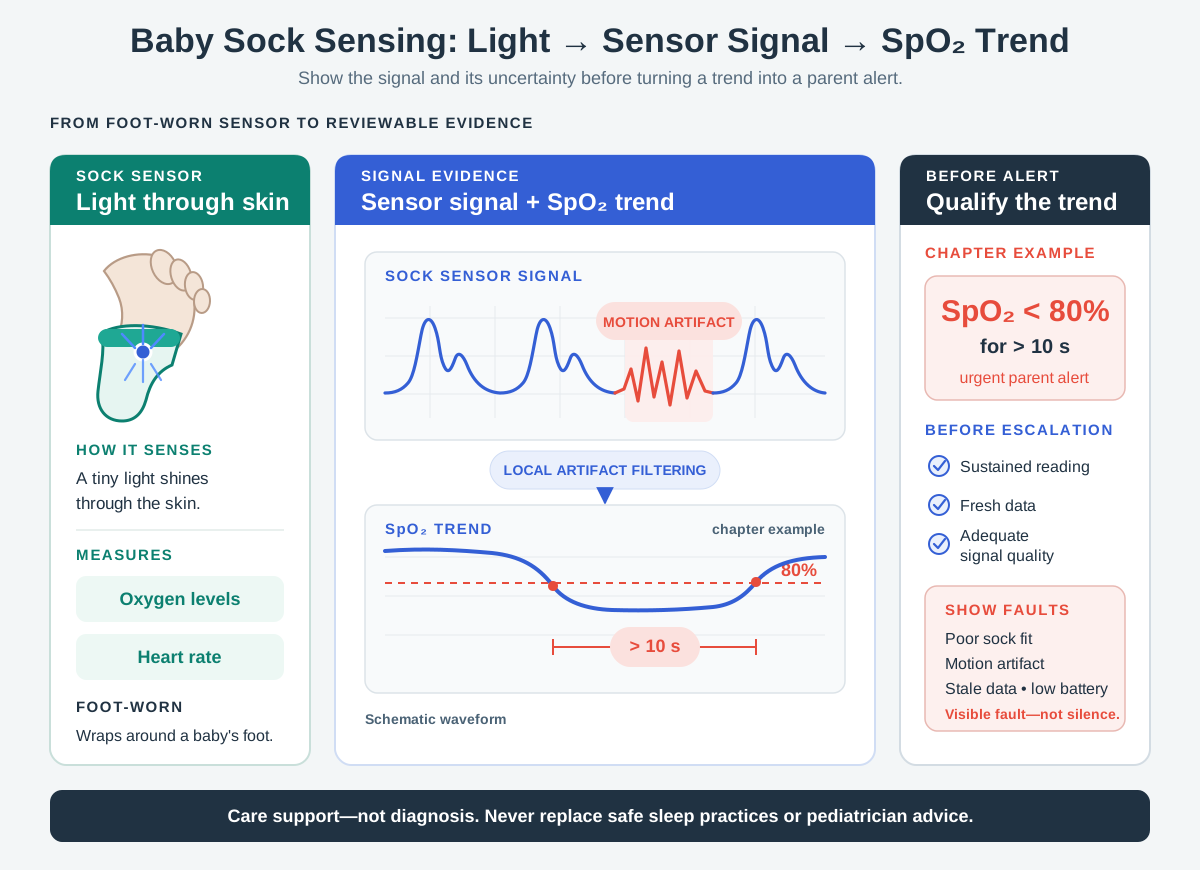
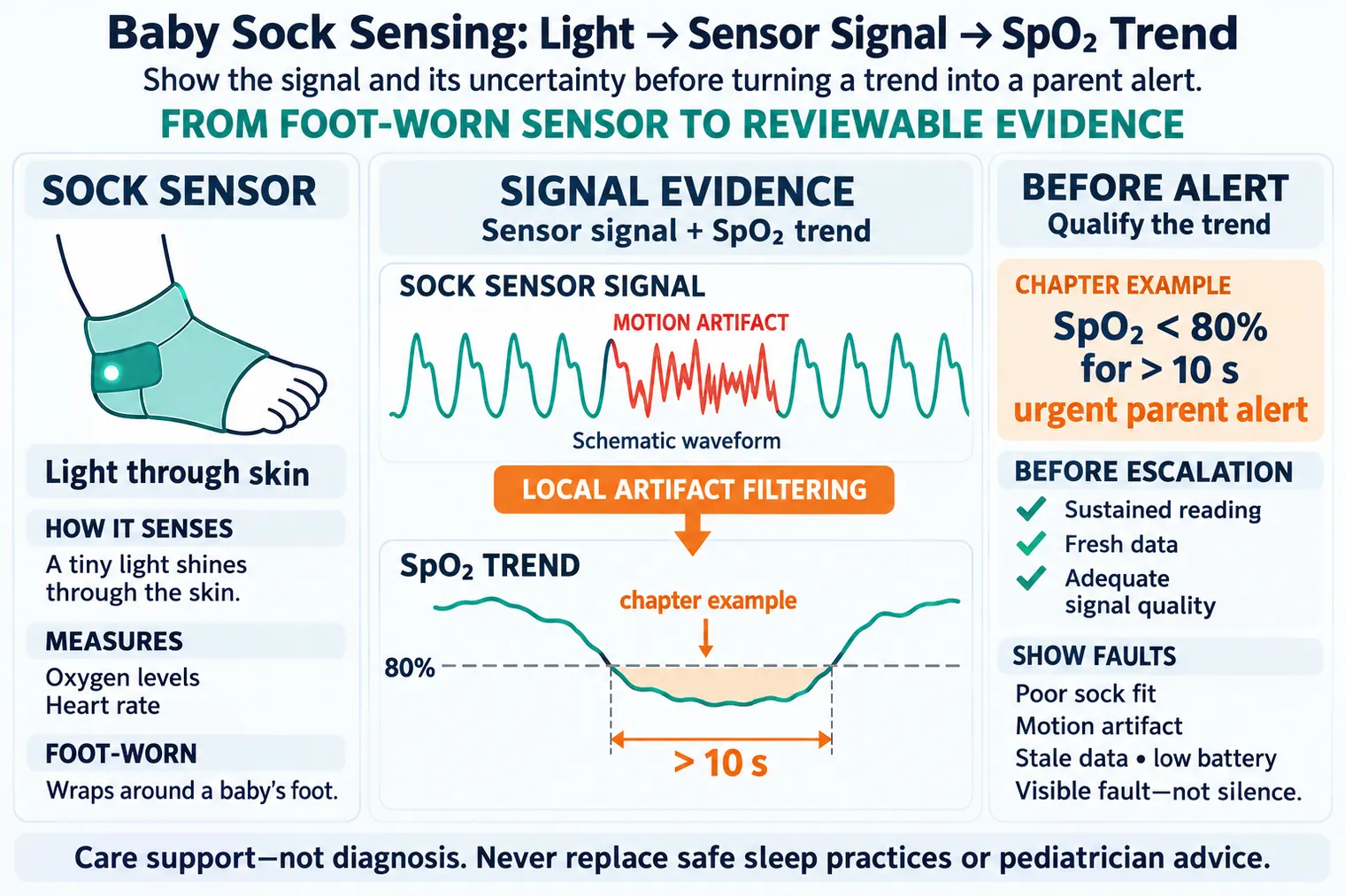
- Sensors collect data: A tiny sock on the baby's foot measures oxygen levels and heart rate.
- A pad under the mattress detects breathing movements.
- Environmental controls maintain ideal sleep conditions automatically, without parents checking constantly.
Major section
Smart Baby Monitoring Basics (continued)
A traditional baby monitor just lets you hear the baby cry -- by then, there may already be a problem.
- Smart monitors can detect subtle changes (like slow breathing or low oxygen) BEFORE the baby shows distress.
- Fictional workflow: A clinician-set sustained oxygen threshold triggers a parent alert; the device cannot promise advance warning of a breathing emergency.
- They help parents feel informed but should never replace safe sleep practices or pediatrician advice.
Major section
Baby Monitoring as Care Support
That distinction affects every product claim and every screen.
- The goal is to make useful signals visible, correct the environment when automation can do so safely, and route concerns to a human caregiver without hiding uncertainty.
- The concern loop handles wearable fit, breathing motion, SpO2 trend, heart-rate trend, diaper events, camera status, and parent acknowledgement.
- Figure: Wearable monitoring boundary draws the two loops just described, and puts the check that separates them in the middle.
Major section
Baby Monitoring as Care Support (continued)
If temperature exceeds the care plan's safe limit or correction fails, notify the caregiver; show a poor-quality breathing signal as a separate visible fault, never as reassurance.
- A consumer monitor can help a parent notice a trend, but it should not imply that a single SpO2 value is a diagnosis or that an app can replace safe sleep practice.
- A useful design explains whether the signal is a measured vital trend, an environmental condition, a sensor-quality warning, or an automation result.
- Stage three then names the class of the response, from routine status to clinical follow-up, and waits for acknowledgement.
Major section
Baby Monitoring as Care Support (continued)
It also makes uncertainty visible: loose wearable, motion artifact, blocked camera, stale hub data, and low battery should be shown as product states rather than silently converted into reassurance.
- Care boundary: The product supports safe sleep practices and caregiver awareness; it must not imply that an app notification replaces a pediatrician, emergency care, or safe sleep setup.
- The dashed branch shows what happens when it is not: a poor sock fit or a flat battery becomes a visible fault rather than silence.
- The engineering goal is not to promise that the product prevents SIDS or diagnoses disease.
Major section
Parent Workflow Before Sensors
The highest-risk design mistake is assuming that more measurements automatically create safer monitoring.
- A parent needs to know what happened, how certain the system is, what changed automatically, and what action is expected.
- Each scenario changes consent, alert routing, data retention, and acceptable sensor burden.
- One self-powered UTI-monitoring design makes that diaper event chain concrete.
Major section
Parent Workflow Before Sensors (continued)
The circuit converts the optical reading into a PWM waveform, and a BLE module sends that signal to the caregiver.
- A pediatrician or support team needs enough history to distinguish a real pattern from a loose sock, a dead battery, Wi-Fi loss, a blocked camera, or a nursery thermostat problem.
- For room temperature, the hub may ask a thermostat to correct first, keep observing heart-rate and motion trends, and notify the parent with an advisory rather than a critical alarm.
- Separate alert classes: Use different states for routine status, sensor-quality warning, comfort correction, urgent parent attention, and clinical follow-up advice.
Deck summary
Key takeaways
The carer must decide whether to check the child, change the room, seek help, or dismiss a bad reading.
- The next step is a care action within the product's stated role, such as checking the child or room; the device cannot turn one reading into a diagnosis.
- The first view should show what happened, when it happened, and what is known now.
- Two records may reach the screen in the wrong order.
- The simple story is not a claim that the work is simple.
Retrieval practice
Recall check 1 of 3

Ada says: answer from memory, then check your reasoning.
Q1A tired caregiver receives a nursery alert at night. What information best supports a calm next step?
Show answer
Answer: C The route connects care needs to fresh evidence, device state, and a plain explanation.
Retrieval practice
Recall check 2 of 3
Ada says: answer from memory, then check your reasoning.
Q2A family wants non-contact observation of the crib or nursery without putting a device on the infant. Which choice fits the stated need?
Show answer
Answer: A Non-contact tools fit observation, but their blind spots remain explicit.
Retrieval practice
Recall check 3 of 3
Ada says: answer from memory, then check your reasoning.
Q3A wearable reports a low-quality SpO2 trend. What should the alert path examine before escalating?
Show answer
Answer: D The described path uses local artifact filtering and adequate quality before escalation.
Print reference
Answers
Answer key.
- C · The route connects care needs to fresh evidence, device state, and a plain explanation.
- A · Non-contact tools fit observation, but their blind spots remain explicit.
- D · The described path uses local artifact filtering and adequate quality before escalation.