Specialized Architectures · Study deck

Dumb Nodes & Recovery

Picture a simple room sensor that misses its usual report.

Blueprint Bina is your guide for this deck.

node-behaviorrecoverymissing-data
Node Behavior Dumb Recovery cover: Bina moving a simple IoT node from warning through retry and fallback to recovery.
iotclass.org

After studying this chapter

Learning objectives

Limited diagnostics require a cautious recovery decision tied to visible evidence.

  • A missing message establishes silence without establishing its cause.The room sensor may be sleeping, disconnected, depleted, stuck, or storing readings for later, so one absent report leaves several explanations open.
  • Schedules, last accepted observations, and peer reports give silence its context.Related sources that keep reporting can distinguish an isolated bin-fill gap from a condition affecting a group of nodes.
  • Recovered records need freshness, ordering, duplicate, and gap checks.A node reconnecting after an outage can deliver old observations that belong in history rather than the current decision.
  • A recovery action needs an evidence record and a retest trigger.A complete new reading, a returned buffer, or continued silence can reopen the temporary decision without making the limited-evidence label permanent.

I am reviewing a simple room sensor that missed its usual report. I preserve the expected schedule and last accepted observation before choosing what the application can still trust.

iotclass.org

Major section

Begin With Silence, Not a Verdict

Protect the affected decision while the reason for a missed report remains uncertain.

  • The quiet node may be sleeping, disconnected, depleted, stuck, or buffering.Limited local status cannot distinguish these ordinary explanations automatically, so the first action must remain tied to the observed absence.
  • The review needs expected send time, last contact, and last good value.Nearby-node state and stored-data availability help explain the missing interval without replacing unknown information with a guessed cause.
  • A quick reset can restore service while erasing diagnostic clues.The chapter also notes that a reset can repeat a fault, so restored communication alone cannot establish why the report was missing.
  • Waiting is suitable only when the application can tolerate unavailable data.Preserving clues has a cost if the decision remains blind, so the expected recovery window must bound the wait-and-recheck action.

I notice the room sensor has missed a report, but its cause is still unclear. I weigh a reset against waiting while keeping the affected decision protected from stale evidence.

iotclass.org

Major section

Limited diagnostics and a bounded response

A simple node may be unable to explain why useful evidence stopped arriving.

  • A simple node may be unable to explain its own current state.It can miss a wake window, lose context, or buffer readings without exposing enough diagnostics for an automatic root-cause decision.
  • The expected message or acknowledgement defines the missing evidence.The review needs to state what should have arrived before interpreting the quiet interval as a failure of the node’s role.
  • The affected decision needs an explicit account of usable data.The bin-fill example preserves its last accepted observation while making the current source unavailable when that reading is no longer fresh.
  • Recovery actions need observed state and a clear retest condition.New messages, changed schedules, and returned buffers can support another review without implying the original cause has been proven.

I am looking at a small sensor with little or no local status information. I separate the message that failed to arrive from the data still usable and the next recovery action the evidence supports.

iotclass.org

Major section

Timing, peers, and remaining uncertainty

Use the dumb-node label to express limited evidence without claiming permanent failure.

  • The schedule and last accepted observation determine when silence matters.A missing expected report and an expired last-good reading leave the application without current evidence from that particular source.
  • Related-node reports help separate an isolated gap from a shared condition.One silent node, several related silent nodes, and a node returning after restart can justify different bounded recovery actions.
  • Limited local diagnostics require uncertainty to remain explicit.The dumb-node label cannot establish that the device is defective, harmless, or permanently isolated from the network.
  • Freshness and validity checks still apply when stored readings return.A recovered connection does not prove that buffered records are ordered, complete, or suitable for updating the current decision.

I compare the silent sensor’s schedule with its last accepted report and nearby nodes. I keep the cause unresolved when the local diagnostics cannot explain the gap, even if recovery is already underway.

iotclass.org

Major section

From missing messages to a bounded action
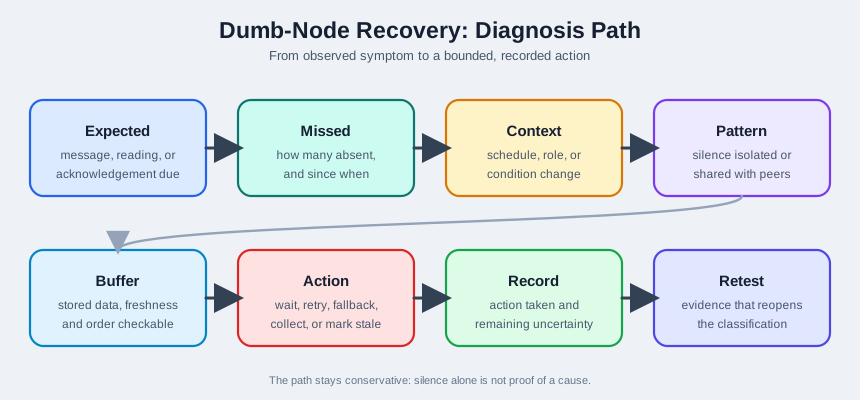
Follow the diagnosis flow from expected messages through context and buffers to a bounded action.

  • The flow begins with expected messages, their absence, and elapsed time.The first stages establish which report or acknowledgement was due, how many are missing, and when the gap began.
  • Context and peer checks compare schedule, role, and the silence pattern.Related nodes may share the same absence, while a changed role or wake schedule can alter what the system should expect.
  • The buffer stage checks order and freshness before allowing reuse.Stored readings need an accepted use because late arrival alone cannot establish whether they describe history or the current condition.
  • The final stages record the action and the evidence needed for retesting.Waiting, retrying, fallback, collection, or unavailability must remain a reversible response rather than a claimed cause inferred from silence.
Dumb-node recovery diagnosis path: expected message due, missed messages, context check, peer pattern, buffer state, bounded recovery action, record, and retest trigger.
iotclass.org

Major section

Environmental link loss and working sensors

Environmental conditions can interrupt communication while the sensing circuit still works.

  • High temperature, rainfall, or fog can reduce effective communication range.The chapter describes environmental link loss as a possible source of silence even while the sensing circuit continues working.
  • A node may keep sensing while the gateway receives no reports.The missing communication looks like silence from the review side until evidence separates local observation from successful transmission.
  • A problem that tracks environmental conditions needs context review.The chapter expects an environmental explanation to follow the condition that caused it, rather than assuming permanent hardware failure.
  • The recovery record must retain that context before a stronger action.Checking whether an environmental explanation was considered keeps reset, escalation, or another recovery choice tied to the available evidence.

I am checking whether the quiet interval follows high temperature, rainfall, or fog. I keep that environmental context beside the gateway’s missing reports before treating the sensing hardware as failed.

iotclass.org

Major section

The recovery record keeps uncertainty visible
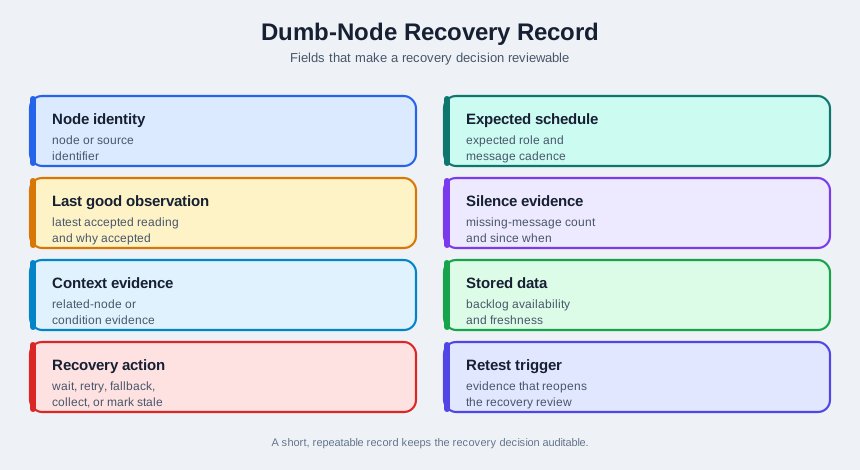
Read the recovery sheet from source and schedule through stored data to action and retest.

  • Identity and expected schedule can establish which absence matters.The opening fields connect the source to its required report, so a quiet interval can be judged against the node’s actual role.
  • The next fields connect last-good data with silence and peer evidence.The latest accepted observation shows when useful evidence expired, while missing messages and related-node reports describe the current gap.
  • Stored-data state constrains the choice of recovery action.Waiting, retry, fallback, collection, or escalation needs evidence about availability and validity rather than an assumption that every returned record is usable.
  • Residual uncertainty and a retest trigger keep the decision temporary.The record needs the observation that would change or clear the label, such as new messages, validated buffers, or silence beyond the review rule.
Dumb-node recovery record fields: node identity, expected schedule, last good observation, silence evidence, context evidence, stored data, recovery action, and retest trigger.
iotclass.org

Activity 1 · Draw it

✎ Build a silence review card

I want you to preserve the clues before choosing how to recover the node.

Draw a review card for a missed sensor report. Add expected schedule, last accepted observation, peer context, stored-data state, bounded action, and retest trigger. Show where you would mark information that is still unknown.

4 minutes · Pen and paper · Answer: Activity 1

Your answer
iotclass.org

Major section

Reconnection and returned-data validity

Re-establishing communication and validating returned data are separate recovery tasks.

  • CoRD and CoRAD address reconnection after the dumb state is detected.The chapter places detection before a bounded reconnection action, so naming a recovery scheme cannot replace evidence that the state was established.
  • The scheme name leaves the review record to be completed.Expected schedule, missing-message evidence, context, chosen action, and retest trigger remain necessary whichever detection or reconnection approach is used.
  • Observation time and receive time can differ after an outage.Late arrival establishes contact with the gateway, but the record’s own observation time determines whether it may still count as fresh.
  • Buffer acceptance needs order, duplicate, gap, and validity checks.Retries can create repeated records, old observations may update only history, and missing intervals must remain visible after collection.

I am reviewing a node that reconnects and delivers stored readings after a quiet interval. I treat restored contact and accepted data as separate outcomes, checking when each observation was made before allowing reuse.

iotclass.org

Major section

Worked Review: Silent Simple Node

The missing bin-fill record leaves the current decision without fresh evidence from that source.

  • The bin-fill node normally sends a level record and battery flag.It has no rich diagnostics, so the missing periodic report supplies less information than a full explanation of the node’s condition.
  • The last accepted reading is too old for the current decision.The dashboard must not turn that stale fill-level observation into a current value merely because no replacement has arrived.
  • Expected timing and continuing peer reports can establish an isolated gap.The monitor confirms the schedule and compares related sources, which remain available during the bin-fill node’s silent interval.
  • Isolated silence supports a scoped response without proving the cause.The affected decision can use a justified fallback while the original source stays marked unavailable and the recovery review remains open.

I am reviewing the bin-fill node after its normal record stops reaching the gateway. I preserve the last accepted level and battery flag while checking whether the gap is isolated among related sources.

iotclass.org

Major section

Unavailable source, visible fallback, and retest

Preserve the last accepted observation while making current unavailability explicit.

  • The current source must be marked unavailable rather than silently reused.The last accepted level remains evidence of an earlier observation, not proof of the bin’s present condition.
  • Fallback is justified when another evidence path supports the affected decision.The chapter permits substitution when the missing node is not the only source, while requiring that the original absence remain visible.
  • The substitution must stay visible beside the original missing state.Hiding the fallback would make the application appear to have current evidence from a node that still has not reported.
  • New records, returned buffers, schedule changes, or continued silence trigger review.Those conditions can change the temporary recovery decision once the new evidence is complete or the missing state outlasts the review rule.

I keep the bin-fill source marked unavailable while another evidence path supports the decision. I preserve the last accepted observation separately and name the event that will let me review the temporary substitution.

iotclass.org

Major section

Returned records need time and sequence evidence

A returning connection does not make every stored observation fresh.

  • Observation and receive times support ordering and duplicate review.The records cover a period without live gateway messages, so the reviewer must establish their sequence before allowing a merged data path.
  • Validated fresh records may support the current decision.Reconnected communication alone cannot grant that permission when record age, sequence, or other validity evidence is still uncertain.
  • Validated older records belong in history, with gaps still marked.A recovered buffer may fill some historical evidence without establishing every missing interval or supplying a fresh current observation.
  • Repeated gaps, late returns, or conflicts require another recovery review.Changed duplicate handling and disagreement with related evidence can invalidate the earlier acceptance of returned records.

I am inspecting a returning node’s buffer after an interval with no live messages. I separate fresh records from valid history and keep missing intervals visible instead of treating reconnection as a complete data repair.

iotclass.org

Activity 2 · Predict

✎ The buffer returns without trustworthy time

I want you to decide what the recovered records can prove before merging them.

A node reconnects with buffered readings that pass a checksum but have unreliable times and ordering. Predict whether they may update current state or history. Write what evidence would permit reuse.

3 minutes · Pen and paper · Answer: Activity 2

Your answer
iotclass.org

Major section

From observed role to a cautious label
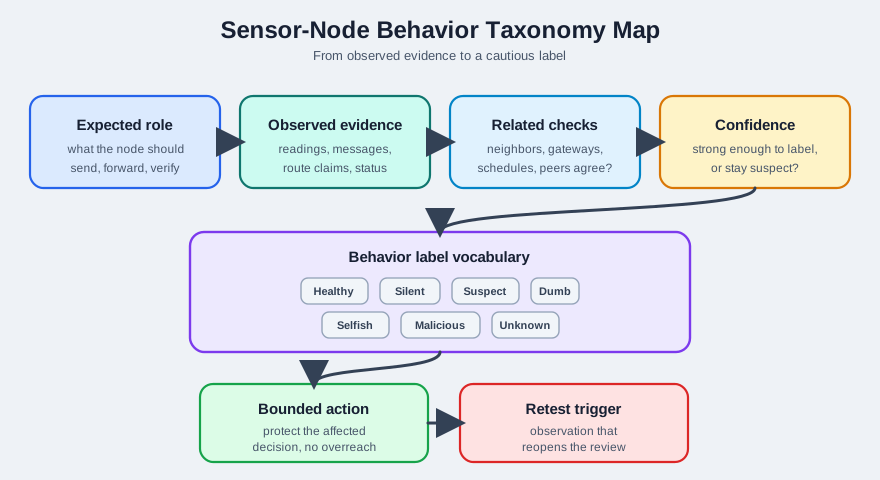
Follow the taxonomy map from expected role through evidence and confidence to label, action, and retest.

  • The opening role field establishes what the node should do.The taxonomy map begins with expected sending, forwarding, acknowledgement, or validation before interpreting the evidence that arrived or remained missing.
  • Related checks compare observations with neighbors, schedules, and context.Gateway and peer evidence can separate an isolated missing message from a shared condition before the behavior label is chosen.
  • The confidence stage retains cautious labels when corroboration is weak.Unknown or suspect remains appropriate when the record cannot support a stronger conclusion about failure, non-cooperation, or active harm.
  • The final action and retest trigger keep the label reversible.A new observation can reopen the current label, so the taxonomy supports the affected decision without assigning a permanent identity to the node.
Sensor-node behavior taxonomy map: expected role, observed evidence, related checks, and confidence lead to a behavior label from the vocabulary, then a bounded action and a retest trigger.
iotclass.org

Deck summary

Key takeaways

Recovery preserves usable evidence while keeping uncertainty visible to the affected decision.

  • Silence needs context checks before a stronger behavior or failure label.Expected schedules, topology roles, last accepted observations, and peer reports constrain what the missing room-sensor message can establish.
  • Stale last-good readings must not silently replace current observations.The bin-fill example marks its source unavailable and makes any justified fallback visible to the affected decision.
  • Returned buffers require time, order, duplicate, gap, and validity checks.Fresh records may update current state, while valid older records belong in history and missing intervals retain their missing status.
  • Every temporary action needs a review record and retest trigger.New messages, returned data, changed schedules, or silence beyond the review rule can change the recovery response while residual uncertainty stays explicit.

I return to the quiet room sensor with a recovery record that names what is known and unknown. I keep stale-data protection and the next retest condition visible while the application uses only supported evidence.

iotclass.org

Retrieval practice

Recall check 1 of 4

Blueprint Bina says: answer from memory, then check your reasoning.

Q1A simple node returns after an outage with buffered readings, but the records have no trustworthy ordering or freshness evidence. What is the safest recovery action?

AKeep the buffer separate until its order, age, and validity can be checked, and record what evidence would permit reuse.
BMerge the buffer as current data after a checksum check, since intact local records can fill the outage gap.
CLabel the node malicious because missing timestamps prove that it intended to falsify history.
DReset the node once more; a successful restart makes the buffered records safe to treat as current.
Show answer

Answer: A A returning dumb node may carry useful buffered evidence, but recovery keeps it quarantined until freshness, ordering, and validity are established for the affected decision.

iotclass.org

Retrieval practice

Recall check 2 of 4

Blueprint Bina says: answer from memory, then check your reasoning.

Q2A simple node misses several expected messages. The last accepted reading is now stale, related nodes are still reporting, and there is no current local status from the silent node. What is the strongest recovery review action?

AMark the source unavailable, preserve the last accepted observation as stale, and record the retest trigger
BKeep using the last value as current because the node was previously healthy
CClassify the node as permanently failed from silence alone and close the review before checking related evidence
DDelete the source from every decision path immediately
Show answer

Answer: A Dumb-node recovery should keep missing evidence visible, prevent stale data from being treated as current, and record the evidence that would clear or change the label.

iotclass.org

Retrieval practice

Recall check 3 of 4

Blueprint Bina says: answer from memory, then check your reasoning.

Q3A node misses one expected message during a period when its sleep schedule may have changed. Which classification move best follows the taxonomy?

ACheck role, schedule, and peers; keep the state silent, suspect, or unknown until stronger evidence supports another label.
BClassify the node as failed after the missed message so the network can begin routing around it promptly.
CClassify the node as selfish because sleeping and refusing to forward are equivalent observations.
DKeep the node labelled healthy because taxonomy changes should wait for hardware-maintenance evidence.
Show answer

Answer: A The taxonomy separates observed absence from inferred cause.

iotclass.org

Retrieval practice

Recall check 4 of 4

Blueprint Bina says: answer from memory, then check your reasoning.

Q4A node misses an expected message, but the reviewer has not checked schedule, related nodes, or whether the last accepted value is still fresh. Which label is best supported first?

ASilent, because the expected message is missing and the cause is not yet proven
BMalicious, because any missing message is active disruption by the node
CHealthy, because the node had a previously accepted value
DSelfish, because every silent node is avoiding shared work
Show answer

Answer: A The taxonomy should start from observable evidence.

iotclass.org

Print reference

Answers

Answer key.

  1. A · A returning dumb node may carry useful buffered evidence, but recovery keeps it quarantined until freshness, ordering, and validity are established for the affected decision.
  2. A · Dumb-node recovery should keep missing evidence visible, prevent stale data from being treated as current, and record the evidence that would clear or change the label.
  3. A · The taxonomy separates observed absence from inferred cause.
  4. A · The taxonomy should start from observable evidence.
iotclass.org

Print reference

Activity 1 answer

Model answer.

Draw it: The card preserves timing and last-good evidence, compares related nodes, and states whether buffered records exist and are usable. Unknown cause or buffer validity stays explicit. Choose an evidence-supported action and name the new message, context change, or continued silence that reopens review.

iotclass.org

Print reference

Activity 2 answer

Model answer.

Predict: Keep the buffer separate pending freshness, ordering, and validity checks. A checksum does not establish observation age or sequence. Trustworthy times, reconstructed order, duplicate handling, and explicit gaps are needed before deciding whether records support history or current state.

iotclass.org