Wireless Sensor Networks · Study deck

Node Behaviour: Contradictions and Review

A node can send valid-looking values that clash with its neighbours.

Packet Pete is your guide for this deck.

node-behaviorsensor-networksdata-quality
iotclass.org

After studying this chapter

Learning objectives

You will be able to:

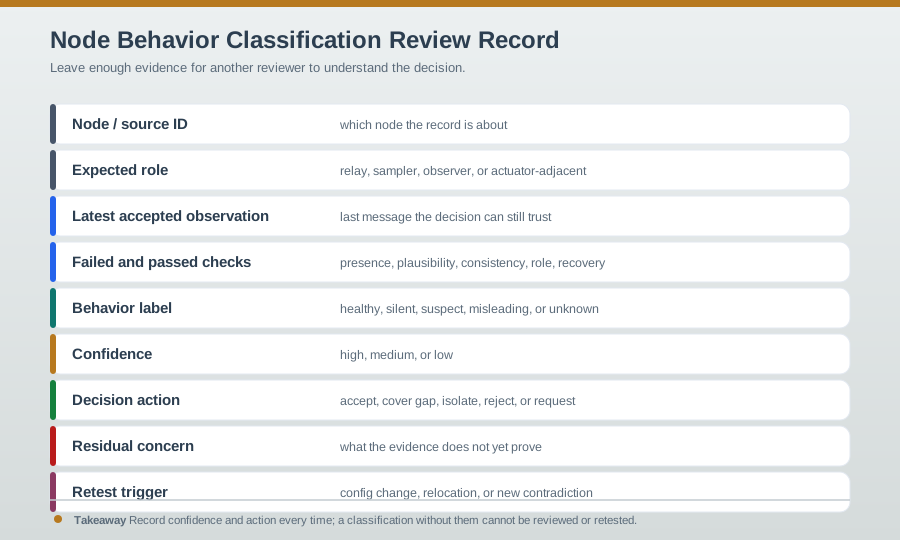
  • Explain: The route through the map at Figure: Node behavior classification review record with nine fields is Node / source ID to: Expected role to: Latest accepted observation.
  • Explain: One node reports a value that is possible by itself, but it repeatedly contradicts nearby observations and the expected process state.
  • Explain: The node's previous reading was accepted, but the expected message did not arrive during the current review window.
  • Explain: If nearby nodes are also missing, the label may stay silent or move into limited-capability recovery review.
iotclass.org

Major section

Plausible but Contradictory

Scenario: a storage area has several related condition readings.

  • One node reports a value that is possible by itself, but it repeatedly contradicts nearby observations and the expected process state.
  • Observation: The node still sends complete messages.
  • The value is not impossible, but it does not match related evidence.
iotclass.org

Major section

Worked Review: Mixed Missing Evidence

Scenario: a gateway notices that one node's current reading is missing.

  • The node's previous reading was accepted, but the expected message did not arrive during the current review window.
  • The strongest first label is silent because the expected message is absent.
  • If nearby nodes are also missing, the label may stay silent or move into limited-capability recovery review.
iotclass.org

Major section

Review Record

The route through the map at Figure: Node behavior classification review record with nine fields is Node / source ID to: Expected role to: Latest accepted observation.

  • The retest trigger matters because node behavior can change.
  • It leaves the review record claim with an explicit test boundary.
Node behavior classification review record with nine fields so another reviewer can follow the decision.
iotclass.org

Major section

Common Mistakes

Assuming a root cause from one symptom.

  • Removing a node from every decision when only one decision path is affected.
  • Forgetting to retest after configuration or placement changes.
  • Firmware is the code that runs on a device.
iotclass.org

Deck summary

Key takeaways

Scenario: a storage area has several related condition readings.

  • Scenario: a gateway notices that one node's current reading is missing.
  • The route through the map at Figure: Node behavior classification review record with nine fields is Node / source ID to: Expected role to: Latest accepted observation.
  • Assuming a root cause from one symptom.
iotclass.org

Retrieval practice

Recall check 1 of 4

Packet Pete says: answer from memory, then check your reasoning.

Q1A node still sends complete messages. Its values are possible by themselves, but they repeatedly conflict with nearby observations and the process state used by the application. What is the best classification for the affected decision?

ASilent, because consistency failure means the node should be treated as absent
BHealthy, because possible values are enough once each message arrives on time
CMisleading, because active messages fail the consistency evidence for that decision
DUnknown, because no physical inspection has identified the root cause yet
Show answer

Answer: C Behavior classification should distinguish active but untrustworthy data from missing data and should stay tied to the affected decision.

iotclass.org

Retrieval practice

Recall check 2 of 4

Packet Pete says: answer from memory, then check your reasoning.

Q2A WSN design review says a node is acceptable because the sensor board worked on a bench. What is the strongest next question?

ACan the bench result be reused for every leaf, relay, cluster-head, and gateway-adjacent role?
BCan enclosure, antenna, calibration, and service access wait until after installation?
CWhich field role is approved, and what evidence proves sensing, reporting, power, service, and retest behavior?
DCan power, radio, and maintenance evidence be deferred until the first field fault?
Show answer

Answer: C A WSN sensor node should be approved against a written role claim, not against a generic board label.

iotclass.org

Retrieval practice

Recall check 3 of 4

Packet Pete says: answer from memory, then check your reasoning.

Q3A soil-moisture leaf node is now being used as a relay for nearby nodes. Which evidence should the practitioner add before accepting the new role?

AThe original soil calibration record plus the old leaf-node battery estimate and sampling plan.
BForwarded traffic, receive windows, queues, route repair, power margin, diagnostics, and relay-failure behavior.
CA dashboard label that marks the node as a relay and hides forwarding evidence from review.
DNo extra evidence if board, firmware, antenna, enclosure, and sensor calibration are unchanged.
Show answer

Answer: B A sensor-node evidence record must be reviewed again when the field role changes, even if the hardware did not.

iotclass.org

Retrieval practice

Recall check 4 of 4

Packet Pete says: answer from memory, then check your reasoning.

Q4A WSN node buffers data during gateway outage, but the review does not show queue limit, replay order, duplicate handling, or visible loss state. What is the best under-the-hood response?

ARequire storage and firmware evidence before accepting the outage claim
BAccept it because buffered readings can be replayed after the gateway returns.
CIgnore queue behavior because the gateway is responsible for data quality.
DRemove diagnostics so the node saves energy during the outage.
Show answer

Answer: A Sensor-node trust depends on boundary evidence: measurement, custody, firmware, radio, power, and service behavior must stay visible.

iotclass.org

Print reference

Answers

Answer key.

  1. C · Behavior classification should distinguish active but untrustworthy data from missing data and should stay tied to the affected decision.
  2. C · A WSN sensor node should be approved against a written role claim, not against a generic board label.
  3. B · A sensor-node evidence record must be reviewed again when the field role changes, even if the hardware did not.
  4. A · Sensor-node trust depends on boundary evidence: measurement, custody, firmware, radio, power, and service behavior must stay visible.
iotclass.org