RFID, NFC & UWB · Study deck
NFC Protocols: Mode Foundations
Both actions use a tap, yet they assign power, roles, data, and trust in different ways.
Radio Remi is your guide for this deck.

After studying this chapter
Learning objectives
You will be able to:
- Compare reader/writer, card emulation, peer-to-peer, and handover boundaries without mixing their responsibilities.
- Separate RF interface, tag technology, NDEF payload, and application-policy layers.
- Describe polling, anti-collision, selection, and activation at the level needed for design review.
- Choose tag and NDEF patterns from application needs instead of assuming all NFC tags are interchangeable.
Major section
Start With the Story
Both actions use a tap, yet they assign power, roles, data, and trust in different ways.
- Near field communication, or NFC, lets nearby devices exchange small records.
- A protocol means the shared rules for that exchange.
- The operating mode says who starts, who answers, and which interface appears.
- This runway does not make proximity equal to trust.
Major section
Start With the Story (continued)
The deeper sections explain operating modes, activation, tag technologies, record formats, handover, and the evidence each application needs.
- The same phone can read a tag, emulate a card, or exchange data with another device, but those modes have different responsibilities.
- Confusing the mode usually means confusing who starts, who answers, and what evidence the system can trust.
- Separate reader/writer, card emulation, peer-to-peer, handover, tag technology, and NDEF so each design decision has the right boundary.
Major section
Key Concepts
Card emulation mode: A device presents a contactless card interface to an external reader; the application and credential policy decide what the emulated card is allowed to do.
- Peer-to-peer mode: Two active NFC devices exchange data using NFCIP-1 with link protocols such as LLCP; many modern designs use NFC only for handover rather than bulk transfer.
- Activation: The polling, anti-collision, selection, and protocol activation sequence that happens before useful application data is exchanged.
- Trust boundary: The point where tag, peer, or emulated-card data enters application policy and must be validated before it changes IoT state.
Major section
In 60 Seconds
NFC is a 13.56 MHz short-range interface with three operating modes.
- Reader/writer mode is for tags.
- Card emulation is for external readers that expect a contactless card.
- Peer-to-peer and handover are for exchanging a small setup message between active devices.
Major section
NFC as Specialized HF RFID
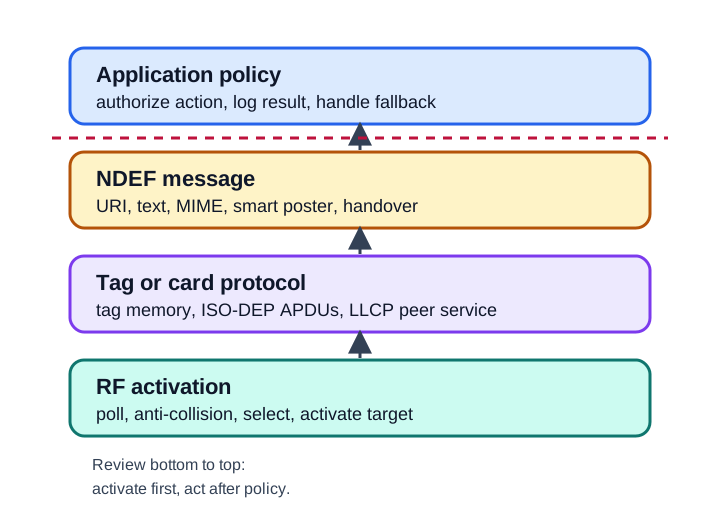
NFC sits inside the HF RFID family, but it adds operating modes and application conventions that ordinary RFID systems do not always provide.
- A useful review starts by separating the layers before arguing about tag type or user experience.
- A reader first polls, resolves collisions, selects, and activates a target.
Major section
Operating Modes
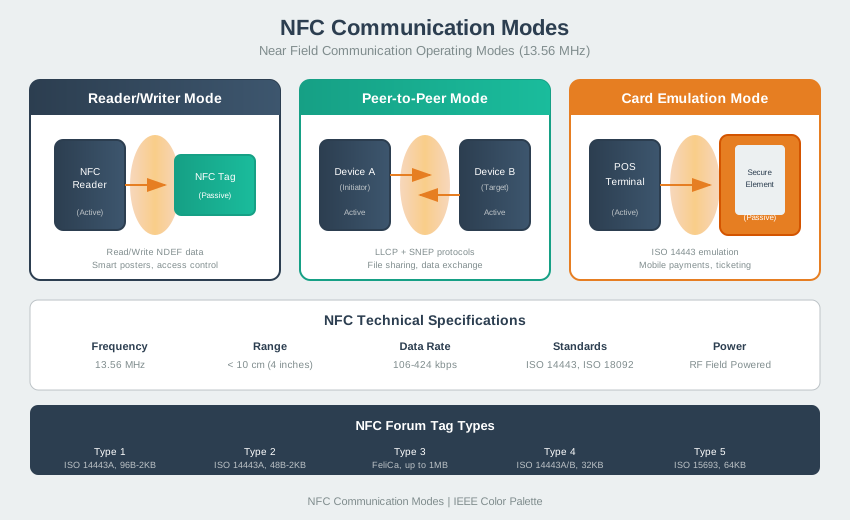
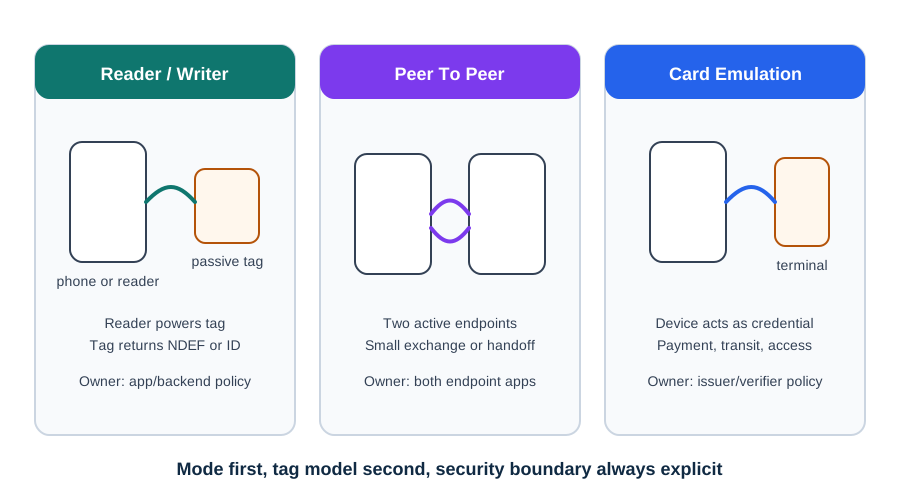
NFC designs should name the mode first, then state who powers the field, who initiates commands, and where policy is enforced.
- A peer exchange instead has two active endpoints that negotiate a small exchange or handover.
- These modes share a close-range radio, but their evidence is different: tag decoding, peer-session result, or credential decision.
Major section
One Radio, Three Roles
All NFC runs at 13.56 MHz over a few centimetres, but a single NFC chip can take different roles on different taps.
- The role switch changes who owns timing, who owns the RF field, and which software boundary must approve the result.
- For reader/writer, fallback might be a printed asset ID.
Major section
One Radio, Three Roles (continued)
For card emulation, fallback might be a manual credential check or denied-entry message.
- In reader/writer mode, a phone reads a passive GW-142 label; the app validates its URI and asks whether the signed-in technician may configure that gateway.
- Each mode has a different data owner and fallback, so a successful RF exchange says little about permission.
- For handover, fallback might be a setup code when the follow-on carrier fails.
Major section
One Radio, Three Roles (continued)
If a phone taps a gateway label to open https://ops.example/setup/GW-142, the phone is in reader/writer mode and the passive label only supplies a small record.
- The app must still validate the URI, bind it to an authenticated technician session, and ask policy whether this gateway can be configured.
- If the same phone is presented to a cabinet reader as a service credential, it is in card emulation mode.
- If two powered devices exchange a setup token, peer-to-peer or handover may apply, but the follow-on Bluetooth, Wi-Fi, Thread, or backend session carries the durable connection.
Major section
Eddie's Math Bridge: Divide the 13.56 MHz Field Clock
The mathematical gist: A 13.56 MHz field has a 22.1 m free-space wavelength and a 3.52 m reactive near-field boundary.
- A generous 1 MHz, 30 dB Shannon screen is 9.97 Mbps, showing that NFC deliberately operates far below that ceiling.

Major section
Card Emulation Mode
Card emulation mode lets a device respond to an external reader as if it were a contactless card.
- The external reader still controls the RF field and command timing.
- The emulating device decides, through its local policy and credential storage model, whether it can answer the requested application.
- The important design question is not only "can the phone emulate a card?" but also "which application owns the credential, which reader applications are accepted, and how are failed or ambiguous taps handled?".
Major section
Peer-to-Peer Mode
Peer-to-peer mode uses NFCIP-1 so two active devices can exchange data over an NFC link.
- LLCP provides a link layer for peer services, and SNEP is one way to exchange NDEF messages over that link.
- The two powered peers first negotiate a link they can both implement.
- The agreed values bound data rate, active or passive communication behavior, timing, and the maximum information field that can be carried in one protocol data unit.
Major section
Peer-to-Peer Mode (continued)
In the classic teaching profile, the data block is at most 256 bytes.
- For example, an NFC tap can identify a speaker and carry authenticated Bluetooth handover data.
- The devices then stop treating NFC as the transport and establish the audio link over Bluetooth.
- Many systems instead use NFC for a small handover message and move the longer session to Bluetooth, Wi-Fi, Thread commissioning, or an application backend.
Deck summary
Key takeaways
Both actions use a tap, yet they assign power, roles, data, and trust in different ways.
- The deeper sections explain operating modes, activation, tag technologies, record formats, handover, and the evidence each application needs.
- Card emulation mode: A device presents a contactless card interface to an external reader; the application and credential policy decide what the emulated card is allowed to do.
- NFC is a 13.56 MHz short-range interface with three operating modes.
- NFC sits inside the HF RFID family, but it adds operating modes and application conventions that ordinary RFID systems do not always provide.
Retrieval practice
Recall check 1 of 3
Radio Remi says: answer from memory, then check your reasoning.
Q1A phone reads a valid NFC record. Which layer decides whether the tap may open a locker?
Show answer
Answer: C Parsing a record does not authorize a physical action.
Retrieval practice
Recall check 2 of 3
Radio Remi says: answer from memory, then check your reasoning.
Q2An NFC phone must present itself to an external reader that expects a contactless card. Which NFC mode is this?
Show answer
Answer: B Presenting a device to an external reader as if it were a contactless card is NFC card emulation mode.
Retrieval practice
Recall check 3 of 3
Radio Remi says: answer from memory, then check your reasoning.
Q3Nearby NFC tags answer a reader. What must happen before a record is read?
Show answer
Answer: B The reader must choose a target before exchanging records.
Print reference
Answers
Answer key.
- C · Parsing a record does not authorize a physical action.
- B · Presenting a device to an external reader as if it were a contactless card is NFC card emulation mode.
- B · The reader must choose a target before exchanging records.