RFID, NFC & UWB · Study deck
NFC Protocols: Handover Boundaries
An NFC tap is a short-range radio exchange.
Radio Remi is your guide for this deck.

After studying this chapter
Learning objectives
You will be able to:
- Test handover boundary with a concrete scenario and pass criteria.
- Validate design review checklist with a concrete scenario and pass criteria.
- Explain: An NFC tap is a short-range radio exchange.
- Explain: Handover is a boundary pattern, not a promise that NFC will carry the whole session.
Major section
Start With the Decision
An NFC tap is a short-range radio exchange.
- The reader starts that exchange and a tag responds.
- A mode sets their roles; handover uses the tap to set up another link that carries data.
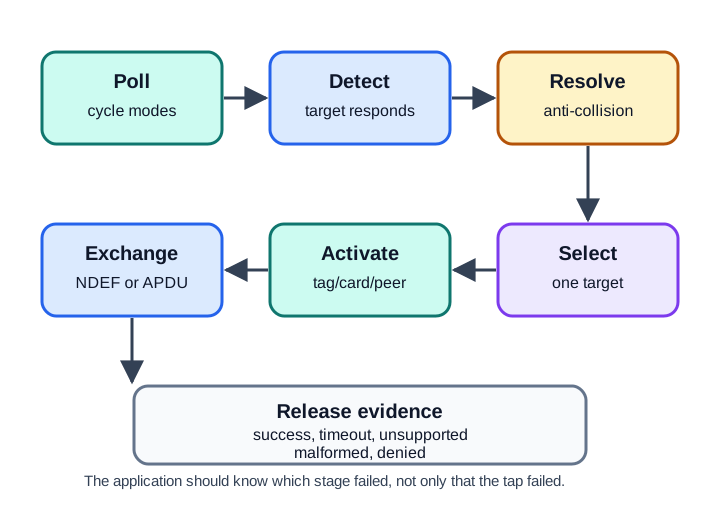
- Polling looks for a target, and anti-collision helps the reader select one tag when several respond.
Major section
Handover Boundary
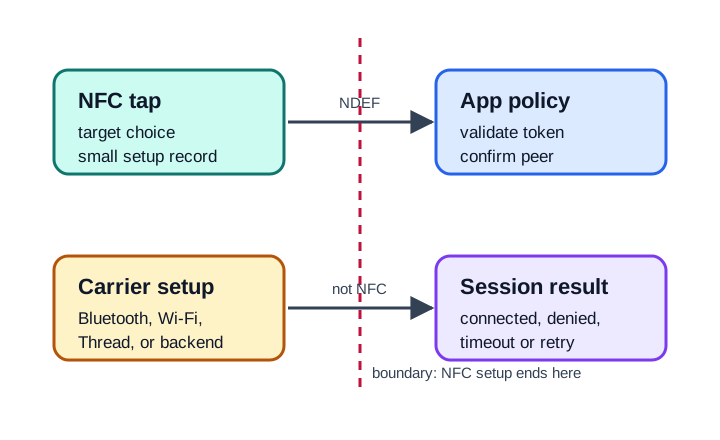
Handover is a boundary pattern, not a promise that NFC will carry the whole session.
- NFC carries enough information to identify the peer, select a carrier, or pass a setup token.
- The tap selects a target and carries a small setup record.
- A successful NDEF exchange does not prove that the follow-on link is secure or usable.
Major section
Polling, Anti-Collision, and Activation
Detection is followed by anti-collision so the reader selects one target before protocol activation and application data exchange.
- The failure examples distinguish a malformed TLV, which the parser rejects, from an unknown URI host, which policy rejects.
- A successful Type 2 read of a setup URI only establishes that data arrived.
Major section
Initiator, Target, and Passive Communication
Having a battery does not mean the phone owns the field.
- Every NFC exchange has an initiator that starts and drives the exchange and a target that responds.
- This distinction explains several field failures.
- A successful "phone seen by reader" test can still hide a credential-policy failure.
Major section
Technology Matrix and Compatibility Evidence
The label path needs reader/writer tests with the actual tag family, record size, lock state, and mounting surface.
- Beneath the modes are RF technologies inherited from HF RFID smart cards.
- A tap works only when both sides share a supported technology.
- The cabinet path needs card-emulation tests against the installed readers and accepted application identifiers.
Major section
Release Evidence
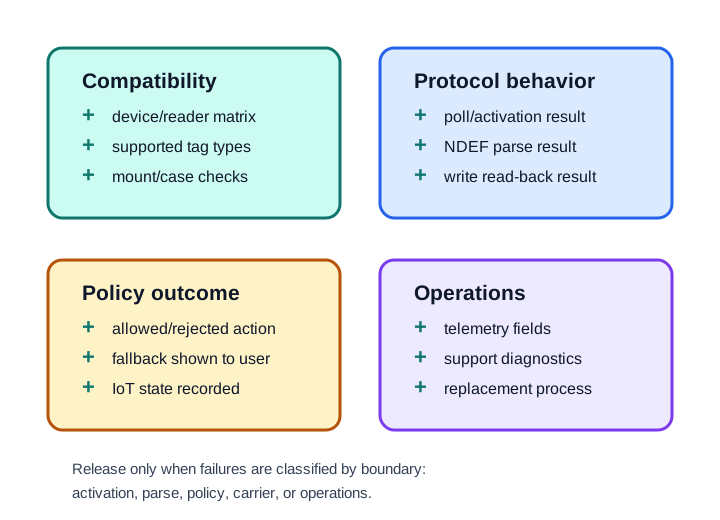
NFC failures often appear as "the tap did not work." Good release evidence makes those failures diagnosable before field rollout.
- Protocol evidence records polling, activation, NDEF parsing, and write read-back rather than a single pass flag.
- Policy evidence includes both an allowed and rejected action and the fallback route.
Major section
Concept Relationships
NFC Security and Comparisons: Threat models and controls depend on the operating mode and trust boundary.
- Bluetooth, Wi-Fi, and Thread commissioning often use NFC as a setup input rather than as the long-running connection.
- NDEF records should be schema-checked before they drive IoT actions.
- Tag type choice should be documented with compatibility and release evidence, not only with memory size.
Deck summary
Key takeaways
An NFC tap is a short-range radio exchange.
- Handover is a boundary pattern, not a promise that NFC will carry the whole session.
- Detection is followed by anti-collision so the reader selects one target before protocol activation and application data exchange.
- Having a battery does not mean the phone owns the field.
- The label path needs reader/writer tests with the actual tag family, record size, lock state, and mounting surface.
Retrieval practice
Recall check 1 of 2

Radio Remi says: answer from memory, then check your reasoning.
Q1A phone taps a payment terminal to pay. Which NFC role and communication behavior is the phone using?
Show answer
Answer: D NFC payment uses card emulation with the terminal as initiator powering the field and the phone as target replying by load modulation.
Retrieval practice
Recall check 2 of 2
Radio Remi says: answer from memory, then check your reasoning.
Q2A maintenance tablet taps an NFC label on a pump. The label contains an NDEF URI with the pump identifier, and the tablet then opens the work-order app. Which design statement is strongest?
Show answer
Answer: B Reader/writer mode is useful for deliberate object selection, but the NDEF payload crosses a trust boundary.
Print reference
Answers
Answer key.
- D · NFC payment uses card emulation with the terminal as initiator powering the field and the phone as target replying by load modulation.
- B · Reader/writer mode is useful for deliberate object selection, but the NDEF payload crosses a trust boundary.