RFID, NFC & UWB · Study deck
How NFC Taps Work
A commuter brings a phone within centimetres of a station reader and sees a tap complete.
Radio Remi is your guide for this deck.

After studying this chapter
Learning objectives
You will be able to:
- Explain why a successful NFC tap is a bounded local-selection signal, not proof of identity, authorization, or payload authenticity
- Identify the four NFC layers (field and roles, protocol mode, payload meaning, application policy) and what evidence each layer can and cannot provide
- Build an NFC design record naming workflow intent, mode/role, payload and parser checks, application policy, and physical release evidence
- Diagnose a tap that opens an unapproved host from a copied label by identifying the payload-parser and policy-action boundary responsible
Major section
Follow the Tap evidence Before Trusting It
The final beep or screen is an outcome, not proof that every earlier security check passed.
- The reader receives a credential identifier and sends it to the access controller.
- The controller checks credential status, door policy, time, and any anti-passback rule, then returns allow or deny.
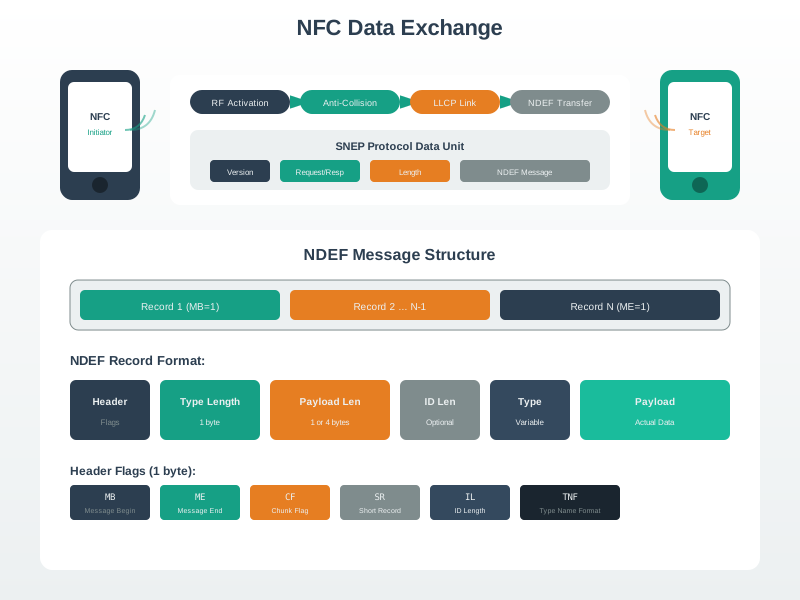
- NFC modes change the participants.
Major section
Follow the Tap evidence Before Trusting It (continued)
Card emulation lets a phone act like a contactless credential.
- Peer-style exchanges or handover records can help devices start another connection.
- The centimetre-scale user experience reduces accidental taps, but radio messages can still be observed or relayed with specialist equipment and conditions.
- The application should report incomplete, denied, and completed states differently.
Major section
Follow the Tap evidence Before Trusting It (continued)
Sensitive applications need cryptographic challenge and response, transaction freshness, bounded timing where appropriate, backend policy, and a clear user confirmation.
- Range, timing, phone behavior, antenna tuning, and protocol support depend on the actual reader, tag, enclosure, and environment.
- A phone can act as reader or emulate a card, with operating-system and secure-element rules affecting availability.
- Data format needs versioning.
Major section
Follow the Tap evidence Before Trusting It (continued)
If an application hands a larger transfer to Bluetooth or Wi-Fi, the NFC record should say what was exchanged to start that second link and how the peer was authenticated.
- An NDEF record can carry a URI, text, or application-defined content, but the receiving app must validate type, length, scheme, and allowed action.
- A stable tag ID observed across locations can track an object or person even if its application content is harmless.
- The phone may show a tick while the backend decision is pending, or the reader may beep before the lock reports movement.
Major section
Start With the Story
Radio frequency means the rate of change used by a radio signal.
- Near field communication (NFC) uses a very short radio link for a deliberate exchange.
- Radio frequency identification (RFID) is the wider family of radio tag and reader methods.
- A payload is the useful content carried in a message.
Major section
Start With the Story (continued)
The tap can select the intended asset and carry a service link.
- Close range supports intent but is not complete trust.
- The deeper sections explain modes, records, tags, cards, handover, security, and the separate evidence owners after the tap.
- This chapter starts with the tap and follows it downward.
Major section
Overview: What an NFC Tap Can Prove
The close exchange selects a nearby target and activates the reader, but it does not prove identity, authenticity, authorization, or safety.
- Parsing must bound the record type and length; the app must then check a session and policy before choosing a scoped action.
Major section
Summary
NFC is a 13.56 MHz near-field technology for deliberate local interactions, not a general proof of identity or authorization.
- Reader/writer, card-emulation, and peer-to-peer modes have different field owners, data owners, trust boundaries, and evidence requirements.
- NDEF makes common tag records portable, but it does not provide secrecy, authenticity, freshness, authorization, or anti-cloning by itself.
- A production NFC design should record workflow intent, mode, payload checks, application policy, physical placement, fallback, owner, and retest triggers.
Deck summary
Key takeaways
The final beep or screen is an outcome, not proof that every earlier security check passed.
- Card emulation lets a phone act like a contactless credential.
- Sensitive applications need cryptographic challenge and response, transaction freshness, bounded timing where appropriate, backend policy, and a clear user confirmation.
- If an application hands a larger transfer to Bluetooth or Wi-Fi, the NFC record should say what was exchanged to start that second link and how the peer was authenticated.
- Radio frequency means the rate of change used by a radio signal.
Retrieval practice
Recall check 1 of 3

Radio Remi says: answer from memory, then check your reasoning.
Q1A team says an NFC gateway setup flow is ready because a phone can tap the label and open a URL. What should the review say?
Show answer
Answer: C Opening a URL shows only that decode works; the review still needs the mode, payload, parser, app-session, object-state, fallback, audit, and retest boundaries.
Retrieval practice
Recall check 2 of 3
Radio Remi says: answer from memory, then check your reasoning.
Q2A maintenance label contains an NDEF URI that opens the correct asset record, but the team has not defined parser checks or technician policy. What is the evidence gap?
Show answer
Answer: C The gap is payload validation and application policy: approved host and schema, asset-state check, authenticated technician session, role, audit, fallback, and retest triggers.
Retrieval practice
Recall check 3 of 3
Radio Remi says: answer from memory, then check your reasoning.
Q3Where should the unapproved-host opening be investigated after a reliable tap?
Show answer
Answer: A An unapproved host from a copied label points at the payload-to-parser and policy-to-action boundary: allowed host, schema, length, object state, session rule, audit, fallback, and copy handling.
Print reference
Answers
Answer key.
- C · Opening a URL shows only that decode works; the review still needs the mode, payload, parser, app-session, object-state, fallback, audit, and retest boundaries.
- C · The gap is payload validation and application policy: approved host and schema, asset-state check, authenticated technician session, role, audit, fallback, and retest triggers.
- A · An unapproved host from a copied label points at the payload-to-parser and policy-to-action boundary: allowed host, schema, length, object state, session rule, audit, fallback, and copy handling.