RFID, NFC & UWB · Study deck

Practice: NFC Reader Simulation

Picture a phone tapping a label to open the correct equipment record.

Radio Remi is your guide for this deck.

appssimulation
iotclass.org

After studying this chapter

Learning objectives

You will be able to:

  • Define what an NFC reader simulation can and cannot prove.
  • Model the reader state sequence from polling through tag selection, NDEF parsing, policy validation, and release evidence.
  • Decode simple NDEF TLV and URI records well enough to spot length, type, and host-validation failures.
  • Simulate multi-tag, malformed-payload, cloned-static-data, and relay-risk scenarios without overclaiming physical accuracy.
iotclass.org

Major section

Start With the Story

A software exercise can show whether the reader accepts a wrong field or repeated message before radio details make the fault harder to see.

  • NFC means Near Field Communication, a short-range link used for deliberate taps.
  • A payload means the useful record carried inside a message.
  • A protocol means the shared rules for an exchange.
iotclass.org

Major section

Start With the Story (continued)

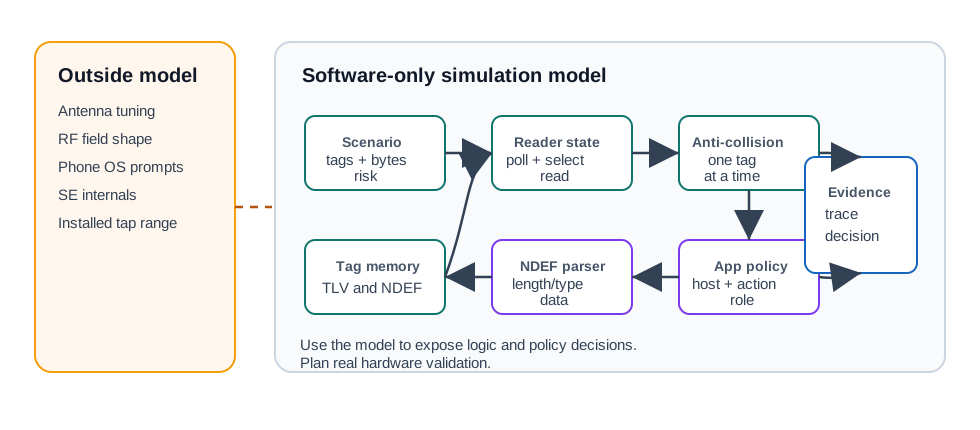
This runway does not prove antenna range, phone behavior, or field timing.

  • The deeper lab covers reader states, NDEF structure, validation, injected faults, evidence capture, and the hardware checks left open.
  • A simulation cannot prove the RF field, but it can make the NFC logic visible.
  • Polling, anti-collision, NDEF parsing, policy checks, and failure cases become easier to inspect when the lab removes the hardware uncertainty.
iotclass.org

Major section

Reader State Model

The simulation should make each transition explicit so a bad tag, ambiguous field, malformed record, or policy denial is visible rather than hidden behind a single "read failed" message.

  • Idle to polling.: The reader waits, then sends a polling request for compatible tags in range.
  • Polling to selection.: If more than one candidate responds, the anti-collision procedure selects one tag at a time.
  • Policy to evidence.: The simulation stores the decision, trace, inputs, and reason codes for the lab report.
iotclass.org

Major section

Activation Loop Trace

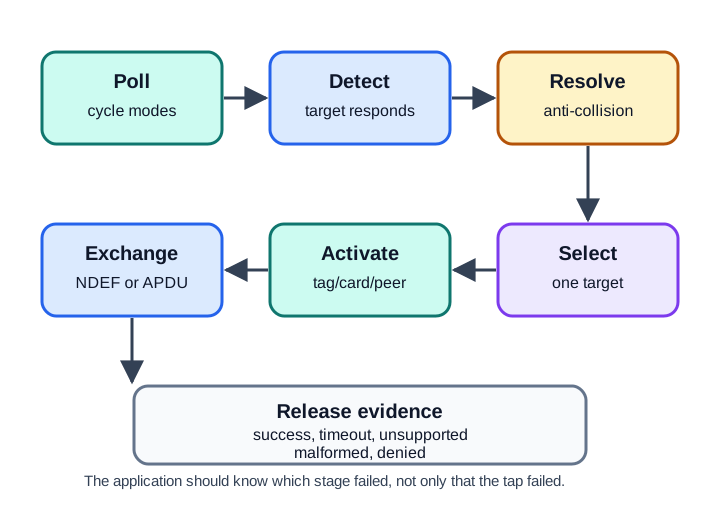
Simulating an NFC reader means modelling a repeating loop, not a single read.

  • That trace lets a review distinguish a polling miss, collision-resolution issue, payload rejection, policy denial, or release-evidence outcome.
  • The simulation boundary should be explicit in the same report.
NFC reader activation flow from polling through detection, anti-collision, selection, activation, exchange, and release evidence.
iotclass.org

Major section

Activation Sequence Details

The terminal starts the conversation, the AID selects an app or secure element route, and each command draws a response until a security policy decides the result.

  • You can inject a second card at the anti-collision step, drop the field mid-APDU, corrupt a TLV length, or delay a response and then ask which state owns the failure.
  • A practical scenario table should include one clean tag and several negative cases.
  • The byte trace can stay small.
iotclass.org

Major section

Activation Sequence Details (continued)

The point is not to imitate every analog timing detail; it is to make the reader software obligations explicit enough that the review can separate parser, policy, and follow-up hardware risks.

  • In the clean case, a Type 2 tag advertises an NDEF Message TLV, the parser finds a URI record, and policy accepts the host.
  • In a malformed case, the TLV length claims more bytes than the buffer contains, so the parser must reject before policy sees a partial URI.
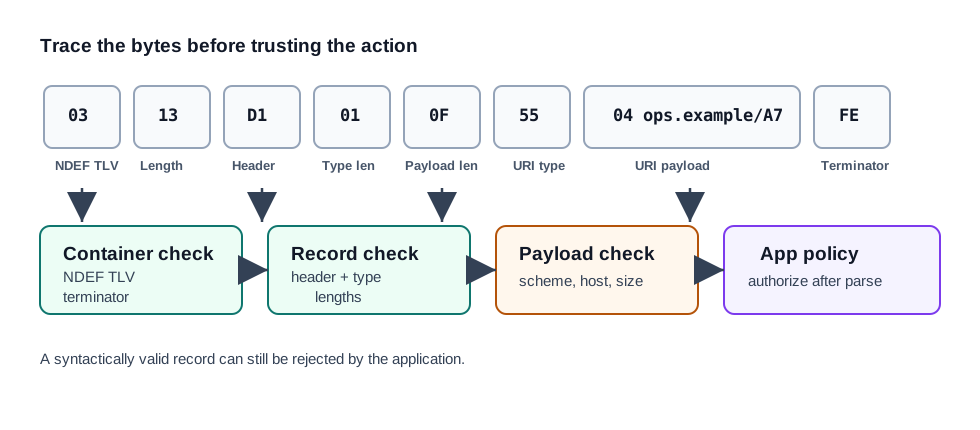
  • For example, 03 13 means an NDEF Message TLV with length 0x13, or 19 bytes, before the FE terminator.
iotclass.org

Major section

NDEF Trace Review

The simulation should teach byte-level reasoning without burying the learner in a thousand-line sketch.

  • The important question is whether the parser and application disagree with the raw bytes.
NDEF trace example showing TLV type, TLV length, record header, type length, payload length, URI identifier code, URI payload, terminator, parser checks, and application policy checks.
iotclass.org

Major section

Failure Injection Matrix

A useful lab does not only show the happy path.

  • It should include failure scenarios that force the reader and application to explain their decision.
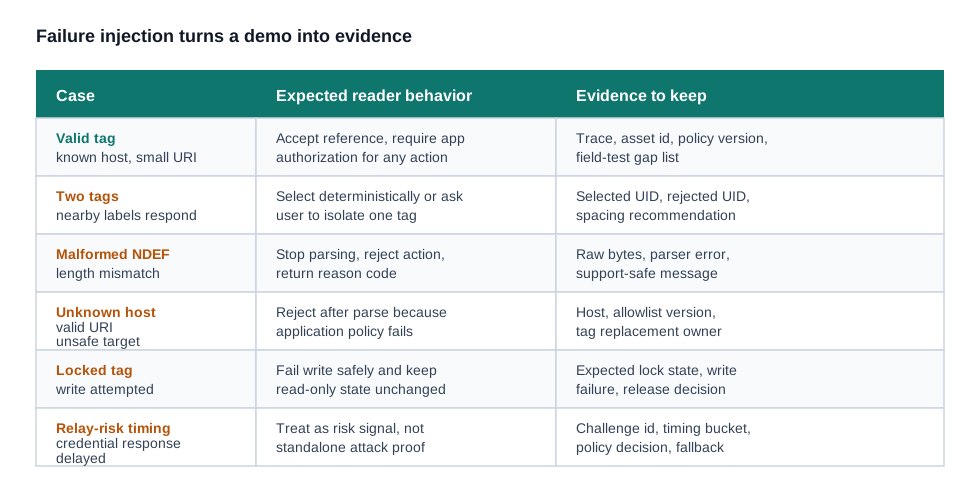
  • For the evidence behind failure injection matrix, use it to distinguish: Failure injection turns a demo into evidence from: Expected reader behavior.
  • The conclusion depends on known host, small URI.

Why it matters

Unknown host.: Confirm that an otherwise valid URI is rejected when the application does not recognize the destination.

NFC simulation failure-injection matrix comparing valid tag, two tags, malformed NDEF, unknown host, locked tag, and relay-risk timing against the reader behavior and required evidence.
iotclass.org

Major section

Failure Injection Matrix (continued)

Unknown host.: Confirm that an otherwise valid URI is rejected when the application does not recognize the destination.

  • Malformed payload.: Confirm that parser errors stop action and produce a readable reason code.
  • Multiple tags.: Confirm that the reader either selects one predictable tag or asks the user to isolate the target.
  • Locked or read-only tag.: Confirm that write operations fail safely and that release evidence records the intended lock state.
iotclass.org

Major section

UID Anti-Collision and Cascade Levels

For NFC-A, ISO/IEC 14443-3 Type A uses bit-oriented anti-collision over the card UID.

  • Cards reply with UID bits; when two disagree at a bit position, the reader detects the collision, fixes the prefix, and asks again.
  • That binary walk continues until one card is uniquely identified.
  • Because UIDs can be 4, 7, or 10 bytes, this happens in cascade levels: CL1, CL2, and CL3.

Key terms

Once the full UID
Once the full UID is known, SELECT activates that one card.

Numbers to remember

10 bytesBecause UIDs can be 4, 7, or 10 bytes
iotclass.org

Major section

UID Anti-Collision and Cascade Levels (continued)

Once the full UID is known, SELECT activates that one card.

  • NFC-B uses a different time-slotted anti-collision process, so a simulator should not pretend all technologies resolve collisions the same way.
  • The simulator should expose the difference between reader capability and application safety.
  • For a read-only lookup, selecting one card may be acceptable.
  • For a write, lock, or credential action, policy may require one visible target in the field before proceeding.
iotclass.org

Major section

UID Anti-Collision and Cascade Levels (continued)

Cascade-level logging also protects the model from treating every UID as an opaque string.

  • A 4-byte UID can be resolved in one cascade level, while longer UIDs require later levels after the cascade tag indicates that more bytes follow.
  • If the model never records those steps, it cannot test partial UID handling, duplicate prefixes, or mistaken selection after a collision.
  • A software scenario can simulate stale challenge identifiers, delayed responses, duplicate credential observations, and policy decisions that deny high-value actions.
iotclass.org

Major section

Common Pitfalls

Using a new-project simulator as evidence.: A generic board page does not validate an NFC workflow unless the scenario, parser, policy, and failure cases are explicit.

  • Confusing parsed data with trusted data.: Valid NDEF syntax only means the bytes decoded.
  • The application still needs host, type, length, schema, and authorization checks.
  • Overclaiming relay detection.: Timing signals can inform risk, but credential flows need challenge freshness, policy, audit, and fallback decisions.
iotclass.org

Major section

Summary

A useful NFC simulation is a logic and evidence tool, not a substitute for RF, phone, and installation testing.

  • Valid NDEF syntax does not mean the payload is trusted or authorized.
  • Failure injection is part of the lab, especially malformed records, unexpected hosts, nearby tags, lock-state errors, and relay-risk signals.
  • The final lab output should say what passed, what failed, what remains unproven, and what must be tested with real hardware.
iotclass.org

Deck summary

Key takeaways

A software exercise can show whether the reader accepts a wrong field or repeated message before radio details make the fault harder to see.

  • This runway does not prove antenna range, phone behavior, or field timing.
  • The simulation should make each transition explicit so a bad tag, ambiguous field, malformed record, or policy denial is visible rather than hidden behind a single "read failed" message.
  • Simulating an NFC reader means modelling a repeating loop, not a single read.
  • The terminal starts the conversation, the AID selects an app or secure element route, and each command draws a response until a security policy decides the result.
iotclass.org

Retrieval practice

Recall check 1 of 3

Radio Remi says: answer from memory, then check your reasoning.

Q1A software-only NFC reader simulation passes its tests. Which claim is safe to make?

AThe antenna tuning and 13.56 MHz radio link are now validated by the run.
BThe phone operating-system NFC behavior is now fully verified end to end.
CThe parser and application policy handled the tested NDEF and failure cases.
DThe tags will read reliably on every real mounting surface after installation.
Show answer

Answer: C A software-only NFC simulation can only claim its parser and policy handled the tested NDEF and failure cases.

iotclass.org

Retrieval practice

Recall check 2 of 3

Radio Remi says: answer from memory, then check your reasoning.

Q2In an NFC reader simulation, two Type A cards enter the field simultaneously. What should the modelled reader do, and via what mechanism?

AReport a collision error and stop, since NFC can only ever handle one card at a time.
BImmediately send ISO 7816-4 APDUs to both cards in parallel to read them.
CIncrease the field power until one card wins by drawing more energy than the other.
DRun ISO 14443-3A anti-collision over the UIDs, then SELECT one card and start APDU exchange.
Show answer

Answer: D NFC-A resolves multiple cards with bit-oriented UID anti-collision across cascade levels for 4, 7, or 10 byte UIDs, then SELECT activates one card before ISO 7816-4 APDU exchange.

iotclass.org

Retrieval practice

Recall check 3 of 3

Radio Remi says: answer from memory, then check your reasoning.

Q3Which claim is safe to make after a software-only NFC reader simulation passes?

AThe final tag will read reliably on every phone and every mounting surface.
BThe simulated parser and application policy handled the tested NDEF and failure scenarios.
CA static UID is now enough to authorize maintenance actions in the field.
DRelay attacks are impossible because the simulated timing looked normal.
Show answer

Answer: B The right conclusion is limited and evidence-based: the modeled logic passed the tested scenarios.

iotclass.org

Print reference

Answers

Answer key.

  1. C · A software-only NFC simulation can only claim its parser and policy handled the tested NDEF and failure cases.
  2. D · NFC-A resolves multiple cards with bit-oriented UID anti-collision across cascade levels for 4, 7, or 10 byte UIDs, then SELECT activates one card before ISO 7816-4 APDU exchange.
  3. B · The right conclusion is limited and evidence-based: the modeled logic passed the tested scenarios.
iotclass.org