RFID, NFC & UWB · Study deck

NFC Real-World Applications

Picture a technician tapping a label on a pump.

Radio Remi is your guide for this deck.

appsrealworld
Radio Remi, the module guide, in a scene from this chapter.
iotclass.org

After studying this chapter

Learning objectives

You will be able to:

  • Classify real NFC deployments by operating mode, data owner, credential owner, and backend decision point.
  • Explain how payment, access, product-authentication, smart-poster, commissioning, and maintenance workflows use the tap differently.
  • Separate tag data, user intent, credential proof, and authorization policy in an application design.
  • Identify deployment evidence needed before an NFC rollout: device support, mounting surface, fallback path, privacy review, and retest triggers.
iotclass.org

Major section

Start With the Story

The tap can find the pump record, but it must not grant anyone the right to change the pump settings.

  • A gateway means a device or service that joins two message paths.
  • Near field communication, or NFC, lets nearby devices exchange small records.
  • The app and its policy still decide what the tap may trigger.

Key terms

Behind it
Behind it are credentials, records, policies, secure elements, cloud lookups, and fallback paths.
iotclass.org

Major section

Start With the Story (continued)

This runway does not make proximity a credential or prove every phone works.

  • NFC appears in payments, access, product labels, commissioning, posters, and maintenance, but the tap is only the visible moment.
  • Behind it are credentials, records, policies, secure elements, cloud lookups, and fallback paths.
  • For each workflow, separate the user action from the proof, then decide which boundary carries trust and which evidence must be checked before release.
iotclass.org

Major section

In 60 Seconds

Real NFC deployments use the tap as a proof of user intent, object proximity, or credential presentation.

  • Payment and access flows need issuer-grade credential controls.
  • Product, maintenance, and poster flows usually need trusted URLs, tag write controls, read-back evidence, and a fallback path.
  • Smart-home and commissioning flows use NFC to start an action, then the app, gateway, or cloud policy decides what is allowed.
iotclass.org

Major section

Minimum Viable Understanding

NFC is an application boundary.: A tap can select an object or present a credential, but the application still needs policy, validation, logging, and fallback behavior.

  • Real-world use cases split into two families.: Public tag flows expose a reference or app link; credential flows prove value, access, or entitlement through a controlled issuer/verifier path.
  • Short range does not equal authorization.: Payment, access, and anti-counterfeit systems need dynamic proof or backend validation.
  • Operational evidence matters.: Tag placement, phone model support, staff workflow, replacement process, privacy review, and support scripts decide whether the rollout survives contact with users.
iotclass.org

Major section

Application Pattern Map
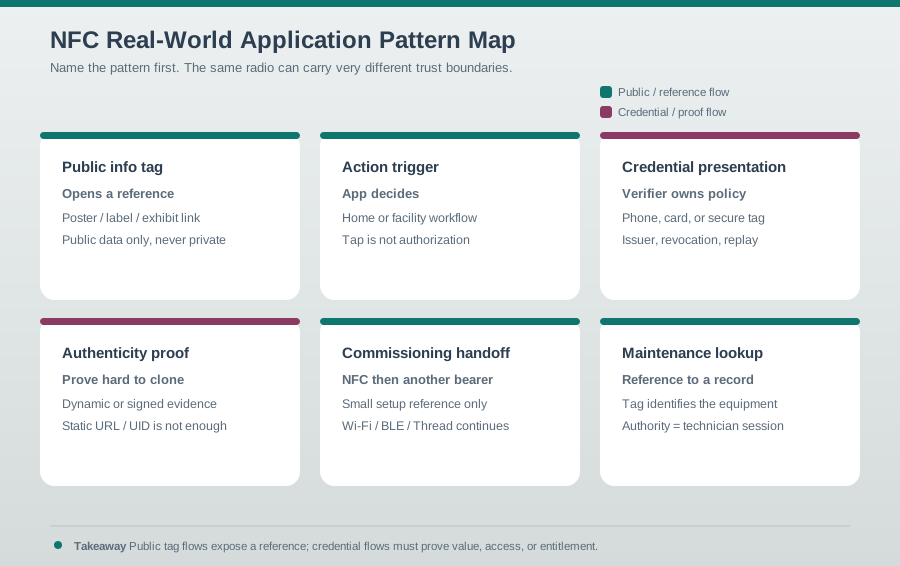
The same NFC radio can support very different trust boundaries.

  • To challenge the claim in application pattern map, keep both: NFC Real-World Application Pattern Map and: Verifier owns policy visible in it.: Authority = technician session marks the next check.
  • Reopen application pattern map whenever: Verifier owns policy changes.
  • The tag should contain a public reference, not private data.
Six NFC real-world application patterns grouped into public-reference flows and credential or proof flows, each naming its trust boundary.
iotclass.org

Major section

Application Pattern Map (continued)

Action trigger: A home, facility, or maintenance tag starts a workflow.

  • The app or controller must decide whether the action is allowed.
  • Credential presentation: A phone, wearable, card, or secure tag acts as a credential.
  • The verifier needs issuer policy, revocation, audit, and replay controls.
  • A static URL or copied UID is not enough.
iotclass.org

Major section

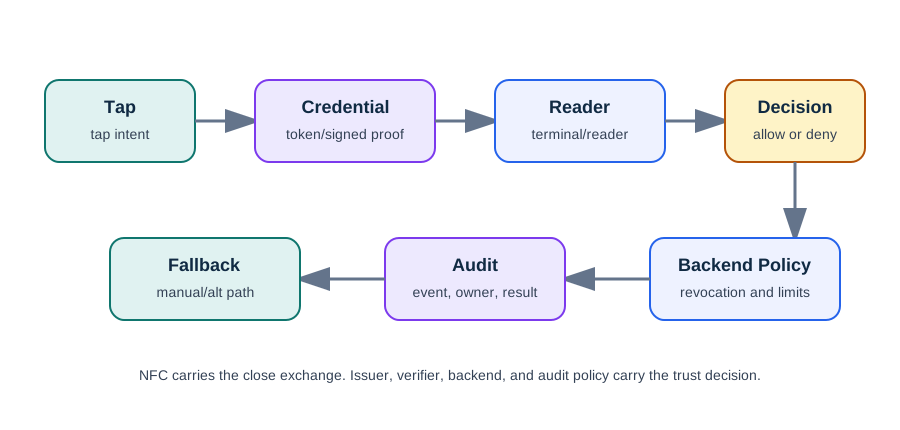
Payments And Access

Payments, transit, door access, and mobile keys are credential systems.

  • NFC supplies the close-range exchange; it does not own the whole security model.
  • The remaining question is manual/alt path.
  • Both tap intent and: Backend Policy need evidence.
  • Dynamic proof: Prefer transaction-specific cryptograms, challenge-response, limited-use tokens, or secure element/HCE policy over static tag values.
NFC credential application trust path from tap through wallet or card credential, terminal or reader, verifier policy, backend decision, and audit record.
iotclass.org

Major section

Payment Security Lives Above The NFC Radio

Each tap generates a dynamic cryptogram under EMV contactless rules, so a captured transaction cannot simply be replayed.

  • The NFC exchange gets a credential or tag reference across a few centimeters; the application decides what that reference means, whether it is fresh, and whether the user is allowed to act.
  • A smart poster tag in a museum may only open a public exhibit page, so the risk is mostly a bad link, stale content, or a rewritten tag.
  • A payment credential presents dynamic proof to a terminal and issuer, so it needs cryptogram validation, token lifecycle, denial handling, and audit evidence.
iotclass.org

Major section

Cryptograms, Tokenization, And Verifier Policy

Together they mean a contactless credential is neither static nor the real secret.

  • A reviewer should look for the same pattern in any high-value NFC flow: the tap should produce bounded evidence, and the verifier should reject copied, stale, malformed, revoked, or wrong-context evidence.
  • For a facility access badge, the checklist is different from a poster tag.
  • For public tags, the practitioner work is about content and operations rather than issuer-grade cryptography.
iotclass.org

Major section

Cryptograms, Tokenization, And Verifier Policy (continued)

The reader should identify the credential type, pass the observed value or response to the access controller, check door rights, time window, revocation, offline rule, duplicate-tap behavior, and audit logging, then decide whether to unlock.

  • If the system only says "UID seen, unlock," it is treating a readable identifier as credential proof.
  • A smart poster should use an approved host, short payload, write protection, privacy-reviewed analytics, and a replacement procedure.
  • A maintenance tag should store an asset reference, not a role or command, and the app should reject unknown hosts, excessive payload length, unexpected record types, and retired schema versions.
iotclass.org

Major section

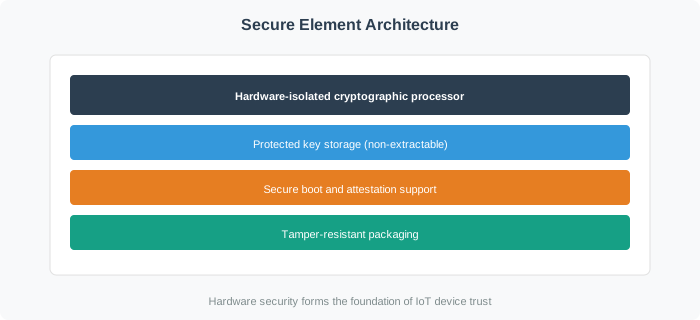
Secure Element, HCE, And Card-Emulation Boundaries

The pictured metal interconnect traces makes setup reproducible.

  • Success at: Hardware-isolated cryptographic processor cannot prove the protected non-extractable key storage boundary.
  • A secure element keeps the secret in tamper-resistant silicon.
  • A concrete release review can trace one tap end to end.
A magnified secure-element die makes the hardware boundary concrete: card-emulation keys and cryptographic operations can remain inside dedicated tamper-resistant silicon instead of general host storage. Photo: Kawe Mazidjatari, CC BY-SA 4.0
iotclass.org

Major section

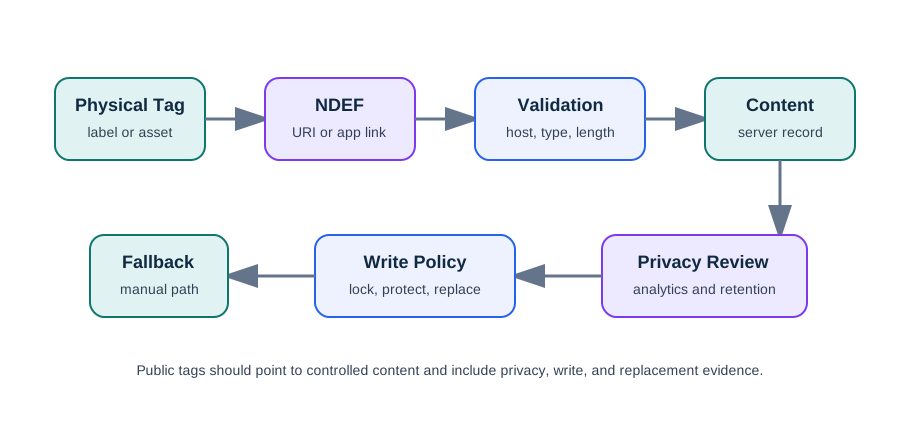
Tags For Posters, Products, And Assets

Public-facing tags are easier to deploy than credential systems, but they still need controls.

  • A bad tag can redirect users, expose private information, or make support teams chase stale labels.
  • Validate before action.: The app should reject unexpected hosts, record types, payload length, unsigned commands, and stale schema versions.
NFC tag application path showing physical tag, NDEF payload, app or browser validation, backend record, analytics and privacy review, and replacement process.
iotclass.org

Major section

Smart Home And Device Commissioning

Pairing handoff: NFC can reduce pairing errors by carrying a small bootstrap record, then Bluetooth LE or Wi-Fi handles the live connection.

  • NFC is useful when setup needs a deliberate, local gesture.
  • Device onboarding: A tag can expose serial number, app link, setup code reference, or Wi-Fi handoff record.
  • Service mode: A maintenance tap can open diagnostics or claim a device only after the technician session and asset state are validated.
iotclass.org

Major section

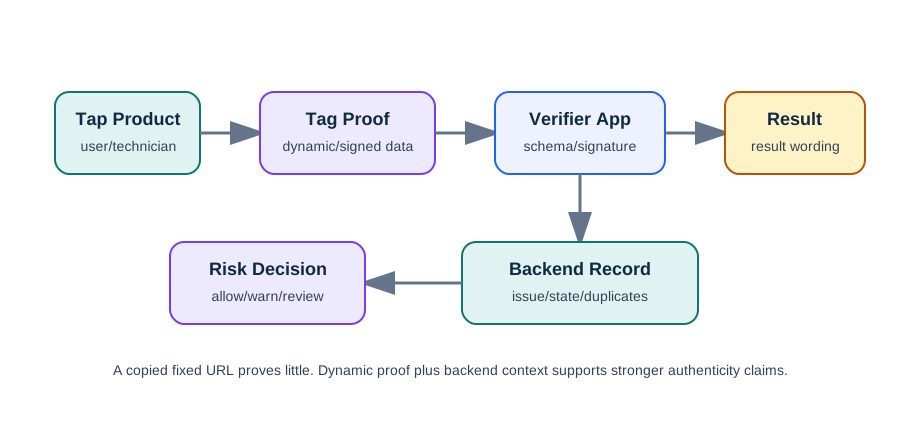
Product Authentication

Authentication tags need stronger evidence than normal smart posters.

  • A product label that only stores a fixed URL can be copied.
  • A stronger design uses dynamic evidence and server-side checks.
  • User result: Separate "information found" from "authenticity verified." The result wording should match the strength of the evidence.

Why it matters

The conclusion depends on allow/warn/review.

NFC product-authentication evidence path from tap through dynamic tag response, verifier app, backend record, risk decision, and customer or technician result.
iotclass.org

Major section

Common Pitfalls

Treating tag data as trusted.: Validate all payloads, even when the tag was installed by your own team.

  • Using NFC as the only fallback.: Public and operational systems need a manual path when a phone model, case, or surface blocks the read.
  • Overclaiming authentication.: A static URL or UID lookup can identify an item, but it does not prove the item is genuine.
  • Skipping installed-surface tests.: A tag that works on a desk can fail after mounting on metal, behind glass, under a protective overlay, or near equipment.
iotclass.org

Major section

Summary

Payment and access use NFC as a close-range credential exchange, but authorization depends on issuer, verifier, and backend policy.

  • Smart posters, product labels, and asset tags should store validated references rather than sensitive data.
  • Device setup and smart-home flows often use NFC to start a workflow, then hand off to the app, controller, or network protocol.
  • A rollout is not ready until payload, security, privacy, physical installation, fallback, support, and retest evidence are recorded.
iotclass.org

Deck summary

Key takeaways

The tap can find the pump record, but it must not grant anyone the right to change the pump settings.

  • This runway does not make proximity a credential or prove every phone works.
  • Real NFC deployments use the tap as a proof of user intent, object proximity, or credential presentation.
  • NFC is an application boundary.: A tap can select an object or present a credential, but the application still needs policy, validation, logging, and fallback behavior.
  • The same NFC radio can support very different trust boundaries.
iotclass.org

Retrieval practice

Recall check 1 of 3

Radio Remi says: answer from memory, then check your reasoning.

Q1A facility NFC tag opens a maintenance record for a gateway. How do you keep the tag from becoming an unsafe authorization shortcut?

AUse the tag only as an asset reference and let the authenticated app and backend decide
BStore the technician's login credentials directly on the tag itself
CGrant the action to anyone who can physically tap the tag
DEncrypt the tag UID and treat that UID as the login token
Show answer

Answer: A An NFC tap should be an asset reference; the authenticated app and backend must decide whether an action is allowed.

iotclass.org

Retrieval practice

Recall check 2 of 3

Radio Remi says: answer from memory, then check your reasoning.

Q2An attacker records a shopper's contactless payment tap in full. Why can they not reuse it, even though NFC has no RF-layer encryption?

AEach EMV transaction uses a one-time dynamic cryptogram, and the tap carries a device token, not the real PAN.
BNFC encrypts the radio link itself, so the recording comes out unreadable.
CThe tap contains the real card number, but it is hashed so it cannot be reversed.
DOnly Secure Element phones are safe, whereas host-card-emulation taps can be replayed.
Show answer

Answer: A Contactless payment security is at the payment layer: a one-time EMV cryptogram prevents replay and tokenization replaces the PAN with a revocable device token, independent of SE versus HCE.

iotclass.org

Retrieval practice

Recall check 3 of 3

Radio Remi says: answer from memory, then check your reasoning.

Q3A facility tag opens a maintenance app record for a gateway. Which design keeps the NFC tag from becoming an unsafe authorization shortcut?

AStore the technician's service role in the NDEF payload so the app can grant access offline.
BUse the tag only as an asset reference, then let the authenticated app and backend decide.
CLook up the tag UID in the approved asset register and grant the service rights stored for that asset.
DAvoid backend validation because NFC's short range already proves the user's identity.
Show answer

Answer: B A safe real-world NFC app separates object selection from authorization.

iotclass.org

Print reference

Answers

Answer key.

  1. A · An NFC tap should be an asset reference; the authenticated app and backend must decide whether an action is allowed.
  2. A · Contactless payment security is at the payment layer: a one-time EMV cryptogram prevents replay and tokenization replaces the PAN with a revocable device token, independent of SE versus HCE.
  3. B · A safe real-world NFC app separates object selection from authorization.
iotclass.org