Core Networking · Study deck

Packet Journey Game: Forwarding Decisions

Treat each game move as a real deployment question.

Packet Pete is your guide for this deck.

fundgame
Packet Pete, the module guide, in a scene from this chapter.
iotclass.org

After studying this chapter

Learning objectives

You will be able to:

  • Apply networking concepts in an interactive game environment by guiding a packet through LAN, WAN, and IoT mesh levels
  • Select correct protocols at each OSI layer based on reliability, latency, and energy constraints in real-time scenarios
  • Differentiate between Layer 2 and Layer 3 forwarding by explaining when switches use MAC addresses versus when routers use IP addresses
  • Evaluate the impact of protocol choices on end-to-end latency by calculating delay budgets across multi-hop paths
iotclass.org

Major section

Routing Decisions in a Packet Simulation

"This is so cool---you get to BE a data packet!" exclaimed Temperature Terry. "You travel through the network, hopping from router to router, making decisions at every stop!".

  • "At each hop, you have to choose the right path," explained the microcontroller. "Take the wrong route and you might hit congestion, a firewall, or a failed node.
  • And at each router, I need to check the routing table to find the best next hop.".
  • The setup has named the player and the three levels.

Try it: Routing Decisions in a Packet Simulation in the chapter

iotclass.org

Major section

Packet Delay Budget Analysis

When a pedestrian presses the crosswalk button, the traffic controller must receive the signal within 500 ms to meet safety standards.

  • Peering point queueing increases from 30 ms to 200 ms during congestion.
  • 5% packet loss requires retransmission.
  • Sensor timeout + retransmit: 1,000 ms (exceeds safety budget).

Numbers to remember

30 msPeering point queueing increases from 30 ms to 200 ms during congestion.
200 msPeering point queueing increases from 30 ms to 200 ms during congestion.
5%5% packet loss requires retransmission.
iotclass.org

Major section

Packet Journey Path Proof
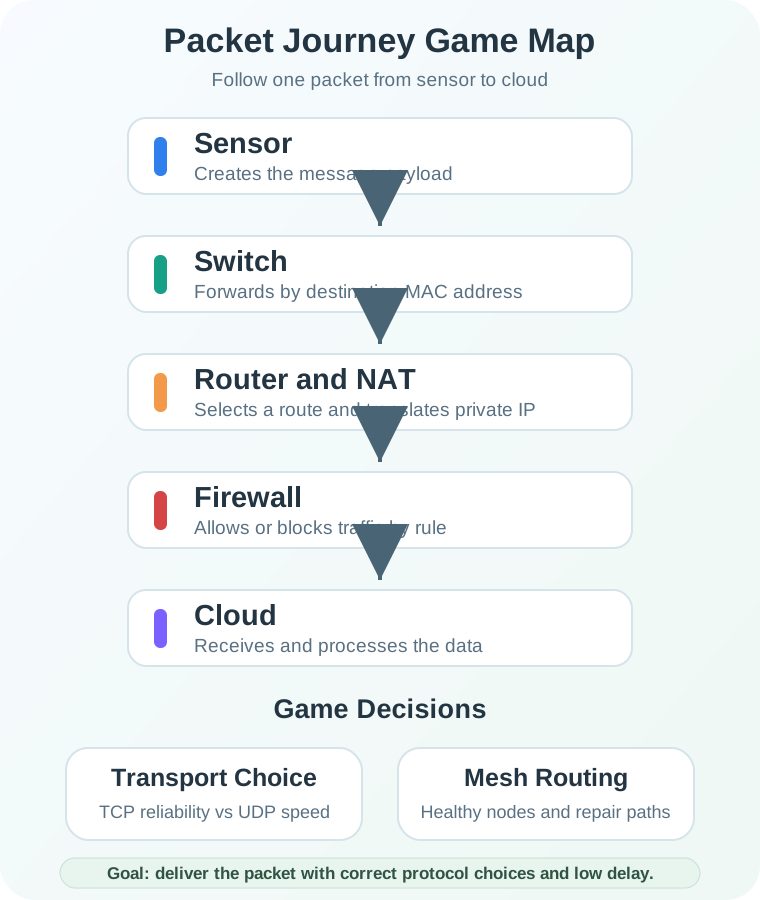
The packet journey game is more than a score.

  • Each choice asks the learner to prove that a packet can move through one boundary without losing the meaning of the previous boundary.
  • The useful score is not just delivery.
  • The important review move is to separate arrival from proof.
Packet journey game map from sensor message through switch, router and NAT, firewall, cloud, transport choice, and mesh routing decisions.
iotclass.org

Major section

Packet Journey Path Proof (continued)

A mesh question asks whether the path still works when a low-power node changes parent or needs a repair path.

  • When a learner can explain the game route this way, the lesson transfers to commissioning work.
  • The operator does not say only "the packet failed." The operator asks which boundary was last proven: payload creation, neighbor delivery, routed next hop, transport recovery, security policy, or application processing.
  • That boundary question keeps the game from becoming memorization; every successful move must leave a clue that would still help during a field failure.
iotclass.org

Deck summary

Key takeaways

"This is so cool---you get to BE a data packet!" exclaimed Temperature Terry. "You travel through the network, hopping from router to router, making decisions at every stop!".

  • When a pedestrian presses the crosswalk button, the traffic controller must receive the signal within 500 ms to meet safety standards.
  • The packet journey game is more than a score.
  • A mesh question asks whether the path still works when a low-power node changes parent or needs a repair path.
iotclass.org

Retrieval practice

Recall check 1 of 3

Packet Pete says: answer from memory, then check your reasoning.

Q1In the packet journey game, a packet reaches a router with a valid destination IP route but a congested next hop. What should the player evaluate before choosing the path?

AWhether the route still delivers the packet with acceptable delay, retry risk, and hop behavior
BWhether the source MAC address identifies a less congested route toward the destination host
CWhether the application payload should be rewritten at each router
DWhether the route's low hop count is enough to offset the congested next hop
Show answer

Answer: A Packet-forwarding games are useful when they make learners connect route choices to layer behavior, congestion, retries, and end-to-end delivery.

iotclass.org

Retrieval practice

Recall check 2 of 3

Packet Pete says: answer from memory, then check your reasoning.

Q2Place each packet-journey decision where it lives so you can diagnose whether delivery failed at creation, forwarding, or destination proof.

ASensor Message
BTransport Choice
CSwitch Forwarding
DRouter and NAT
EFirewall Check
FMesh Routing
GCloud Destination
Show answer

Answer: A Trace the sensor message and transport choice into switching, routing, and firewall decisions, then through mesh or cloud delivery so you can locate the failed boundary.

Q3Complete the code that decides whether a packet should keep moving or be dropped when TTL expires:

Attl = ttl - 1
Bttl = ttl + 1
Cttl = 64
Dttl = 0
Show answer

Answer: A TTL is reduced at each hop.

iotclass.org

Retrieval practice

Recall check 3 of 3

Packet Pete says: answer from memory, then check your reasoning.

Q4In the packet journey game, why does a router drop a packet when TTL reaches zero?

ATo prevent packets from looping forever through the network
BBecause the payload has become too large to decode
CBecause the sender's transport timeout has expired during the journey
DBecause mesh networks cannot use transport protocols
Show answer

Answer: A TTL is reduced at each hop.

iotclass.org

Print reference

Answers

Answer key.

  1. A · Packet-forwarding games are useful when they make learners connect route choices to layer behavior, congestion, retries, and end-to-end delivery.
  2. A · Trace the sensor message and transport choice into switching, routing, and firewall decisions, then through mesh or cloud delivery so you can locate the failed boundary.
  3. A · TTL is reduced at each hop.
  4. A · TTL is reduced at each hop.
iotclass.org