Core Networking · Study deck

IPv6 for IoT

IPv4 is the older common plan for network addresses.

Packet Pete is your guide for this deck.

addripv6
Packet Pete, the module guide, in a scene from this chapter.
iotclass.org

After studying this chapter

Learning objectives

You will be able to:

  • Explain: On a constrained radio, Figure: 6LoWPAN keeps IPv6 usable on constrained links by begins with the 40-byte IPv6 base header and removes predictable context from the transmitted form.
  • Explain: The hierarchy connects prefix planning to neighbor, route, firewall, and ownership evidence: when a branch fails, responders can narrow both the affected estate and the responsible control plane.
  • Explain: Header compression does not shorten the logical IPv6 address space; it avoids repeating fields that both ends can reconstruct on that link.
  • Explain: Auto setup can reduce hand work, but bad router data can spread a bad choice.
iotclass.org

Major section

Begin With One New Device

IPv4 is the older common plan for network addresses.

  • IPv6 is a newer plan with a far larger address space.
  • A gateway is a node that joins one network to another.
  • It needs an address, a local path, and a route to the service.
  • Also test a device that has only the older address plan.

Why it matters

Auto setup can reduce hand work, but bad router data can spread a bad choice.

iotclass.org

Major section

Begin With One New Device (continued)

Auto setup can reduce hand work, but bad router data can spread a bad choice.

  • The large address space removes a shortage, but it does not remove design work.
  • Two address plans can ease a move, but they add tests and failure paths.
  • The deeper routes prove how the first device really joins and stays reachable.
iotclass.org

Major section

Overview: IPv6 Removes the Address Bottleneck, Not the Design Work
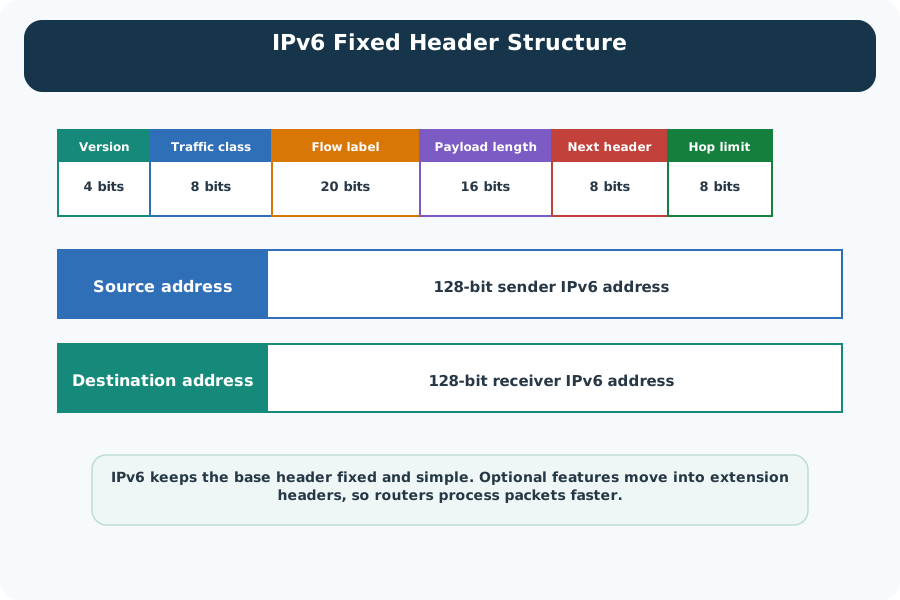
The header fields expose the routing, lifetime, traffic, and next-protocol evidence that operations must be able to capture.

  • The fixed sequence separates per-packet forwarding information from optional extension headers.
  • That distinction connects explicit prefix planning to packet-trace evidence when reachability, policy, or path lifetime fails.
IPv6 fixed base header and its routing and delivery fields
iotclass.org

Major section

Under the Hood: Neighbor Discovery, Routing, and Transition Boundaries
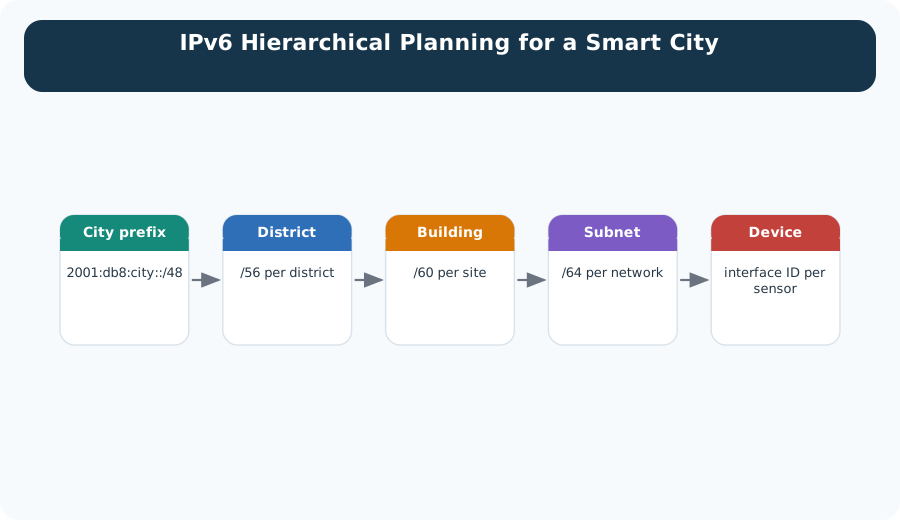
Each branch gives routing and operations a summarizable boundary while leaving room for growth.

  • The hierarchy connects prefix planning to neighbor, route, firewall, and ownership evidence: when a branch fails, responders can narrow both the affected estate and the responsible control plane.
Hierarchical IPv6 prefix plan for a smart-city deployment
iotclass.org

Major section

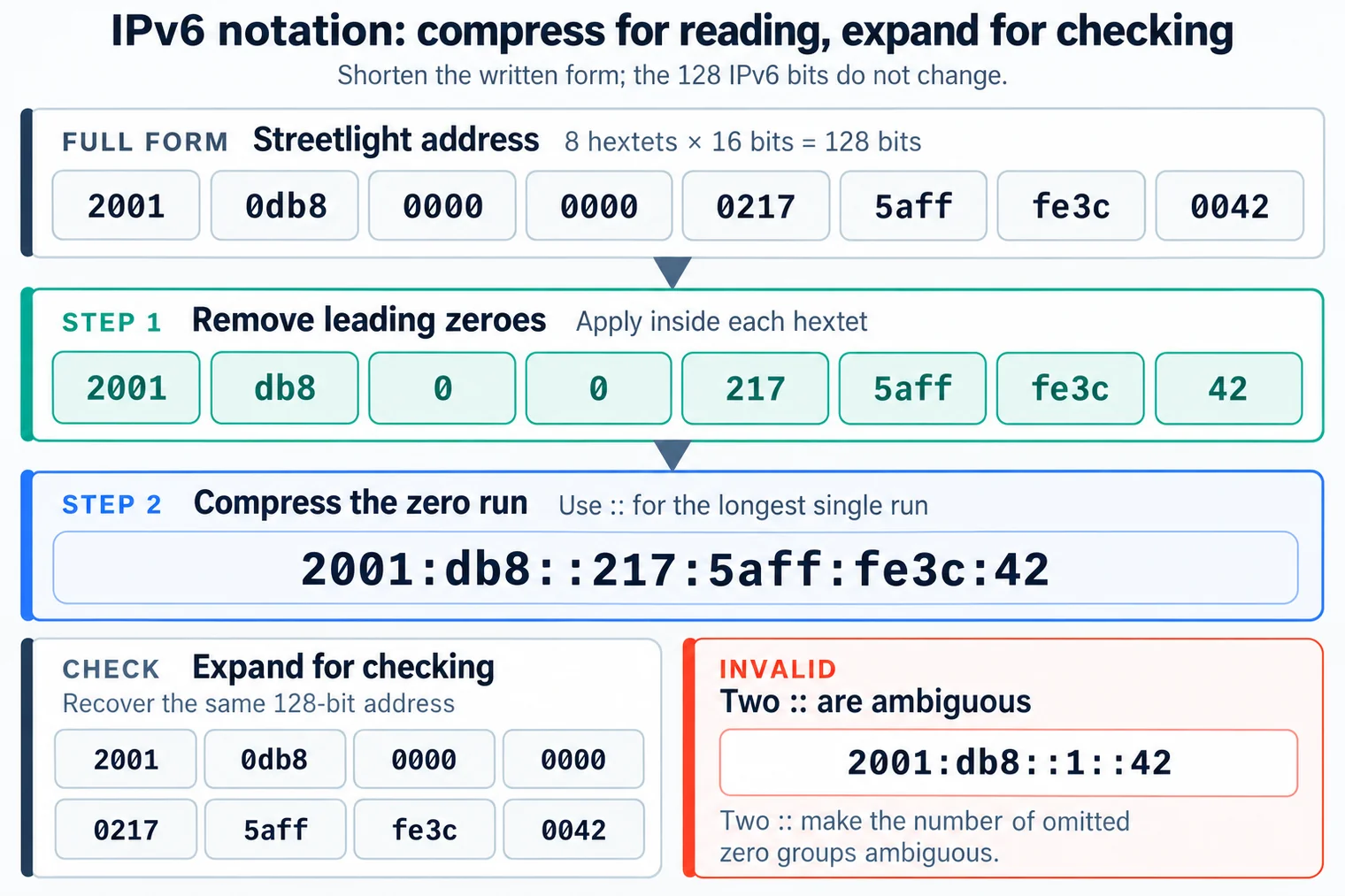
Shorten an IPv6 Address Without Changing It

The 128 IPv6 bits have not changed.

  • On a constrained radio, Figure: 6LoWPAN keeps IPv6 usable on constrained links by begins with the 40-byte IPv6 base header and removes predictable context from the transmitted form.
  • The IPv6 base header also carries a Hop Limit.

Why it matters

Each router reduces it, and a packet is discarded when the value reaches zero.

Address notation should be short enough to read and consistent enough to troubleshoot.
iotclass.org

Major section

Shorten an IPv6 Address Without Changing It (continued)

Header compression does not shorten the logical IPv6 address space; it avoids repeating fields that both ends can reconstruct on that link.

  • Hop Limit bounds a routing loop; it does not state how many radio retries occurred on one low-power link.
  • Two:: marks would make the number of omitted zero groups ambiguous.
  • The link may depend on 6LoWPAN context and compression to fit its packet budget.
iotclass.org

Deck summary

Key takeaways

IPv4 is the older common plan for network addresses.

  • Auto setup can reduce hand work, but bad router data can spread a bad choice.
  • The header fields expose the routing, lifetime, traffic, and next-protocol evidence that operations must be able to capture.
  • Each branch gives routing and operations a summarizable boundary while leaving room for growth.
  • The 128 IPv6 bits have not changed.
iotclass.org

Retrieval practice

Recall check 1 of 3

Packet Pete says: answer from memory, then check your reasoning.

Q1Which IPv6 design habit is strongest for an IoT deployment?

AAssign every device a global prefix first, then add firewall rules after applications are online.
BPlan scope, prefixes, routing policy, local discovery, and verification evidence before rollout.
CDisable link-local addressing so device traffic always uses a routable site or cloud prefix.
DReuse IPv4-style small subnet sizing so the IPv6 deployment conserves address space.
Show answer

Answer: B IPv6 IoT planning should define address scope, prefixes, routing policy, local discovery, access boundaries, and verification evidence.

iotclass.org

Retrieval practice

Recall check 2 of 3

Packet Pete says: answer from memory, then check your reasoning.

Q2A campus IoT team has a large IPv6 allocation and wants addresses that help operations during incidents. What is the best planning move?

APack every device class into the smallest subnet possible so unused address space is minimized.
BUse only link-local addresses because most devices normally talk to a nearby campus gateway.
CUse readable prefixes for site, floor, device class, or trust zone and record route checks.
DUse random prefixes without inventory records because the IPv6 allocation has enough space.
Show answer

Answer: C An IPv6 IoT plan should encode operational meaning in prefixes and record address formation, routing, and verification evidence.

iotclass.org

Retrieval practice

Recall check 3 of 3

Packet Pete says: answer from memory, then check your reasoning.

Q3Why is a clean IPv6 prefix plan not enough by itself?

ABecause IPv6 addresses cannot cross routed networks unless NAT is enabled at each boundary.
BBecause link-local addresses are optional and should usually be disabled on IoT interfaces.
CBecause 6LoWPAN compression removes the need to test constrained low-power links.
DBecause discovery, routing policy, firewalls, constrained links, and transitions must work too.
Show answer

Answer: D IPv6 operations require evidence for local discovery, routing, security policy, constrained-link behavior, and IPv4/IPv6 transition boundaries.

iotclass.org

Print reference

Answers

Answer key.

  1. B · IPv6 IoT planning should define address scope, prefixes, routing policy, local discovery, access boundaries, and verification evidence.
  2. C · An IPv6 IoT plan should encode operational meaning in prefixes and record address formation, routing, and verification evidence.
  3. D · IPv6 operations require evidence for local discovery, routing, security policy, constrained-link behavior, and IPv4/IPv6 transition boundaries.
iotclass.org