Core Networking · Study deck

IPv4 Addressing Fundamentals

Picture a replacement camera that receives an address but cannot reach its recorder.

Packet Pete is your guide for this deck.

addripv4
Packet Pete, the module guide, in a scene from this chapter.
iotclass.org

After studying this chapter

Learning objectives

You will be able to:

  • Explain: IPv4 Packet Header supplies one named condition; 20-byte minimum header — 32 bits per row supplies the necessary comparison for the ipv4 header carries source and destination addresses, ttl, protocol, length, fragmentation fields, and checksum information.
  • Explain: Its visual vocabulary joins IPv4 Subnet Mask to: Bits with value, which frames the subnet mask determines whether two ipv4 addresses are local peers or require a gateway.
  • Explain: The next claim about overview: an ipv4 address names a host in a network context depends on Figure: Classful addressing is historical context.
  • Use masks and prefixes to decide local reachability
iotclass.org

Major section

Start With Where the Device Lives

The four visible numbers are not enough; its local boundary and route may be wrong.

  • Internet Protocol means a system for addressing and routing packets.
  • IPv4 means version 4 of that system.
  • A gateway means the boundary device that forwards traffic beyond the local network.
  • This runway does not prove identity, trust, or permission.
iotclass.org

Major section

Overview: An IPv4 Address Names a Host in a Network Context
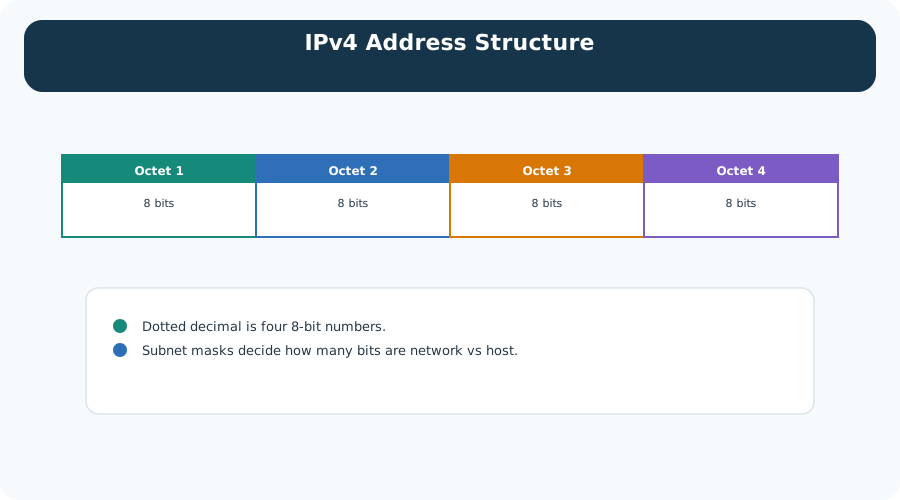
The decision in overview: an ipv4 address names a host in a network context must preserve that labelled boundary.

  • The next claim about overview: an ipv4 address names a host in a network context depends on Figure: Classful addressing is historical context.
IPv4 is a 32-bit address. Dotted-decimal notation is a human-readable view of those bits.
iotclass.org

Major section

Practitioner: Plan Subnets Around Device Groups and Traffic Rules
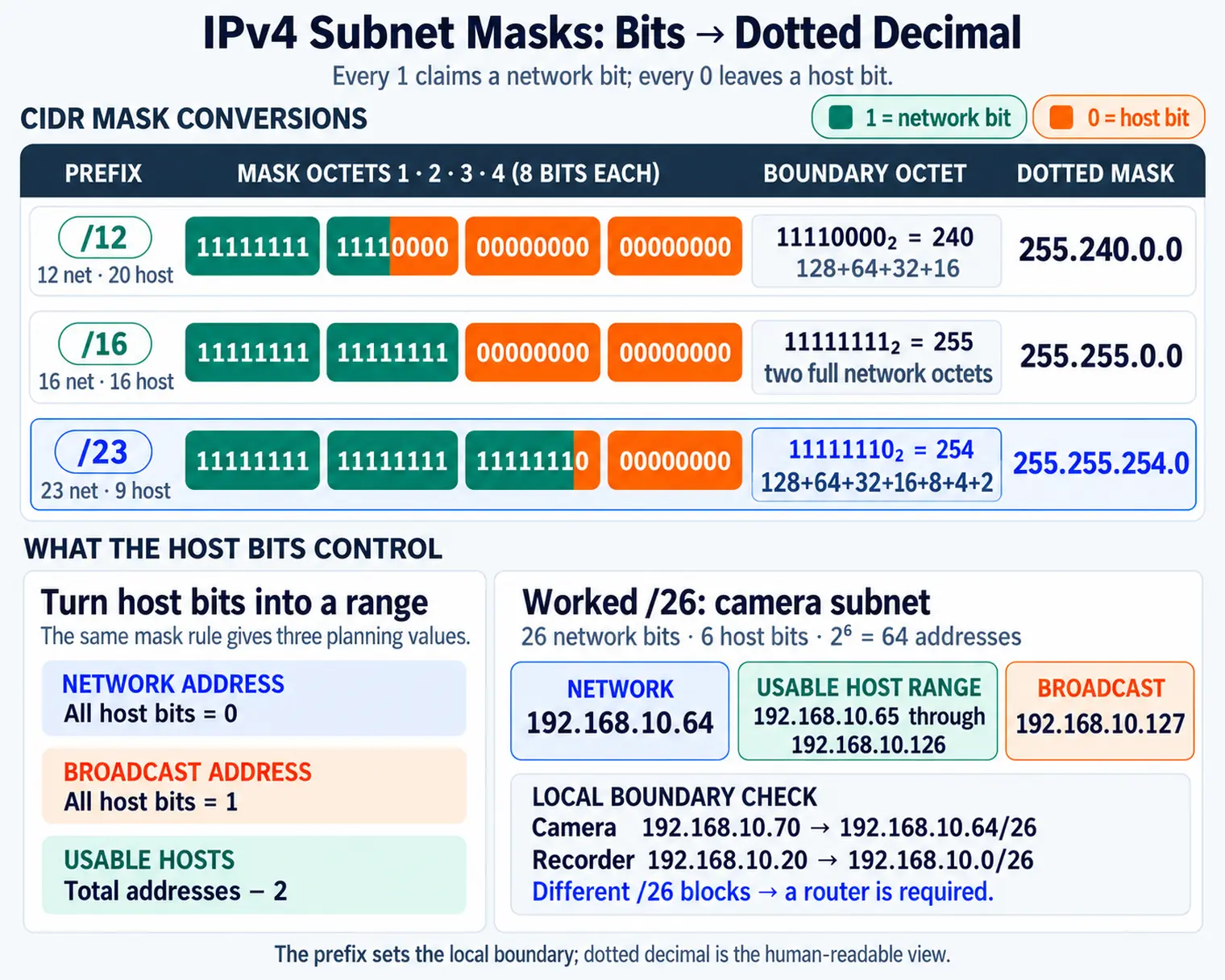
Its visual vocabulary joins IPv4 Subnet Mask to: Bits with value, which frames the subnet mask determines whether two ipv4 addresses are local peers or require a gateway.

  • Together those labels make the subnet mask determines whether two ipv4 addresses are local peers or require a gateway testable.
The subnet mask determines whether two IPv4 addresses are local peers or require a gateway.
iotclass.org

Major section

Under the Hood: Packets Carry Addresses, Routers Use Prefixes
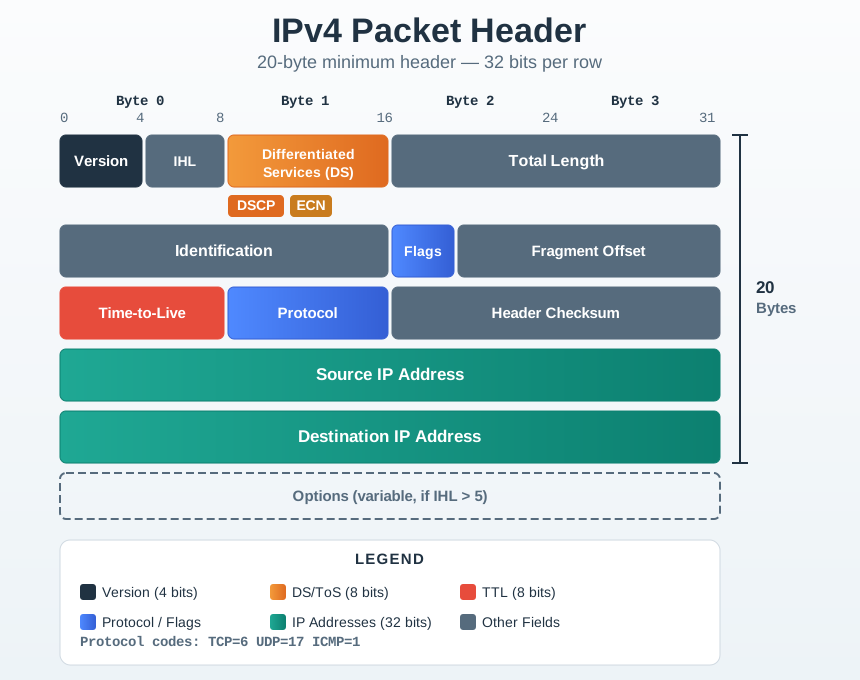
IPv4 Packet Header supplies one named condition; 20-byte minimum header — 32 bits per row supplies the necessary comparison for the ipv4 header carries source and destination addresses, ttl, protocol, length, fragmentation fields, and checksum information.

  • The decision in under the hood: packets carry addresses, routers use prefixes must preserve that labelled boundary.
The IPv4 header carries source and destination addresses, TTL, protocol, length, fragmentation fields, and checksum information.
iotclass.org

Major section

Place a Camera on the Correct IPv4 Street

For a /26 prefix, 26 bits name the network and 6 bits remain for hosts.

  • Each block therefore contains 2^6=64 addresses.
  • They need a router even though their first three octets match.
  • Its ordinary host range is therefore 192.168.10.65 through 192.168.10.126.

Numbers to remember

26 bits26 bits name the network and 6 bits remain for hosts.
6 bits6 bits remain for hosts.
IPv4 is a 32-bit address. Dotted-decimal notation is a human-readable view of those bits.
iotclass.org

Deck summary

Key takeaways

The four visible numbers are not enough; its local boundary and route may be wrong.

  • The decision in overview: an ipv4 address names a host in a network context must preserve that labelled boundary.
  • Its visual vocabulary joins IPv4 Subnet Mask to: Bits with value, which frames the subnet mask determines whether two ipv4 addresses are local peers or require a gateway.
  • IPv4 Packet Header supplies one named condition; 20-byte minimum header — 32 bits per row supplies the necessary comparison for the ipv4 header carries source and destination addresses, ttl, protocol, length, fragmentation fields, and checksum information.
iotclass.org

Retrieval practice

Recall check 1 of 3

Packet Pete says: answer from memory, then check your reasoning.

Q1What makes an IPv4 address usable in an IoT network?

AThe device has an address, a mask or prefix, and a gateway decision for non-local traffic.
BThe address is written with four decimal numbers, regardless of mask or gateway.
CThe address starts with 192, because that always means it is reachable.
DThe address is public, because private addresses cannot be used by IoT devices.
Show answer

Answer: A IPv4 troubleshooting starts with the full context: address, prefix, local subnet, gateway, and any reserved-address role.

iotclass.org

Retrieval practice

Recall check 2 of 3

Packet Pete says: answer from memory, then check your reasoning.

Q2A sensor is configured as 172.20.15.45 with mask 255.255.255.0 and cannot reach a server at 172.20.30.10. Link status is up. What is the most likely first diagnosis?

AThe /24 mask makes the server appear outside the local subnet
BThe 172.20 range is multicast and cannot be used for IoT devices.
CThe addresses cannot communicate because all private addresses are isolated from one another.
DIPv4 exhaustion prevents new devices from joining private networks.
Show answer

Answer: A A subnet mask controls local reachability.

iotclass.org

Retrieval practice

Recall check 3 of 3

Packet Pete says: answer from memory, then check your reasoning.

Q3Why does a subnet plan matter to routers and firewalls, not just to humans?

ARouters and firewalls make decisions from prefixes, next hops, and policy rules
BRouters read device names in IPv4 addresses and infer the device type automatically.
CSubnetting is only a documentation practice and has no effect on packet forwarding.
DThe TTL field replaces routing tables for IoT traffic.
Show answer

Answer: A A usable IPv4 plan connects human inventory, device groups, prefixes, gateways, and firewall policies.

iotclass.org

Print reference

Answers

Answer key.

  1. A · IPv4 troubleshooting starts with the full context: address, prefix, local subnet, gateway, and any reserved-address role.
  2. A · A subnet mask controls local reachability.
  3. A · A usable IPv4 plan connects human inventory, device groups, prefixes, gateways, and firewall policies.
iotclass.org