Design Methodology · Study deck
Network Traffic Analysis: Capture Points and Tools
A device trace records what the device sends or receives.
Blueprint Bina is your guide for this deck.
After studying this chapter
Learning objectives
You will be able to:
- Explain: The useful facts are the CONNECT/CONNACK timing, PUBLISH cadence, keepalive interval, DNS lookup, TCP reconnects, and whether the observed payload size and report interval match the simulation input.
- Explain: RF sniffer Wireless link evidence Use for 802.15.4, Thread, Zigbee, BLE, or other over-the-air behavior when gateway logs cannot show the radio exchange.
- Explain: MQTT topic or payload faults require visibility into the affected fields, while LoRaWAN radio problems call for RF, device, or gateway evidence about joins and link conditions.
- Explain: Traffic protected by production keys should remain controlled by security policy.
Major section
Start With the Decision
A device trace records what the device sends or receives.
- An RF trace records radio signals in the air; RF means radio frequency.
- A capture point is the place where the team records that evidence.
- The two traces expose different faults, so choose the point that can observe the claim under test.
Major section
Tool Roles
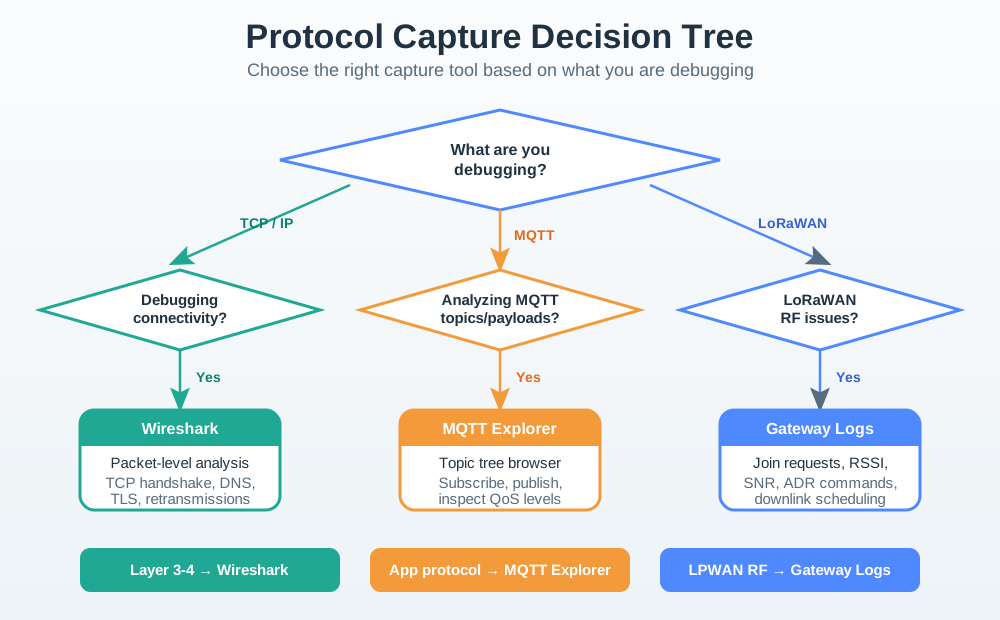
Wireshark Interactive protocol review Use for packet dissection, timeline inspection, stream following, field exploration, and training reviewers on what the trace shows.
- tcpdump Remote packet capture Use on gateways, routers, Linux devices, and field systems where a lightweight command-line capture is practical.
- tshark Repeatable extraction Use for scripted field extraction, test automation, CI checks, and producing repeatable summaries from PCAP files.
- Application logs Outcome correlation Use to connect packets with commands, alerts, dashboards, user events, and incident timelines.
Major section
Tool Roles (continued)
RF sniffer Wireless link evidence Use for 802.15.4, Thread, Zigbee, BLE, or other over-the-air behavior when gateway logs cannot show the radio exchange.
- Flow logs Aggregate path evidence Use when packet payloads are unnecessary and the question is about endpoints, volume, timing, or backhaul behavior.
- TCP/IP faults call for packet dissection, timelines, and stream following at a point that can observe the handshake or retransmission.
- MQTT topic or payload faults require visibility into the affected fields, while LoRaWAN radio problems call for RF, device, or gateway evidence about joins and link conditions.
Major section
Reading a Trace
The strongest traffic analysis reports behavior, not just packets.
- Periodic reports, keepalive timing, command timing, sleep/wake windows, and event bursts.
- Mismatch between firmware timing and protocol expectations can cause disconnects or stale data.
- Retransmissions, duplicate messages, acknowledgements, retry limits, backoff, and missing responses.
- High retry behavior can indicate weak links, congestion, queueing, broker pressure, or application timeouts.
Major section
Encryption and Evidence Limits
Modern IoT traffic is often encrypted.
- Traffic analysis should be honest about what remains visible and what needs another evidence source.
- Production secrets, private payloads, and customer data should not be exposed just for convenience.
- Decrypted test captures when session keys or test certificates are intentionally available.
- Traffic protected by production keys should remain controlled by security policy.
Major section
Comparing Traffic With Simulation
Traffic analysis is especially useful after simulation because it tests whether modeled assumptions match a field or pilot system.
- Checks whether the simulated workload matches real device behavior.
- Checks whether recovery time and command freshness remain acceptable.
- Commissioning, key rotation, diagnostics, firmware update, and support traffic.
Try it: Comparing Traffic With Simulation in the chapter
Major section
Incremental Examples
A room sensor pilot reports stale occupancy events after several nodes rejoin.
- A lab team wants to confirm that an ESP32 temperature node publishes every 60 seconds to a local Mosquitto broker.
- The capture can run on the gateway or broker host with tcpdump, then be reviewed in Wireshark or summarized with tshark.
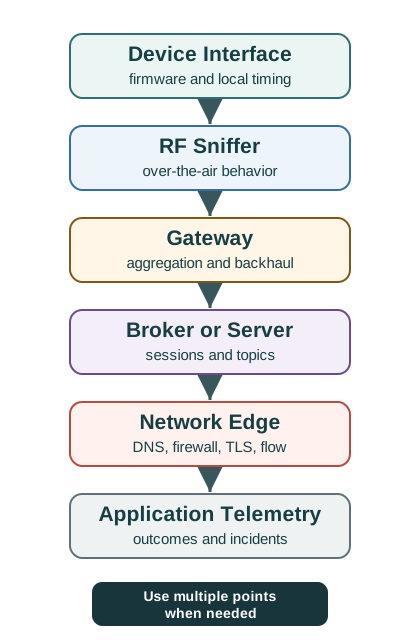
- The traffic-analysis plan should combine an 802.15.4 sniffer, gateway logs, and application timestamps during a planned join wave.
Major section
Incremental Examples (continued)
The useful facts are the CONNECT/CONNACK timing, PUBLISH cadence, keepalive interval, DNS lookup, TCP reconnects, and whether the observed payload size and report interval match the simulation input.
- A Nordic nRF Sniffer, TI SmartRF Packet Sniffer, or supported 802.15.4 capture dongle can expose frame timing, acknowledgements, route repair, and channel behavior, while gateway logs show what reached the IP side.
- The result should identify whether the stale event is caused by RF retries, route repair, gateway queueing, or broker/application delay.
- A facilities program needs to compare a simulation with field evidence from Wi-Fi gateways, LoRaWAN devices, and cellular backhaul.
Deck summary
Key takeaways
A device trace records what the device sends or receives.
- Wireshark Interactive protocol review Use for packet dissection, timeline inspection, stream following, field exploration, and training reviewers on what the trace shows.
- RF sniffer Wireless link evidence Use for 802.15.4, Thread, Zigbee, BLE, or other over-the-air behavior when gateway logs cannot show the radio exchange.
- The strongest traffic analysis reports behavior, not just packets.
- Modern IoT traffic is often encrypted.
Retrieval practice
Recall check 1 of 3

Blueprint Bina says: answer from memory, then check your reasoning.
Q1What chooses packet observation point, time window, filters, consent and retention boundary?
Show answer
Answer: B The capture plan selects the observation point, time window, filters, consent, and retention boundary.
Retrieval practice
Recall check 2 of 3
Blueprint Bina says: answer from memory, then check your reasoning.
Q2A simulation predicts reliable alarm delivery, but the pilot shows occasional stale alarms after gateway reboot. Which traffic-analysis plan is strongest?
Show answer
Answer: C Traffic analysis is strongest when it captures the exact scenario window that produced the symptom and compares packet behavior with logs and simulation assumptions.
Retrieval practice
Recall check 3 of 3
Blueprint Bina says: answer from memory, then check your reasoning.
Q3A packet capture shows TLS application data but no readable MQTT topics or payloads. What is the correct interpretation?
Show answer
Answer: D Encrypted traffic analysis must state evidence limits.
Print reference
Answers
Answer key.
- B · The capture plan selects the observation point, time window, filters, consent, and retention boundary.
- C · Traffic analysis is strongest when it captures the exact scenario window that produced the symptom and compares packet behavior with logs and simulation assumptions.
- D · Encrypted traffic analysis must state evidence limits.