Design Methodology · Study deck
Network Design: Topology Tradeoffs
Topology means the shape of the links between devices.
Blueprint Bina is your guide for this deck.

After studying this chapter
Learning objectives
You will be able to:
- Test topology patterns with a concrete scenario and pass criteria.
- Validate references and standards with a concrete scenario and pass criteria.
- Explain: The same protocol may support different shapes, and the same topology may behave very differently in two sites.
- Explain: The device path is easy to reason about because there is usually one network hop from device to gateway.
Major section
Topology Patterns
The same protocol may support different shapes, and the same topology may behave very differently in two sites.
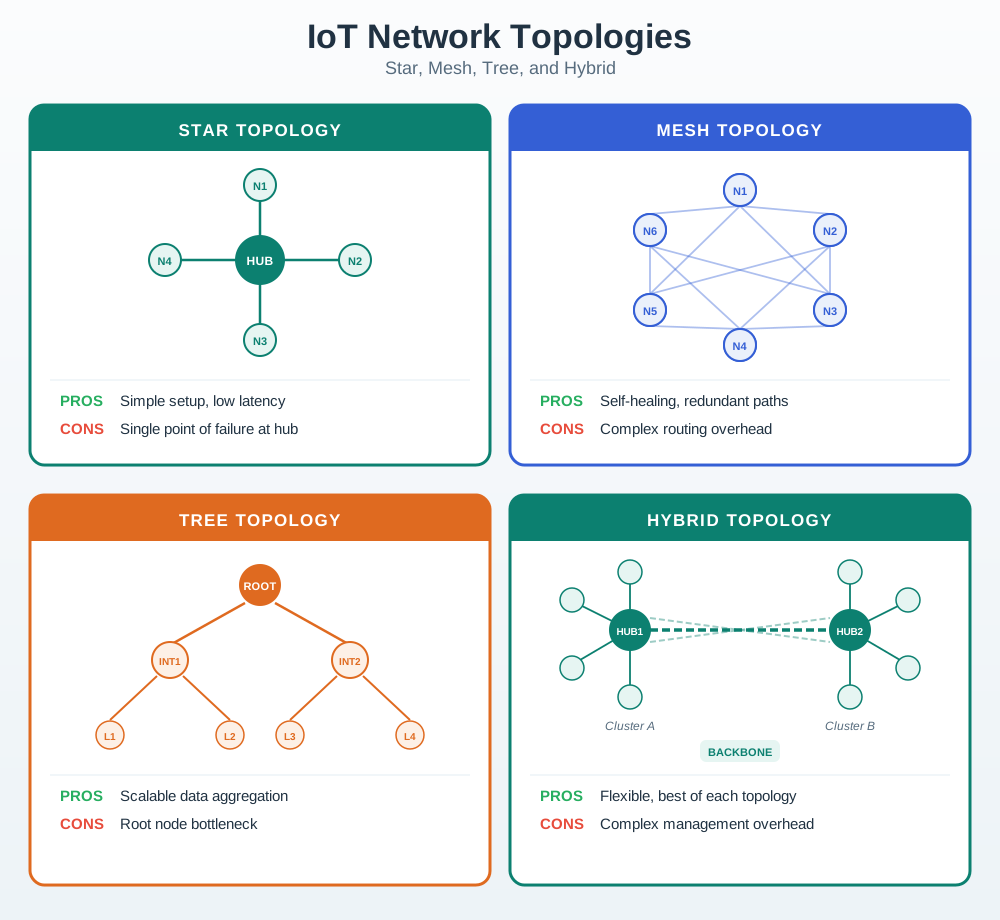
- Contrast: STAR TOPOLOGY against it to make topology choice a reviewable trade-off between simplicity, reach, resilience, energy, and operating complexity.
- In a star topology, each device communicates with a central gateway, access point, coordinator, or controller.
Major section
Topology Patterns (continued)
The device path is easy to reason about because there is usually one network hop from device to gateway.
- In a mesh topology, devices can forward messages through neighboring devices.
- A site might use local star clusters, a mesh lighting layer, wired gateway backhaul, and cloud integration.
- Hybrid design is normal when subsystems have different traffic, power, security, or maintenance needs.
Major section
Topology Selection Matrix
Simple device-to-gateway reporting, bounded area, low-power end nodes, centralized control.
- Gateway outage or overload can affect many devices.
- Routing overhead can increase latency, energy use, and troubleshooting complexity.
- Parent or cluster-head failure can isolate children.
- Interfaces between layers can hide failures and ownership gaps.
Major section
Requirements That Shape the Network
Coverage is not just distance.
- Walls, metal shelving, equipment, bodies, weather, antenna orientation, and gateway elevation can all change link quality.
- A design should identify expected weak areas and explain how they will be tested.
- Capacity planning starts with an estimate of generated application payload traffic.
- This estimate is only a screening check.
Major section
Example Capacity Check
Latency is the time from event or reading to useful receipt.
- Jitter is latency variation.
- For monitoring dashboards, occasional delay may be acceptable.
- For alarms, synchronized sampling, or control actions, delay variation can matter as much as the average delay.
- Network topology affects the security model.
Major section
Requirements to Criteria
Good requirements are testable.
- Each installed location reports with the agreed margin during normal and busy site conditions.
- Timestamped event tests, gateway logs, simulation trace, percentile summary.
- Failure scenario run, failover test, buffer drain test, recovery timeline.
- The measured duty cycle, retransmission rate, and sleep current support the maintenance interval with margin.
Major section
Building Monitoring Pilot
The brief says the system will support dashboards, comfort tuning, maintenance alerts, and future lighting integration.
- Low latency is useful, but occasional delayed data may be acceptable outside alerts.
- Equipment rooms may have metal, noise, and access restrictions.
- Dedicated gateway or wired backhaul if wireless evidence is weak.
- Separate segment; possibly mesh if powered nodes can relay.
Deck summary
Key takeaways
The same protocol may support different shapes, and the same topology may behave very differently in two sites.
- The device path is easy to reason about because there is usually one network hop from device to gateway.
- The table below is a decision aid, not a rule book.
- Coverage is not just distance.
- Latency is the time from event or reading to useful receipt.
Retrieval practice
Recall check 1 of 3

Blueprint Bina says: answer from memory, then check your reasoning.
Q1What shows which network nodes communicate and where single paths create dependencies?
Show answer
Answer: D It shows which nodes communicate and where single paths or dependencies exist.
Retrieval practice
Recall check 2 of 3
Blueprint Bina says: answer from memory, then check your reasoning.
Q2A team chooses a mesh network for battery-powered environmental sensors because the diagram looks resilient. The requirements say readings are small, periodic, and delay tolerant, while battery maintenance is expensive. What should the reviewer ask first?
Show answer
Answer: D Topology choice must be tested against the dominant requirement.
Retrieval practice
Recall check 3 of 3
Blueprint Bina says: answer from memory, then check your reasoning.
Q3What evidence must support the coverage claim before design approval?
Show answer
Answer: A A coverage claim is not reviewable until it includes criteria, site assumptions, gateway locations, and validation evidence.
Print reference
Answers
Answer key.
- D · It shows which nodes communicate and where single paths or dependencies exist.
- D · Topology choice must be tested against the dominant requirement.
- A · A coverage claim is not reviewable until it includes criteria, site assumptions, gateway locations, and validation evidence.