Testing & Validation · Study deck
Network Simulation Tools
Network simulation lets you study how a fleet of IoT devices talks to each other before you can build the fleet.
Test Tessa is your guide for this deck.

After studying this chapter
Learning objectives
You will be able to:
- model a network fleet you cannot yet build
- choose a network simulator type and the scenario evidence it should produce
- account for the discrete-event engine, random seeds, and the reality gap when reading results
- Explain: A protocol is a set of rules for exchanging messages.
Major section
Start With the Fleet Story
A protocol is a set of rules for exchanging messages.
- A network simulator lets the team build a software fleet, decide how messages move, add delay or loss, and watch the protocol respond before anyone climbs a ladder or ships hardware to the field.
- It may be a packet capture, a bench test, or a field trial.
- The model should make that check sharper and cheaper.
- The Practitioner section compares tools and evidence records.
Major section
Start With the Fleet Story (continued)
This first model cannot copy every wall, radio, clock, or software bug.
- A network simulator lets the team build a software fleet, decide how messages move, add delay or loss, and watch the protocol respond before anyone climbs a ladder or ships hardware to the field.
- A model can show whether traffic backs up, whether retries explode, or whether a route changes under a planned impairment.
- It still proves only what the modeled topology, traffic, timing, and channel can represent.
Major section
Overview: Modeling a Network You Cannot Yet Build
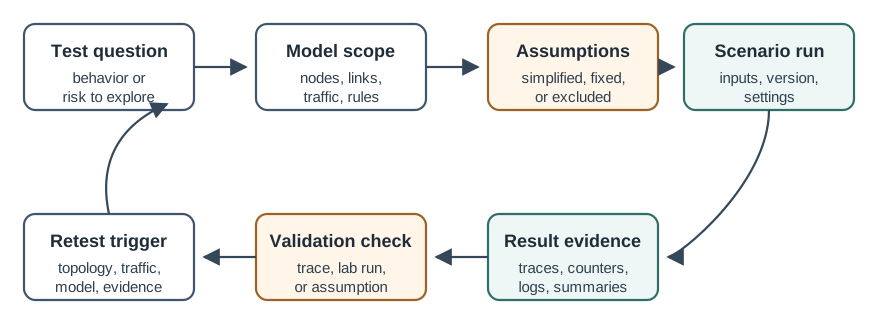
A network simulation tool builds a software model of many devices and the links between them, then runs traffic across that model so you can watch how the network behaves.
- The single most important idea is that a network simulation is a model, and a model represents some things and simplifies others.
- It says nothing about whether one driver runs a red light, because that was never in the model.
- The next field states each short cut in the model.
Major section
Overview: Modeling a Network You Cannot Yet Build (continued)
This route makes large trials repeatable while naming the real-network proof that a model cannot supply.
- Rather than wire up a hundred nodes, you describe the topology, the messages each node sends, and the conditions on the links — loss, delay, congestion, range — and the simulator plays the whole network forward.
- The run then answers only the named case.
- The retest trigger opens the claim again after a useful change.
Major section
Practitioner: Kinds of Network Simulator and Scenario Evidence
"Network simulation tool" covers several techniques that model different layers of the network, and choosing one starts with the question you are trying to answer.
- The category matters less than the evidence it preserves, but the categories do answer different questions, and picking the wrong one wastes the run.
- Real stack behavior under set delay, loss, or bandwidth limits.
- The determinism is the point: the same scenario and seed give the same result, so a failure you find today can be reproduced exactly next month.
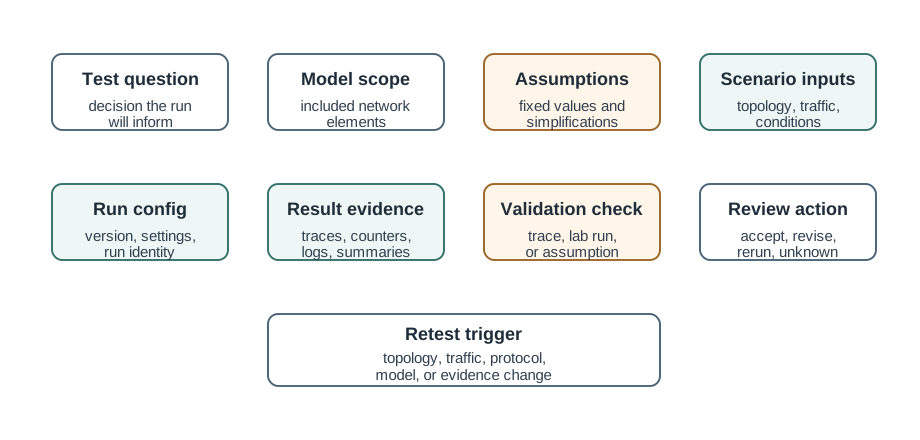
- The assumption field makes each model short cut clear.
Major section
Practitioner: Kinds of Network Simulator and Scenario Evidence (continued)
The review action states what happens next, while the retest trigger says when to run again.
- This record makes a large trial repeatable and keeps the remaining radio or device test in view.
- Worked Example: Routing Under Message LossConsider a mesh routing design that must keep delivering sensor reports as links degrade.
- Reviewing a Simulation Tool's OutputWhen you review someone else's run, the tool is only as good as the record it left.
- If you can pick the right kind of simulator, write a scenario record, and bound a thin run, you can stop here.
Major section
Under the Hood: The Discrete-Event Engine, Seeds, and the Reality Gap
The deeper layer is about why a confident green simulation can still mislead.
- They keep an ordered queue of future events — a packet arrival, a timer firing, a transmission finishing — each stamped with a virtual time.
- Real-time latency and timing races are not reproduced.
- A small physical testbed run.
Major section
Under the Hood: The Discrete-Event Engine, Seeds, and the Reality Gap (continued)
The engine repeatedly takes the earliest event, jumps the virtual clock straight to it, processes it, and lets that processing schedule new events.
- Nothing happens "between" events, so an idle simulated hour can finish in a moment and a microsecond-dense burst can take far longer to compute than it represents.
- Randomness Means One Run Is One SampleLoss, back-off, and arrival timing are usually modeled with a pseudo-random generator driven by a seed.
- A conclusion drawn from one seed, stated as if it were general, is a common and avoidable error.
Major section
Under the Hood: The Discrete-Event Engine, Seeds, and the Reality Gap (continued)
Matching channel fidelity to the question — and recording which effects were assumed away — is the difference between a defensible run and a misleading one.
- The Channel Model Is a SimplificationThe result depends heavily on the modeled channel, and channel models are deliberate simplifications.
- A model that omits interference simply cannot speak to interference, however many nodes it runs.
- One random draw is reported as the general result.
Major section
Under the Hood: The Discrete-Event Engine, Seeds, and the Reality Gap (continued)
An independent per-link loss model is easy to reason about but does not capture correlated, bursty loss, hidden-node collisions, external interference, or multipath fading that real radios face.
- An unvalidated model produces confident numbers with no anchor; a validated one earns trust within the range it was checked against, and no further.
- One scenario becomes a claim about every condition.
- Common PitfallsReview these failure modes in the order they can weaken or invalidate the result.
- Finish with Overstating scope: A clean run on one topology is not a conclusion about every deployment.
Deck summary
Key takeaways
A protocol is a set of rules for exchanging messages.
- This first model cannot copy every wall, radio, clock, or software bug.
- A network simulation tool builds a software model of many devices and the links between them, then runs traffic across that model so you can watch how the network behaves.
- This route makes large trials repeatable while naming the real-network proof that a model cannot supply.
- "Network simulation tool" covers several techniques that model different layers of the network, and choosing one starts with the question you are trying to answer.
Retrieval practice
Recall check 1 of 3

Test Tessa says: answer from memory, then check your reasoning.
Q1Why is a network simulation result described as evidence bounded by its model rather than proof that the deployed network will work?
Show answer
Answer: A The model represents some things and simplifies others; simulation evidence is trustworthy within that boundary and must name what it did not represent.
Retrieval practice
Recall check 2 of 3
Test Tessa says: answer from memory, then check your reasoning.
Q2What should reviewers require before relying on this routing result?
Show answer
Answer: D A hidden channel model and missing inputs make the result unreviewable; bound it, document the assumption, rerun the affected scenario if it matters, and validate against another source.
Retrieval practice
Recall check 3 of 3
Test Tessa says: answer from memory, then check your reasoning.
Q3A team runs a routing scenario once, sees a 99% delivery ratio, and reports the protocol as field-ready. The simulation is stochastic and seeded, and the channel uses independent per-link loss. What is the strongest critique?
Show answer
Answer: D A single seeded run is one sample, and an independent-loss channel omits interference and bursty loss; multiple seeds, realistic channel fidelity, and validation against a real testbed are needed first.
Print reference
Answers
Answer key.
- A · The model represents some things and simplifies others; simulation evidence is trustworthy within that boundary and must name what it did not represent.
- D · A hidden channel model and missing inputs make the result unreviewable; bound it, document the assumption, rerun the affected scenario if it matters, and validate against another source.
- D · A single seeded run is one sample, and an independent-loss channel omits interference and bursty loss; multiple seeds, realistic channel fidelity, and validation against a real testbed are needed first.