Design Methodology · Study deck
Network Simulation: Method Selection and Evidence
One network scenario rarely proves a design.
Blueprint Bina is your guide for this deck.

After studying this chapter
Learning objectives
You will be able to:
- Explain: A small lab group wants to know whether ten ESP32 temperature nodes can publish readings to a local MQTT broker every minute over one classroom access point.
- Explain: The scenario pack can stay simple: one baseline run, one synchronized-reporting burst, one access-point restart, and one check of broker logs and Wireshark captures.
- Explain: The decision is not "Wi-Fi works." It is whether the class demo has enough margin for the planned node count, payload size, and recovery expectation.
- Explain: Backoff, retries, acknowledgements, duty-cycle behavior, routing protocol, route repair, and queue limits.
Major section
Method 3: Choose the Simulation Method
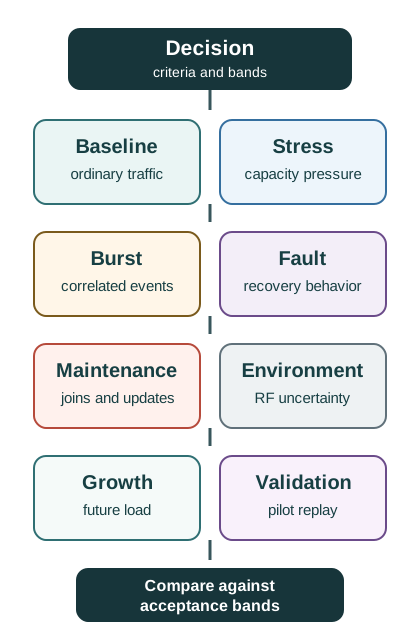
Different questions need different methods.
- A single packet-level run is useful for debugging, but it is rarely enough for a design decision.
- Replay Deterministic scenario Use fixed inputs to debug model mechanics, verify accounting, and make a result reproducible during review.
- Randomness Stochastic replication Repeat randomized placement, traffic timing, channel variation, or MAC behavior until the decision is stable enough to interpret.
Try it: Method 3: Choose the Simulation Method in the chapter
Major section
Method 4: Control Model Boundaries
Every simulator is an approximation.
- The point is not to model the whole world; it is to be explicit about which approximations can affect the decision.
- Coverage and retry behavior look stronger than they will be at the site.
- RF survey, gateway RSSI logs, pilot measurements, or controlled range tests.
Major section
Method 4: Control Model Boundaries (continued)
Backoff, retries, acknowledgements, duty-cycle behavior, routing protocol, route repair, and queue limits.
- Latency, loss, and recovery behavior are attributed to the wrong cause.
- Protocol documentation, packet captures, simulator model docs, and bench tests.
- The design passes quiet telemetry but fails during real events or maintenance.
Major section
Method 4: Control Model Boundaries (continued)
Application logs, captures, synthetic load tests, and production telemetry from similar systems.
- Transmit, receive, sleep, sensing, processing, join, retry, and update states when battery life matters.
- Provisioning, key rotation, monitoring, replacement process, access constraints, and support response.
- A network that works in simulation becomes difficult to install, observe, or repair.
Major section
Method 5: Package the Runs
A simulation run should be packaged so another reviewer can rerun it or understand why they cannot.
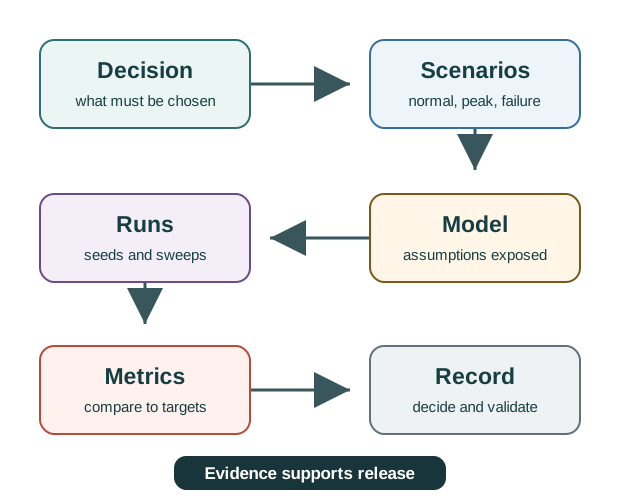
- A run package should let a reviewer see both the choice and its limits.
- The model box records tool versions and what the model includes or leaves out; the runs box keeps inputs, topology, traffic, and seed policy together.
Major section
Method 5: Package the Runs (continued)
Metrics are read as distributions and tails against the bands, not as one attractive average.
- A field gap sends the model or claim back for another pass.
- For stochastic models, the exact number of observations depends on variability and consequence.
- Instead, report the policy: what was randomized, how observations were generated, how stable the result was, and whether additional observations would change the decision.
Major section
Method 6: Analyze Variation
Simulation output should be read as a result set, not a screenshot.
- Averages are useful only after you know what they hide.
- Spread of delivery, latency, retries, queue depth, or energy across runs or nodes.
- Packet accounting, queue events, retries, route changes, and drop reasons.
Major section
Method 7: Validate and Decide
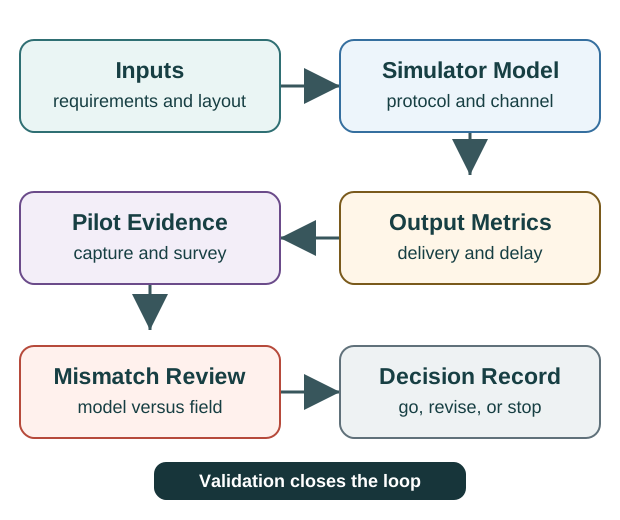
Verification and validation are different review steps.
- Finish with sanity checks against protocol limits and known behavior.
- Passing this sequence shows that the run is internally consistent, not that deployment is proven.
- Validate Check real-world fit Begin with packet captures that check protocol timing and retry behavior.
Major section
Method 7: Validate and Decide (continued)
The comparison identifies which model claims can move toward release and which still need evidence.
- The simulation decision basis should make the evidence useful later.
- Include the selected design, rejected alternatives, scenarios passed, scenarios failed, assumptions not yet validated, evidence owners, and monitoring that will be used after deployment.
- Passing these checks establishes internal consistency; deployment still needs measured evidence.
Major section
Incremental Examples
A small lab group wants to know whether ten ESP32 temperature nodes can publish readings to a local MQTT broker every minute over one classroom access point.
- The scenario pack can stay simple: one baseline run, one synchronized-reporting burst, one access-point restart, and one check of broker logs and Wireshark captures.
- The decision is not "Wi-Fi works." It is whether the class demo has enough margin for the planned node count, payload size, and recovery expectation.
- A greenhouse team is comparing one gateway location with a two-gateway plan for soil-moisture and air-temperature sensors.
Major section
Incremental Examples (continued)
A useful pack would vary spreading factors, payload interval, downlink acknowledgements, gateway RSSI/SNR assumptions, ADR behavior, and a correlated alarm event after irrigation.
- Tools may include ns-3 or OMNeT++/INET for traffic and queue behavior, plus gateway logs and an RF walk test during the pilot.
- If the result depends strongly on one path-loss assumption, the release decision should wait for measured site evidence.
- A facilities program has Wi-Fi devices in buildings, Thread or Zigbee sensors in dense rooms, and LTE-M or NB-IoT monitors in remote areas.
Deck summary
Key takeaways
Different questions need different methods.
- Every simulator is an approximation.
- Backoff, retries, acknowledgements, duty-cycle behavior, routing protocol, route repair, and queue limits.
- Application logs, captures, synthetic load tests, and production telemetry from similar systems.
- A simulation run should be packaged so another reviewer can rerun it or understand why they cannot.
Retrieval practice
Recall check 1 of 3

Blueprint Bina says: answer from memory, then check your reasoning.
Q1What preserves simulation seeds, configuration, versions, inputs and outputs for reproduction?
Show answer
Answer: D The run package preserves configuration, seeds, versions, inputs, and outputs so results can be reproduced.
Retrieval practice
Recall check 2 of 3
Blueprint Bina says: answer from memory, then check your reasoning.
Q2A team runs only a quiet normal-operation simulation and concludes the gateway plan is ready. What is the main review concern?
Show answer
Answer: D Baseline simulation is useful, but it is not enough for a deployment decision.
Retrieval practice
Recall check 3 of 3
Blueprint Bina says: answer from memory, then check your reasoning.
Q3A simulation result changes strongly when the path-loss assumption is varied. What should the team do before using the result as release evidence?
Show answer
Answer: B When a result is sensitive to an uncertain model input, the simulation decision basis should call out the uncertainty and plan validation evidence such as RF surveys, packet captures, pilot measurements, or gateway telemetry.
Print reference
Answers
Answer key.
- D · The run package preserves configuration, seeds, versions, inputs, and outputs so results can be reproduced.
- D · Baseline simulation is useful, but it is not enough for a deployment decision.
- B · When a result is sensitive to an uncertain model input, the simulation decision basis should call out the uncertainty and plan validation evidence such as RF surveys, packet captures, pilot measurements, or gateway telemetry.