Design Methodology · Study deck
Network Design: Prototype Strategy
A plan may show that every unit can talk.
Blueprint Bina is your guide for this deck.

After studying this chapter
Learning objectives
You will be able to:
- Translate an IoT deployment brief into network requirements that can be reviewed and tested.
- Compare star, mesh, tree, star-of-stars, and hybrid topologies without treating any one pattern as universally best.
- Explain how traffic, latency, reliability, power, coverage, security, and operations constraints shape topology choice.
- Plan gateway placement and segmentation decisions from evidence instead of from diagrams alone.
Major section
Start With the Places Devices Actually Sit
Design From the Site, Then Test the Weak Path: Picture a care home that adds door alarms, room sensors, staff tablets, and two outside units.
- A plan may show that every unit can talk.
- An alarm may need to arrive in two seconds.
- A room reading may be safe if it arrives in five minutes.
Major section
Start With the Places Devices Actually Sit (continued)
The simple map cannot predict every radio change or shared queue.
- The real site adds thick walls, metal lift doors, busy halls, locked cupboards, and a night team with little time for repairs.
- Latency means the time from an event to the result that needs it: Write a time and loss limit for each message instead of calling the whole network fast or reliable.
- Practitioner compares the main shapes against service needs.
Major section
Start With the Places Devices Actually Sit (continued)
A gateway is the unit that links a local group of devices to another network or service.
- A star, mesh, tree, or mixed design is only a means to keep the site promise.
- Under the Hood works through load, delay, recovery, power, and link margin.
- Network fundamentals begin with the real deployment story: where devices sit, how they are powered, what they must send, which paths are blocked, and what evidence would show the topology can survive the place.
Major section
Topology Follows Requirements
Network topology is the shape that best protects the deployment promise.
- A simple star may be correct for low-power meters.
- A mesh may be correct for powered lighting nodes.
- A star-of-stars may be correct for LoRaWAN sensors.
- A hybrid may be necessary when monitoring, control, maintenance, and security zones have different needs.
Major section
Topology Follows Requirements (continued)
A topology drawing without those requirements can look tidy while hiding the constraint that will break the deployment.
- A star Wi-Fi design may work for tablets but waste power on coin-cell sensors.
- A LoRaWAN star-of-stars design may reach outdoor yard sensors but may not support frequent acknowledgements or low-latency commands.
- A Thread or Zigbee mesh may suit powered lighting nodes but may be weak for battery tags that cannot relay.
Major section
Topology Follows Requirements (continued)
The useful question is not which pattern is fashionable; it is which traffic classes, power sources, physical obstructions, and recovery needs each pattern can prove.
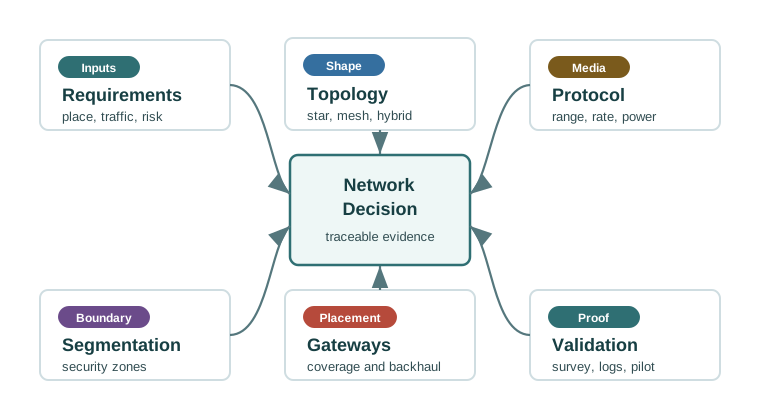
- A reviewable design packet therefore starts with a requirements map.
- It lists device classes, traffic classes, candidate topology shapes, protocol candidates, gateway locations, security segments, and the evidence that would reject the design.
- If the packet cannot say how a gateway outage, weak dock coverage, certificate expiry, or firmware rollout will behave, the topology is not yet a design decision.
Major section
Check Topology Against Risk
Each topology has a failure pattern.
- A mesh can spend battery and airtime on relaying.
- A tree can overload or isolate parent nodes.
- A star-of-stars LPWAN deployment can look simple until gateway placement, spreading factor, duty cycle, joins, acknowledgements, and backhaul ownership are tested.
- Practitioners should also separate pilot evidence from production evidence.
Major section
Check Topology Against Risk (continued)
A battery sensor needs current profile, sleep behavior, retransmission rate, and maintenance interval.
- An alarm network needs latency percentiles, duplicate handling, acknowledgement timing, and failover behavior.
- A gateway plan needs RSSI/SNR, packet delivery by location, join rate, queue depth, and backhaul outage handling.
- The winning topology is the one whose weakest assumption is visible and manageable.
Major section
Check Topology Against Risk (continued)
For a campus leak-detection network, a Wi-Fi design should show AP coverage, DHCP behavior after power restoration, TLS provisioning, and alert latency during busy hours.
- A LoRaWAN design should show spreading-factor distribution, airtime budget, confirmed-uplink policy, gateway backhaul, and downlink limits.
- A Thread or Zigbee design should show relay placement, route repair time, mains-powered router availability, and what happens when a corridor is closed for maintenance.
- A bench test can confirm payload shape and broker behavior, but it cannot prove dock-door fading, elevator-shaft shadowing, tenant segmentation, or battery replacement workload.
Major section
Capacity and Recovery Scenarios
Network capacity is not just average payload rate.
- Joins, retries, acknowledgements, route repair, security handshakes, firmware rollout traffic, multicast commands, and gateway buffering can dominate the busy moments.
- The design must show behavior under normal, peak, failure, maintenance, and growth scenarios.
- Recovery behavior is also topology-specific.
- Thread or Zigbee routes may repair after a relay disappears.
Major section
Capacity and Recovery Scenarios (continued)
RPL parent choices may shift after link quality changes.
- LoRaWAN devices may increase spreading factor after weak uplinks.
- Wi-Fi devices may reconnect slowly after access-point or DHCP disruption.
- Cellular devices may roam, back off, or lose service during congestion.
- The under-the-hood model should be scenario based, not just a spreadsheet of average bytes.
Major section
Capacity and Recovery Scenarios (continued)
A 500-node environmental system may look light if each node sends 40 bytes every five minutes.
- The same system can overload during commissioning if every device joins, negotiates keys, downloads configuration, and publishes diagnostic state in the same window.
- A mesh can also create hidden load when a small set of routers carries traffic for a whole floor.
- The design should show which nodes forward, which links are bottlenecks, and which queues fill first.
Major section
Capacity and Recovery Scenarios (continued)
Those details turn a topology from a picture into an operating claim that can be tested before launch.
- Security and operations can change the topology as much as radio physics.
- For example, safety alarms may need a local gateway and local fallback path, while analytics telemetry can tolerate cloud delay.
- A defensible design records recovery drills.
Major section
The Six Questions
If a question is unanswered, topology selection is premature.
- Control loops, alarms, dashboards, and batch logs have different delay and jitter tolerance.
- Some systems tolerate missed readings; others require alternate paths, redundant gateways, or local control.
- Battery nodes should minimize listening and relaying; mains-powered nodes can often support routing or gateway roles.
Deck summary
Key takeaways
Design From the Site, Then Test the Weak Path: Picture a care home that adds door alarms, room sensors, staff tablets, and two outside units.
- The simple map cannot predict every radio change or shared queue.
- A gateway is the unit that links a local group of devices to another network or service.
- Network topology is the shape that best protects the deployment promise.
- A topology drawing without those requirements can look tidy while hiding the constraint that will break the deployment.
Retrieval practice
Recall check 1 of 5

Blueprint Bina says: answer from memory, then check your reasoning.
Q1A gateway is placed on a drawing where coverage looks central. What field plan should test the choice?
Show answer
Answer: B Placement evidence includes physical access and degraded behavior.
Retrieval practice
Recall check 2 of 5
Blueprint Bina says: answer from memory, then check your reasoning.
Q2A campus team starts by asking which topology is best. What should it establish first?
Show answer
Answer: C The chapter chooses topology to protect the deployment promise.
Retrieval practice
Recall check 3 of 5
Blueprint Bina says: answer from memory, then check your reasoning.
Q3Two gateway sites appear equally central on a diagram. What evidence should decide placement?
Show answer
Answer: A Placement needs field and traffic proof, not visual symmetry.
Retrieval practice
Recall check 4 of 5
Blueprint Bina says: answer from memory, then check your reasoning.
Q4Battery nodes cover a campus, but some cannot reach a gateway directly. Which topology comparison is sound?
Show answer
Answer: A The topology must fit coverage and failure behavior.
Retrieval practice
Recall check 5 of 5
Blueprint Bina says: answer from memory, then check your reasoning.
Q5A leak-detection bench test passes. What field claim still needs separate evidence?
Show answer
Answer: D The section distinguishes bench payload and broker proof from field fading and maintenance risk.
Print reference
Answers
Answer key.
- B · Placement evidence includes physical access and degraded behavior.
- C · The chapter chooses topology to protect the deployment promise.
- A · Placement needs field and traffic proof, not visual symmetry.
- A · The topology must fit coverage and failure behavior.
- D · The section distinguishes bench payload and broker proof from field fading and maintenance risk.