Core Networking · Study deck
Ethernet: PoE and Operations
The cable and Ethernet speed are selected, but the powered devices still share a limited switch budget.
Packet Pete is your guide for this deck.

After studying this chapter
Learning objectives
You will be able to:
- Explain: The tag uses EtherType 0x8100, carries priority bits for traffic handling, and uses a 12-bit VLAN identifier, which gives 4096 possible codes before reserved values and operational policy reduce the usable set.
- Explain: A conductive tap makes direct electrical contact with a copper conductor; an inductive tap couples to electromagnetic fields and may be harder to notice because it does not require the same visible break.
- Explain: A bad pair, poor termination, or marginal connector may still produce a link, but the port can downshift, flap, or accumulate frame check sequence and CRC errors under load.
Major section
How the PoE Budget Calculator Works
Planning a PoE deployment requires matching the switch's total power budget to the devices it must power.
- It cannot support another 15 W allocation at the same time.
- If 24 devices each require 15 W from the switch, the 360 W total leaves only 10 W.
- PoE planning is the power version of speed negotiation: the port, switch budget, cable route, and device peak draw all have to agree at the same time.
Major section
Ethernet Reliability Contract
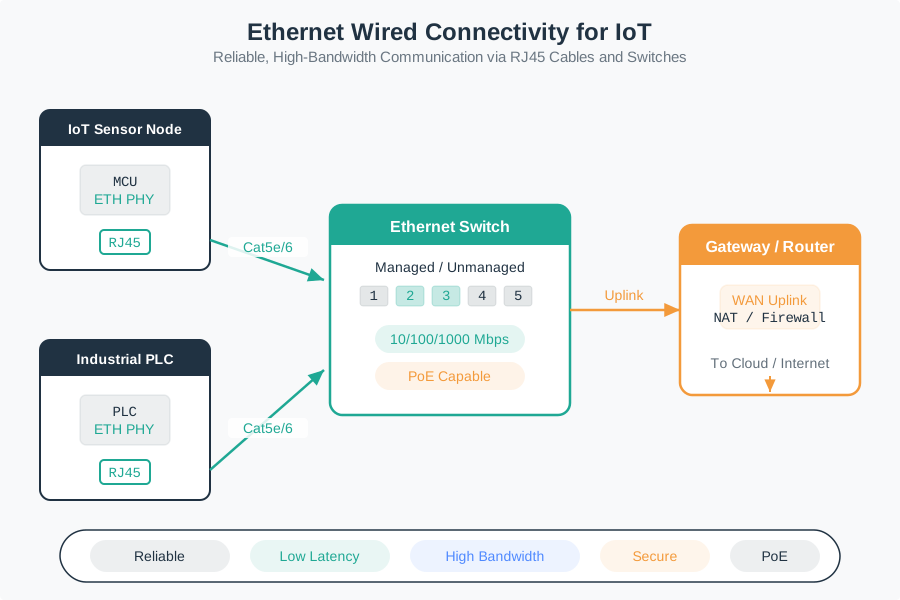
Ethernet is often chosen for IoT when the deployment needs predictable delivery more than mobility.
- A switched full-duplex link gives each device a dedicated path to a switch port, so the design removes radio contention and the old shared-medium collision model.
- That reliability is not automatic.
Major section
Ethernet Reliability Contract (continued)
It depends on cable length, terminations, switch capacity, power budget, VLAN design, grounding, UPS coverage, and testing.
- A good Ethernet design records those constraints before the device is mounted high on a wall or bolted into a cabinet.
- For IoT teams, Ethernet is usually the right answer when physical access is possible and the device must be observable for years.
- Those measurements turn connectivity into evidence that can be reviewed before blaming firmware, cloud services, or radio coverage.
Major section
Ethernet Reliability Contract (continued)
The cable gives technicians a place to test continuity, pair order, length, link speed, duplex mode, PoE class, and error counters.
- A PoE-capable path can carry device power as well as frames, which makes the switch and its power budget part of field availability.
- The gateway uplink adds the next failure boundary between local traffic and platform services.
- Ethernet's high bandwidth and stable medium do not remove connector, cable, loop, power, or configuration faults.
Major section
Ethernet Deployment Record
A gigabit access port can still become a bottleneck if many devices converge through a single 1 Gb/s uplink.
- A practical Ethernet record shows that the physical link, power budget, and network service all match the device's job.
- The record should also state the design margin.
- The deployment record is where the earlier choices become accountable.
Major section
Ethernet Deployment Record (continued)
This makes the installation auditable when a technician replaces a switch, moves a patch lead, or adds another high-bandwidth device to the same closet.
- A PoE installation that passes at idle can still fail when heaters, pan-tilt motors, infrared illuminators, or radios enter peak draw.
- If the field evidence does not match the planned speed, power, and route, the release should pause before the device becomes hard to reach.
- This matters because most field failures are not caused by the Ethernet standard itself; they are caused by underspecified installation details.
Major section
Duplex Fixes Collisions Only
Modern switched Ethernet does not use CSMA/CD on full-duplex links, so classic Ethernet collisions are gone.
- The failure modes move elsewhere: damaged pairs, marginal connectors, cable attenuation, duplex or speed mismatch, oversubscribed uplinks, PoE overload, spanning-tree loops, and unmanaged broadcast traffic.
- Industrial Ethernet and TSN add another layer: timing becomes a scheduled resource.
Major section
Duplex Fixes Collisions Only (continued)
Above the cable, switching behavior decides whether the reliable access link remains useful.
- The physical link can be healthy while the system still fails if time-aware shapers, VLAN priority, clock synchronization, or switch queueing are misconfigured.
- These symptoms are physical-layer evidence.
- Physical tapping is part of that review.
Major section
Duplex Fixes Collisions Only (continued)
The tester sends a pulse down the line and measures reflected energy.
- A bad pair, poor termination, or marginal connector may still produce a link, but the port can downshift, flap, or accumulate frame check sequence and CRC errors under load.
- They should be checked against cable length, bend radius, connector quality, electromagnetic exposure, and the actual speed reported by both ends of the link.
- For deterministic industrial traffic, the failure pattern can be even subtler.
Major section
Duplex Fixes Collisions Only (continued)
MAC address learning directs frames to the right port, VLAN tags separate traffic domains, and spanning tree or rapid spanning tree prevents loops when redundant paths exist.
- If those controls are wrong, broadcast storms, blocked ports, or accidental VLAN leaks can break devices whose local link lights still look healthy.
- PoE adds another hidden state machine: the powered device and power sourcing equipment classify load, apply power, and must survive inrush and peak draw without exhausting the switch budget.
- An 802.1Q VLAN tag is a four-byte field inserted into the Ethernet frame after the source MAC address.
Major section
Duplex Fixes Collisions Only (continued)
The tag uses EtherType 0x8100, carries priority bits for traffic handling, and uses a 12-bit VLAN identifier, which gives 4096 possible codes before reserved values and operational policy reduce the usable set.
- Access ports usually send ordinary untagged frames for one assigned VLAN; trunk ports carry tagged frames for multiple VLANs.
- Long cable routes add a security and maintenance problem that a short patch lead hides.
- A conductive tap makes direct electrical contact with a copper conductor; an inductive tap couples to electromagnetic fields and may be harder to notice because it does not require the same visible break.
Major section
Duplex Fixes Collisions Only (continued)
Optical fiber changes the details but not the principle: a bend, splice, or clamp can leak or disturb signal energy.
- The delay estimates distance to the anomaly; the shape helps distinguish an open cut, short, bad termination, moisture intrusion, crushed section, splice, or tap.
- The same idea explains why a wave pulse reflects differently at a soft boundary than at a hard boundary: impedance changes decide what returns to the tester.
- Address: a deployment record starts at the device -- model, MAC, cable category, and measured run length.
Deck summary
Key takeaways
Planning a PoE deployment requires matching the switch's total power budget to the devices it must power.
- Ethernet is often chosen for IoT when the deployment needs predictable delivery more than mobility.
- It depends on cable length, terminations, switch capacity, power budget, VLAN design, grounding, UPS coverage, and testing.
- The cable gives technicians a place to test continuity, pair order, length, link speed, duplex mode, PoE class, and error counters.
- A gigabit access port can still become a bottleneck if many devices converge through a single 1 Gb/s uplink.
Retrieval practice
Recall check 1 of 3

Packet Pete says: answer from memory, then check your reasoning.
Q1A PoE switch has 120 W total power. Three cameras each need 20 W and two access points each need 15 W at peak. The plan reserves 20% of the switch budget. Does the load fit?
Show answer
Answer: B Sum peak allocations, then subtract them from the budget left after reserve.
Retrieval practice
Recall check 2 of 3
Packet Pete says: answer from memory, then check your reasoning.
Q2What fixed video endpoint can receive PoE and send high-bandwidth traffic on one cable?
Show answer
Answer: C The IP camera is a fixed high-bandwidth endpoint that can receive power and send video on one cable.
Q3Complete the code to parse an Ethernet frame header from raw bytes:
Show answer
Answer: A MAC addresses are 6 bytes formatted as colon-separated hex pairs.
Retrieval practice
Recall check 3 of 3
Packet Pete says: answer from memory, then check your reasoning.
Q4A PoE camera intermittently reboots at night when infrared LEDs turn on. The link otherwise negotiates at 1 Gbps. What should the Ethernet deployment record check first?
Show answer
Answer: C Night IR can raise peak power draw.
Print reference
Answers
Answer key.
- B · Sum peak allocations, then subtract them from the budget left after reserve.
- C · The IP camera is a fixed high-bandwidth endpoint that can receive power and send video on one cable.
- A · MAC addresses are 6 bytes formatted as colon-separated hex pairs.
- C · Night IR can raise peak power draw.