Core Networking · Study deck
Ethernet: Links and Standard Selection
This first route covers link identity, standard selection, device fit, and the evidence behind a wired choice.
Packet Pete is your guide for this deck.

After studying this chapter
Learning objectives
You will be able to:
- Explain the role of Ethernet (IEEE 802.3) in IoT deployments and justify when it is preferable to wireless alternatives
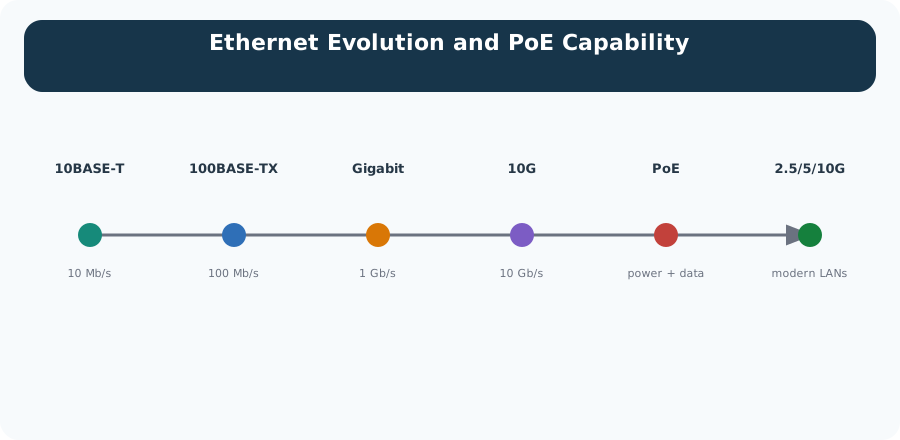
- Compare and differentiate Ethernet standards (10BASE-T, 100BASE-T, 1000BASE-T) by speed, application, and physical layer characteristics
- Select appropriate Ethernet standards for given IoT use cases based on bandwidth and latency requirements
- Evaluate trade-offs between wired Ethernet and wireless connectivity for specific IoT deployment scenarios
Major section
Start With a Link You Can Inspect
The physical layer is the part of a network that carries signals through cable, fibre, or radio.
- A protocol is an agreed set of rules for an exchange.
- A gateway is a bridge between this network and another service.
- The link light is on, yet alarm data arrives in bursts.
Major section
Start With a Link You Can Inspect (continued)
The cause might be a damaged pair, a speed mismatch, a weak power budget, a loop, or congestion beyond this cable.
- One green light cannot choose among them.
- Ethernet gives IoT systems a physical path with visible link state, negotiated speed, switch ports, and often power delivery.
- That makes it a strong choice when reliability, serviceability, and predictable capacity matter more than cable-free installation.
Major section
Key Concepts
Ethernet: The dominant wired LAN standard (IEEE 802.3); defines the physical layer and MAC protocol for wired networks.
- CSMA/CD: The original Ethernet MAC protocol; deprecated in modern full-duplex switched Ethernet where collisions are physically impossible.
- Industrial Ethernet: Deterministic extensions of standard Ethernet for industrial automation (PROFINET, EtherNet/IP, EtherCAT); provides microsecond-level timing.
- Cat5e/Cat6 Cable: Twisted-pair Ethernet cable categories; Cat5e supports Gigabit Ethernet up to 100 m, Cat6 provides better crosstalk performance.
Major section
Phoebe's Field Notes: The 100 m Limit Is a Skin-Effect Problem, Not a Multipath One
The mathematical gist.: Copper skin depth is $\delta=\sqrt{\rho/(\pi f\mu_0)}$, so it falls from 65.2 micrometres at 1 MHz to 6.52 micrometres at 100 MHz.
- The matching square-root conductor-loss model scales 19.8 dB per 100 m at 100 MHz to about 6.26 dB at 10 MHz; real Cat6 also has dielectric and construction losses.
Major section
Reliable Wired Connections
"The trade-off is obvious though," said Sammy. "You cannot put Ethernet cables in a farmer's field or on a moving robot.
- "Why would anyone use wires when wireless is so convenient?" asked Temperature Terry. The microcontroller had a quick answer. "Reliability!
- For critical infrastructure like factory control systems and building automation gateways, wired is the way to go.".
- Ethernet is perfect for STATIONARY devices where reliability matters more than mobility.
Major section
Powerline Networking as a Retrofit Link
The acceptance test should then repeat while high-load appliances operate and after each adapter has restarted.
- Powerline networking carries data over the building's existing mains wiring.
- The convenience does not make the wiring a clean network medium.
- If that evidence is unstable, install a data cable, move the gateway, or choose another radio path.
Major section
IEEE 802.3 Ethernet for IoT
The first pass names the standards, speed choices, cable limit, and negotiation evidence you need before comparing it with wireless options.
- IoT devices may be connected via a wired connection.
- For permanent installations, Ethernet is commonly used.
- The data rate using Ethernet can range from 10 Mbps to more than 1 Gbps (1000 Mbps).
Major section
Putting Numbers to It
Ethernet's maximum cable length is set by signal attenuation physics.
- Cat6 cable attenuation at 100 MHz is approximately 20 dB per 100 meters (per TIA-568-C standard).
- For Gigabit Ethernet (1000BASE-T), the 100 m limit is derived from the signal-to-noise ratio needed for reliable PAM-5 decoding across four wire pairs.

Major section
Putting Numbers to It (continued)
At 100 m, the received signal is close to the noise floor, leaving minimal margin.
- A repeater or switch must be placed every 100 m to regenerate the signal.
- Ethernet cabling is not only a connector choice.
- The conductor, shield, insulation, jacket rating, and route all change whether the link keeps its margin after installation.
Major section
Putting Numbers to It (continued)
Those diagram labels establish the scope of a terminated ethernet patch lead exposes the physical evidence a protocol name omits: eight conductors carried through an rj45 plug, a flexible.
- This skin effect is one reason cable construction, plating, and stranding matter more as data rates rise.
- For building Ethernet, the practical review is usually simpler: verify the cable category, pair twist, shield choice, and jacket rating.
- Long or harsh routes add another evidence layer.
Major section
Putting Numbers to It (continued)
Shielded cable can help near motors, drives, fluorescent ballasts, or radio equipment, but only when grounding and termination are planned; a badly bonded shield can become part of the noise problem.
- Plenum, riser, general-purpose, and low-smoke-zero-halogen jacket ratings are safety and code decisions, not performance labels.
- They say where a cable is allowed to run and what smoke or flame behavior is expected.
- A data-center patch lead, an industrial tray cable, a marine cable, and an undersea fibre cable are all "wired links," but their release evidence is different.
Major section
Putting Numbers to It (continued)
The IoT lesson is to record the physical route beside the protocol: cable type, pathway, bend radius, shield bond, fire rating, moisture exposure, and acceptance test are part of the link contract.
- A deployment record should identify which installed layer provides each protection rather than calling the whole assembly simply "fibre.".
- The source groups the exposure by installed location: rats and termites mainly affect underground cable, rodents and moths affect aerial cable, crows affect drop cable, and ants can invade closures and chew cable or fibre.
- Address: copper is the default conductor for a reason -- low resistance, cost, and flexibility.
Major section
Ethernet vs Wi-Fi for 4K Video
For mission-critical surveillance, the additional $7,000 is justified by eliminating video loss during incidents.
- Scenario: A warehouse needs 50 IP cameras for security.
- The warehouse is 200m x 150m with metal shelving causing RF interference.
- Metal interference causes unpredictable dropouts.
- 25 Mbps uses only 2.5% of available bandwidth.
Major section
Select Protocols for Robots
Scenario: A factory needs to connect 50 industrial robots across a 200m x 150m floor.
- Robots require telemetry every 100 ms with <10 ms latency and zero packet loss for safety.
- LoRaWAN: 2,500 ms latency is 250x too slow.
- Transmission time (1.45s) exceeds update interval (100 ms).
- 250 kbps cannot support 50 robots reliably.
Major section
Select Protocols for Robots (continued)
Result: Gigabit Ethernet with TSN (Time-Sensitive Networking) is the only viable option.
- TSN extensions (IEEE 802.1Qbv) provide deterministic scheduling, ensuring robot control packets are never delayed.
- Key Insight: For safety-critical industrial control, only wired Ethernet can guarantee the bounded latency and zero packet loss required.
- Wireless protocols are fundamentally non-deterministic due to shared medium access.
Deck summary
Key takeaways
The physical layer is the part of a network that carries signals through cable, fibre, or radio.
- The cause might be a damaged pair, a speed mismatch, a weak power budget, a loop, or congestion beyond this cable.
- Ethernet: The dominant wired LAN standard (IEEE 802.3); defines the physical layer and MAC protocol for wired networks.
- The mathematical gist.: Copper skin depth is $\delta=\sqrt{\rho/(\pi f\mu_0)}$, so it falls from 65.2 micrometres at 1 MHz to 6.52 micrometres at 100 MHz.
- The acceptance test should then repeat while high-load appliances operate and after each adapter has restarted.
Retrieval practice
Recall check 1 of 2

Packet Pete says: answer from memory, then check your reasoning.
Q1A factory needs to connect a legacy programmable logic controller (PLC) manufactured in 2005. The PLC supports Ethernet but the datasheet lists only 'IEEE 802.3 10BASE-T' support. Which Ethernet speed will this device operate at?
Show answer
Answer: A The number prefix in Ethernet standard names indicates the speed in Mbps: 10BASE-T = 10 Mbps, 100BASE-TX = 100 Mbps, 1000BASE-T = 1000 Mbps (1 Gbps).
Retrieval practice
Recall check 2 of 2

Packet Pete says: answer from memory, then check your reasoning.
Q2Compare Ethernet 1000BASE-T vs Wi-Fi 802.11ac for transmitting 4K video (25 Mbps) from 100 security cameras in a building. Which is BEST?
Show answer
Answer: B
Print reference
Answers
Answer key.
- A · The number prefix in Ethernet standard names indicates the speed in Mbps: 10BASE-T = 10 Mbps, 100BASE-TX = 100 Mbps, 1000BASE-T = 1000 Mbps (1 Gbps).
- B